.webp)
Every June for more than twenty years I have gone to Royal Ascot. I am not unusual in this. The Gulf I come from is one of the world's highest-spending outbound travel regions per capita, and almost none of that loyalty is being deliberately built for by the places we keep flying home from. This is an argument about why that gap exists, and what it would take to close it.

Every June, in the third week, I am at Royal Ascot. I have done this for more than twenty years. Some years I extend the trip for Glorious Goodwood, occasionally Newmarket; once or twice my own horses have run on British turf and I have stood in the parade ring as an owner rather than a spectator. But the fixed point is Ascot. The morning suit, the race card, the walk down to the grandstand. None of this is a holiday. It is a chapter of the year, and I would not skip it.
The trip is built before I arrive. I stay in Mayfair, as I have on almost every London visit for two decades. We eat at Gymkhana, sometimes Kai when my wife wants a change. We walk a different neighbourhood each day: Marylebone one morning, South Kensington the next, the Regent's Canal towpath when the weather holds. London stopped being a destination for me some time ago. It is closer to a second address. No campaign reminds me to come; the habit does the reminding.
Hold that picture, because it contains a contradiction this article will spend the next twenty minutes resolving. I am about to argue that repeat visitation is something a destination designs, with budgets, calendars and measurement systems behind it. Yet my own twenty years of London loyalty were designed by nobody. They accumulated. A good hotel here, a restaurant that remembered us there, a fixed date in June that anchored the year. The city's marketing authority did not earn my return. The city did, one well-handled afternoon at a time. So the puzzle is this: if loyalty like mine forms by accident, what does it mean to build it on purpose? I will come back to it.
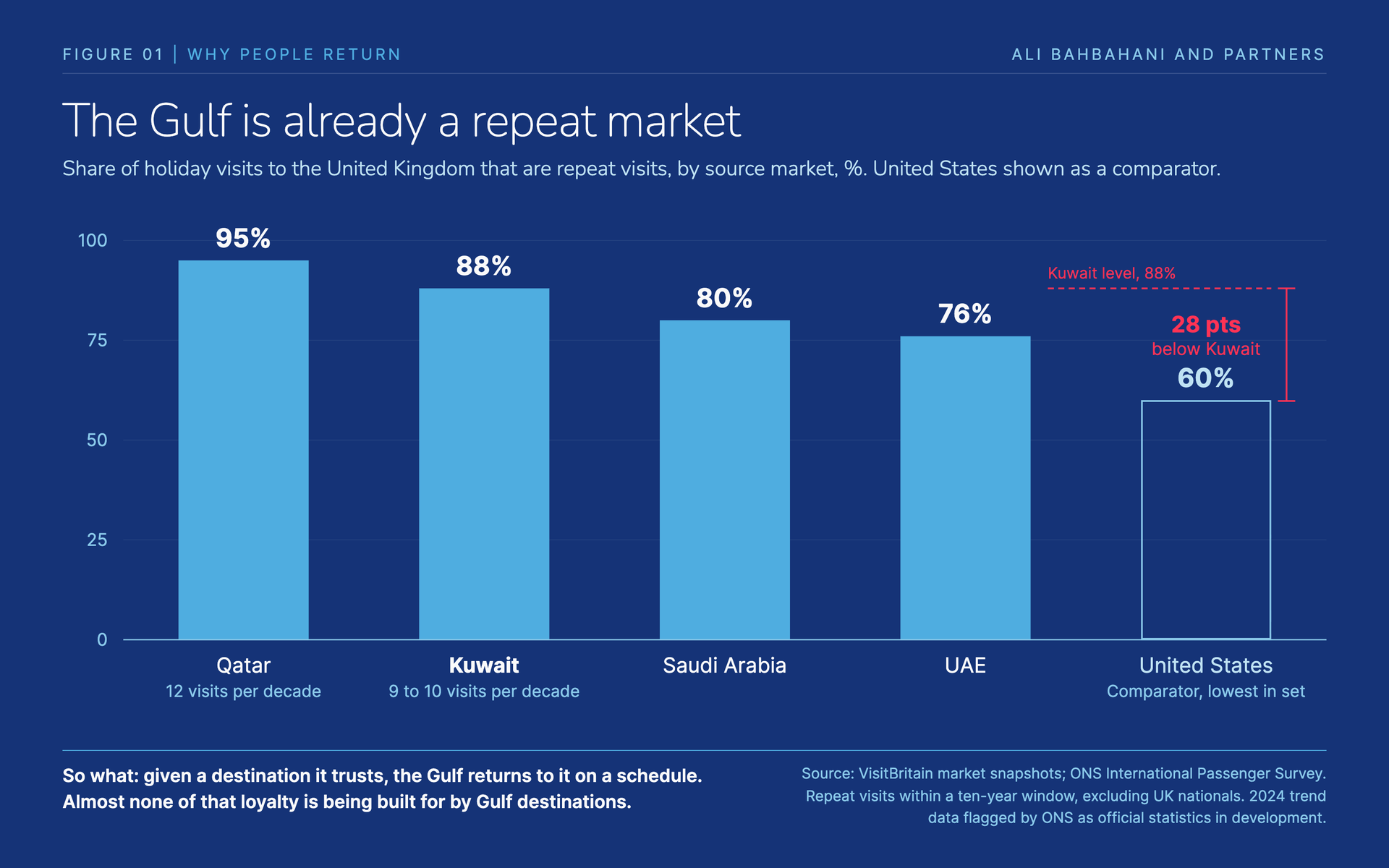
First, the scale of what is at stake. According to VisitBritain's Kuwait market snapshot, 88 per cent of holiday visits from Kuwait to Britain are repeat visits. Holiday visitors from Kuwait return nine to ten times, on average, over a decade, spending £26,253 in total. The per-visit economics are sharper still: average spend was £2,731 per trip in 2023, across an average stay of twelve nights. On those numbers Kuwait ranks 41st in the world for inbound visits to the UK but 19th for inbound spend. For a country of Kuwait's population, that is an unusually high-value relationship with a single foreign destination.
It is not a Kuwaiti quirk. Ninety-five per cent of Qatari holiday visits to Britain are repeats, at an average of twelve visits per decade. Saudi Arabia sits at 80 per cent, the UAE at 76. The American comparator, just under six in ten, is the lowest in the set. Read together, these are not the numbers of a novelty market. They are the numbers of a region that, given a destination it trusts, returns to it on a schedule.
Which raises a more uncomfortable question closer to home. If Gulf travellers are this loyal to destinations elsewhere, why have Gulf destinations captured so little of that repeat behaviour themselves? Everything that follows is equipment for answering it, and the last section answers it for Kuwait.
The spending behind that behaviour is the part most destination strategists underrate. UN Tourism data has long shown GCC outbound spending running several multiples of the global per-head average. One figure circulates everywhere in this conversation: a per-capita Kuwaiti outbound travel spend of roughly USD 3,086 a year against a global benchmark near USD 197. I have not been able to trace it to a primary dataset I would stake a strategy on, so I treat it as colour rather than evidence. The numbers with clean provenance say the same thing more conservatively.
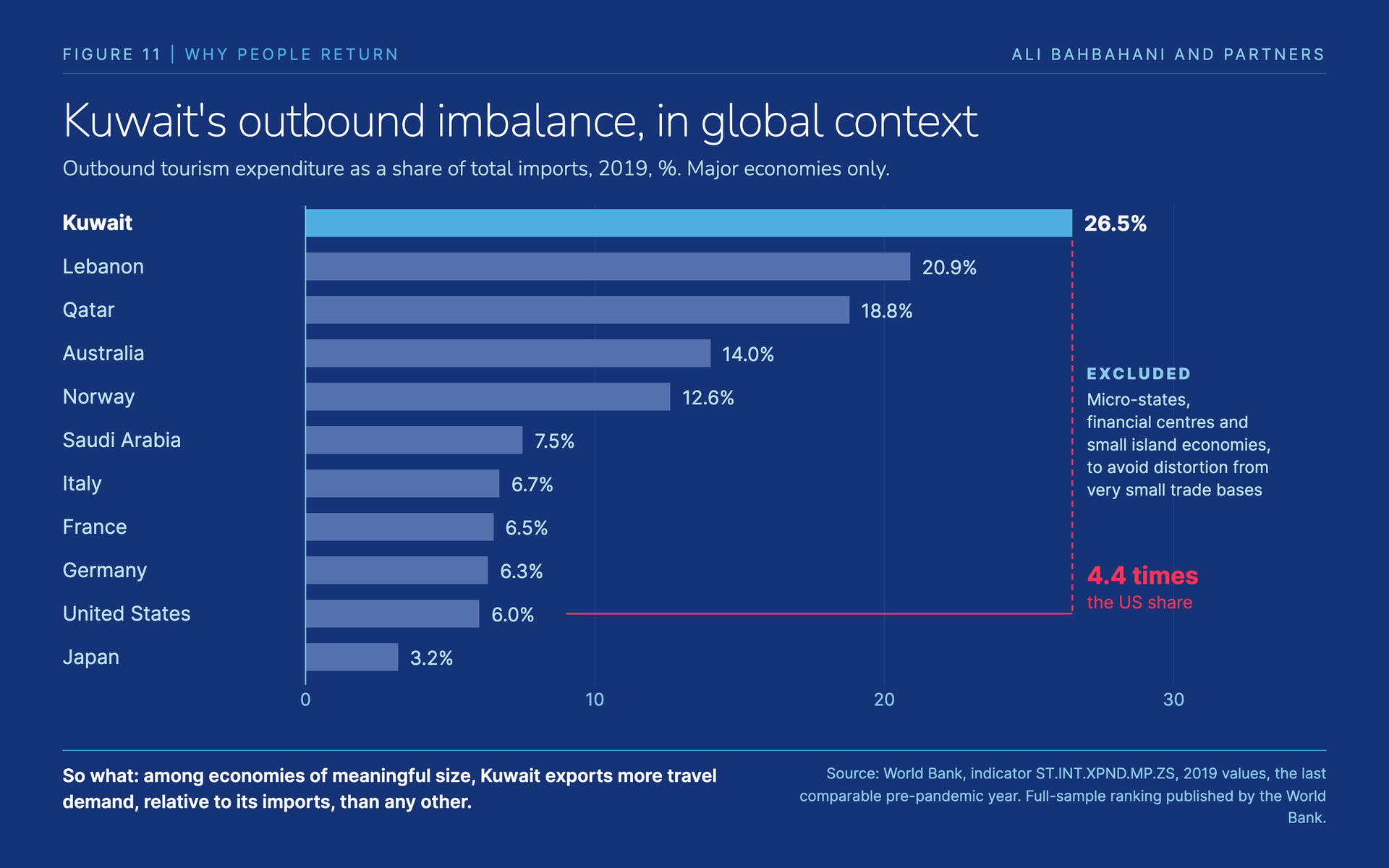
Oliver Wyman puts Kuwait's tourism contribution at around 5 per cent of GDP, well below the global average, while outbound tourism reached roughly 12 per cent of GDP at its 2019 peak. On the last clean pre-pandemic World Bank comparison of outbound tourism expenditure as a share of total imports, Kuwait ranks first among major economies once micro-states, financial centres and small island economies are filtered out.
88% of holiday visits from Kuwait to Britain are repeats: nine to ten visits per traveller over a decade. · 19th is Kuwait's global rank for inbound spend in the UK, against 41st for inbound visits. · USD 890 is what a repeat visitor spends per trip in Dubai, against USD 540 for a first-timer, on Visa's December 2025 data.
01. The acquisition trap
For most of the last twenty years, tourism marketing has been organised around one assumption: that the marginal visitor is a stranger. Campaigns target audiences who do not yet know the destination. KPIs measure top-of-funnel reach. Budgets lean on paid media in source markets that have not yet been cracked. Every part of the operating model follows from the premise that the principal job is converting awareness into a first arrival.
That model made sense when destinations were competing for first encounters. It makes much less sense for a region that has already been arriving, repeatedly, for thirty years.
The correction is now well documented. Skift Research's recent work on destination loyalty argues for a shift from a first-visit mindset toward repeatable, year-round relationships. The OECD's 2024 Tourism Trends and Policies calls for tourism policy to be rebuilt on a stronger evidence base. McKinsey's destination-experience research finds that travellers choose places for their experiences, but only once the essentials of safety, navigability, cost and accommodation quality are met. None of these are loyalty-programme arguments. They are budget-allocation arguments.
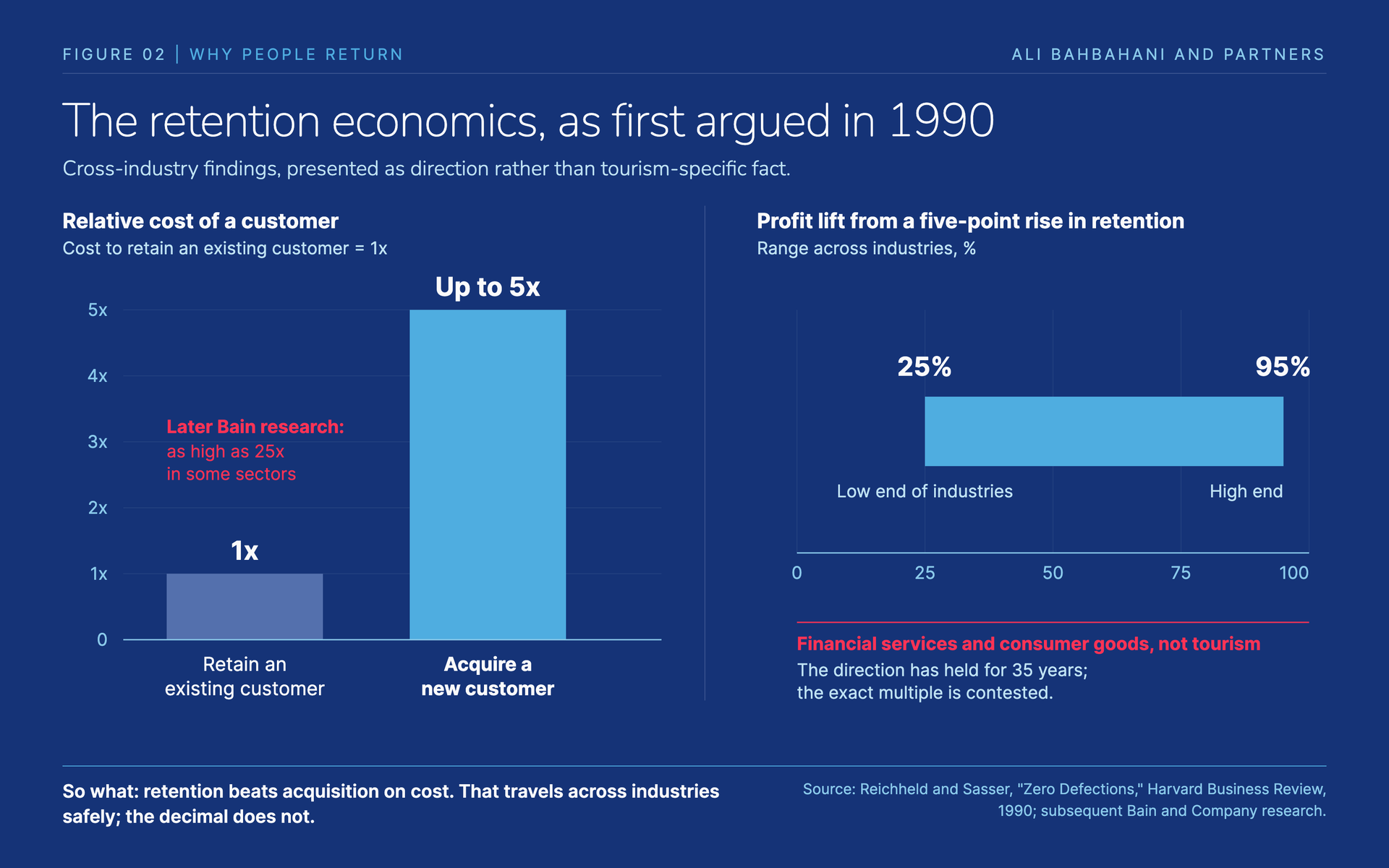
The underlying economics are old and stable. Frederick Reichheld's 1990 Harvard Business Review article "Zero Defections" argued that winning a new customer can cost up to five times more than keeping an existing one, and that a five-point lift in retention can raise profits by 25 to 95 per cent depending on the industry. Later Bain & Company work pushed the multiplier as high as twenty-five times in some sectors. I should be precise about what that evidence is. It comes from financial services and consumer goods, and the exact multiple is contested. What has held across thirty-five years of research is the direction. Retention beats acquisition on cost. That travels across industries safely; the decimal does not.
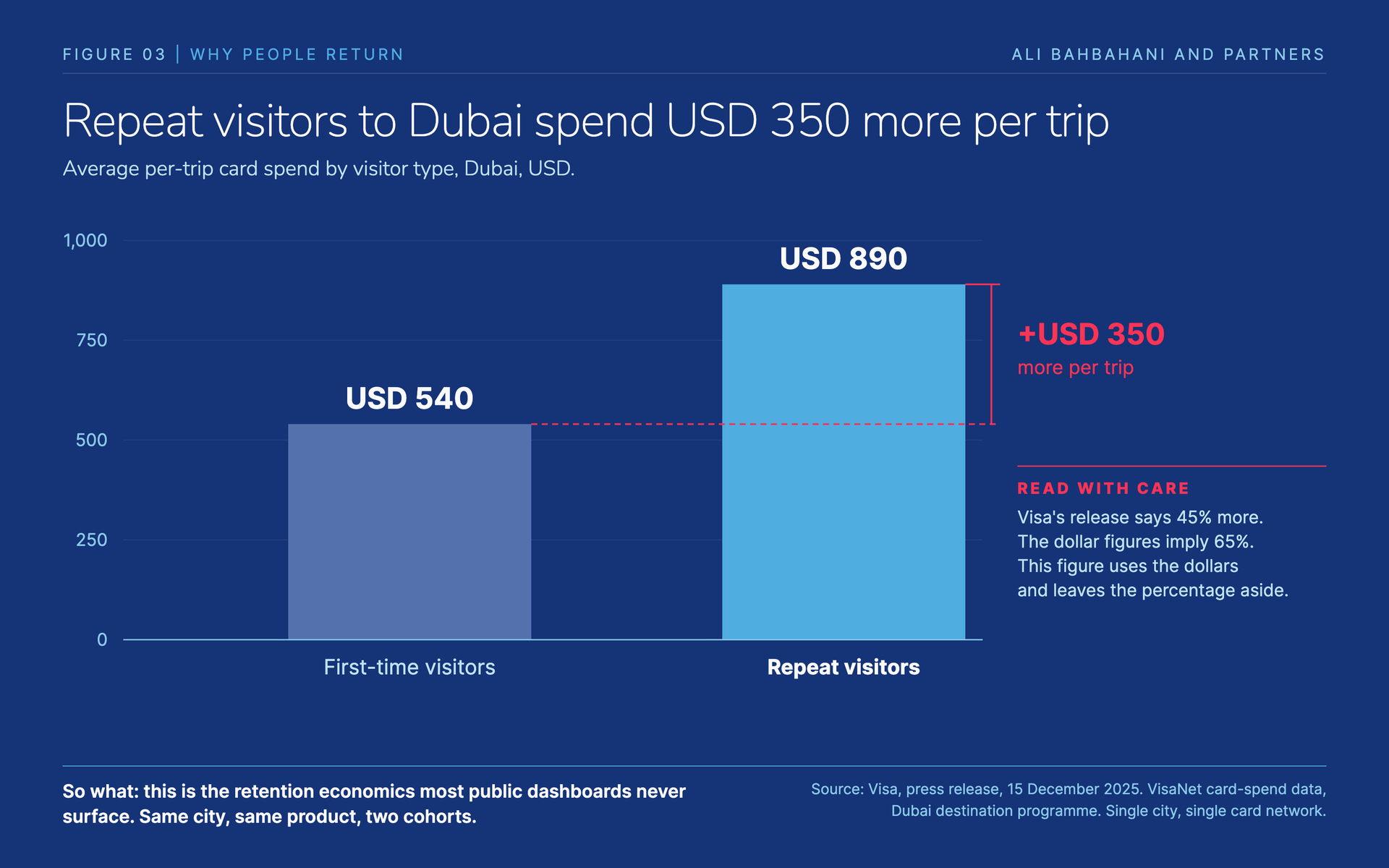
Set that alongside the cleanest tourism-specific data point in the public domain. VisaNet card-spend figures released by Visa in December 2025 show returning visitors to Dubai averaging USD 890 per trip against USD 540 for first-time travellers. Visa's release describes this as 45 per cent more; the dollar figures themselves imply closer to 65 per cent, and I have not been able to reconcile the two, so I lean on the dollar figures and leave the percentage aside. It is a single city, a single card network, a single release. But it is a real, destination-level measurement of the gap between exploration and routine, and it points the same way the cross-industry retention research does. Once advocacy, word-of-mouth and crisis resilience are added, the lifetime value of a retained guest can comfortably exceed the value of acquiring new ones over and over.
And yet the dashboards most tourism authorities present to their boards still report arrivals first, bednights second, and almost nothing about return behaviour. The metric that matters most economically is the one the industry is least equipped to measure. A destination that cannot see its repeat rate cannot manage it, and most still cannot see it at all.
02. Two cohorts, not one market
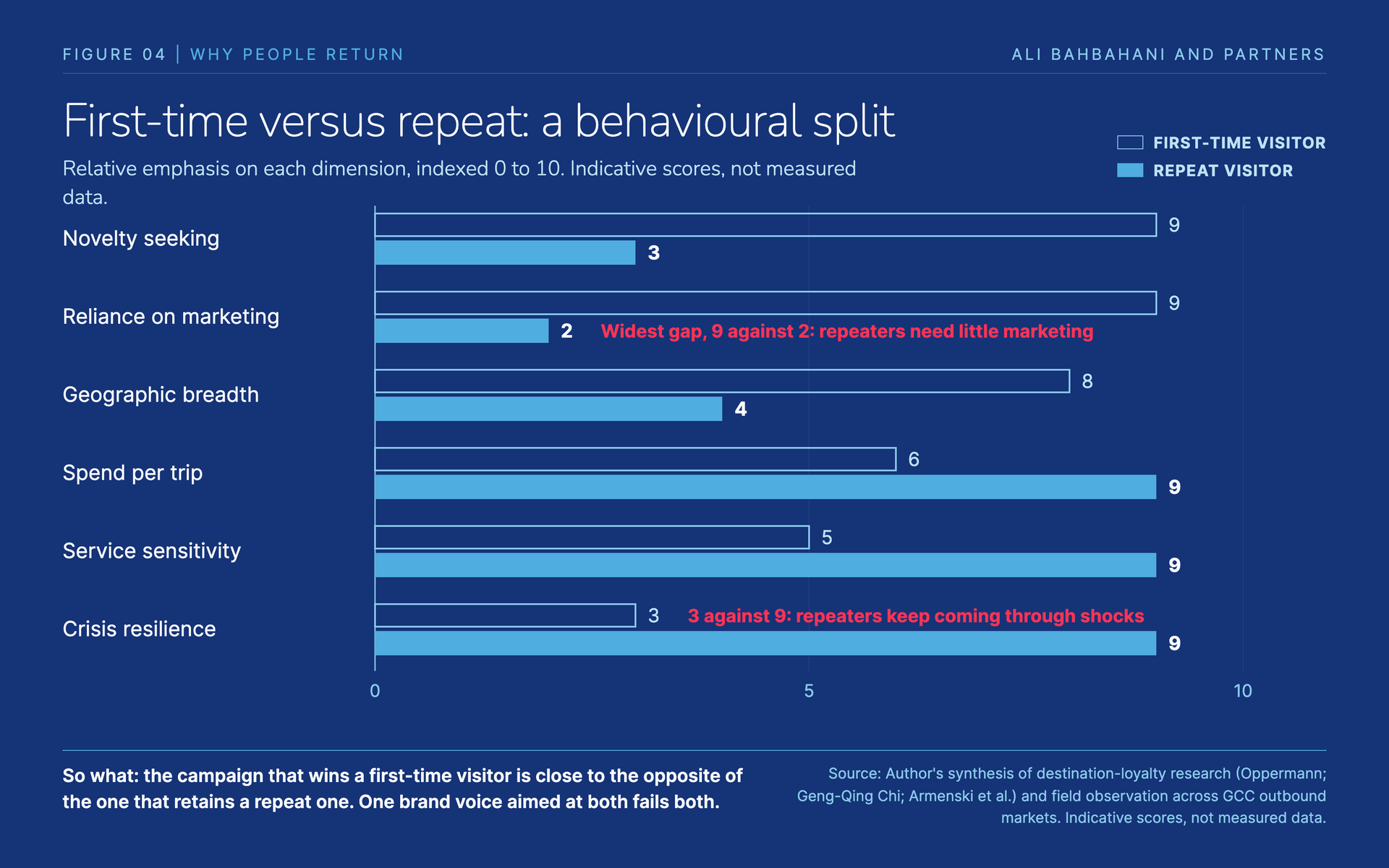
The deeper flaw in the acquisition-first model is that it treats the audience as one thing. The research on tourist behaviour has been clear for three decades: first-time visitors and repeat visitors are not the same people at different points in a funnel. They are two distinct cohorts, psychologically and economically, who travel for different reasons, behave differently on the ground, judge the destination differently afterwards, and respond to entirely different marketing logic.
First-timers are organised around novelty. Their mental picture of the destination is built almost entirely from outside sources: advertising, social media, friends, OTA reviews. They arrive with high uncertainty, plan actively, range widely across the city or country, and concentrate their time on landmarks and primary attractions. Their post-trip verdict is about overall satisfaction. They forgive small frictions because everything is new, and they are demanding on the headline experiences because they get only one attempt at them.
Repeat visitors run on the opposite logic. The sociologist Anthony Giddens called it ontological security, the human preference for environments that feel known, predictable and safe. Repeat travellers are chasing the familiar. Their image of the place is built from memory. They plan less and decide faster. They move less and stay deeper. They eat at the same restaurant, walk the same neighbourhood, return to the same hotel. They are far more sensitive to specific service quality than to overall destination satisfaction, and they forgive less, because they know exactly what good looks like here. They punish drift hard.
The economic consequence follows. First-timers need expensive top-of-funnel acquisition and spread their spend across a wide geography of must-see sites, so their profitability per trip is generally lower. Repeat visitors need less incremental acquisition spend and concentrate their consumption in secondary neighbourhoods and specialised places, the deeper, more local spending that disproportionately benefits small operators. The Dubai VisaNet figure is the cleanest public illustration: same city, same product, two cohorts, a USD 350 gap that is consistent with the broader difference between exploration and routine.
This is not a universal law. Older tourism research has found market-specific exceptions where first-time visitors outspend repeaters in particular categories, and the Talker Research survey behind Figure 14 found US travellers spending less on a return trip (USD 1,854) than on a new one (USD 2,016). An honest reading has to hold that caveat. Across the destinations and segments I see most often in GCC outbound travel, though, the direction is consistent: repeat visitors generate higher lifetime value, higher advocacy and steadier demand.
What this means for destination marketing is uncomfortable for most DMOs. The campaign that wins a first-time visitor is close to the opposite of the campaign that retains a repeat one. First-timers want spectacle, certainty and discovery. Repeaters want depth, recognition, and a reason this trip is different from the last. A single brand voice broadcast at both at once fails both. It speaks fluently to the stranger and ignores the regular.
03. Push and pull: the frame underneath
Before any framework of why people return, there is an older and more useful frame sitting beneath it. In 1977 the tourism researcher Graham Dann split the forces shaping travel into two. Push factors are internal: the conditions in the traveller's home environment that make them want to leave. Pull factors are external: the qualities of a destination that draw them in. Tourists are pushed before they are pulled. The motivation to travel exists before any particular destination wins the choice.
What makes the GCC distinctive is the unusual strength and the structural nature of its push side. Most outbound markets are pushed by ordinary motivations: escape from routine, social aspiration, the wish to broaden horizons. Gulf travel is pushed by something closer to a structural condition. Extreme summer heat, school calendars built around summer departures, exceptional disposable income, and a strong social norm that families leave the country for the hottest months. Once that push is in place, the destination's job is to win against every other destination on the strength of its pull: climate, walkability, food, service, recognition, and a calendar of reasons to come back.
I have looked at how those pull factors interact in my own academic research on multi-destination travel. The regression there identified two statistically meaningful variables: the natural beauty of destinations on the attribute side, and hotel flexibility, particularly flexible check-in and check-out, on the operational side. Together, those two pull-side variables alone explained 41.9 per cent of the variance in travellers' likelihood to engage in multi-destination travel. Almost everything else was secondary.
From the field: the heat
In early summer in Kuwait, the temperature in the sun touches sixty degrees Celsius. In July and August the shade temperature often sits in the high forties and can cross fifty; the nights drop only to about forty. There is a stretch of the year, roughly four months long, when normal outdoor life nearly disappears. You leave the air-conditioned house, cross to the air-conditioned car, arrive at the air-conditioned office, the air-conditioned mall, the air-conditioned restaurant. You do not walk anywhere. You do not sit outside.
This is the push factor that destination marketers in temperate climates do not fully grasp. It is closer to a relocation requirement than a preference for travel. Most Kuwaiti families I know cannot remember a summer spent entirely in Kuwait; it can feel as if half the country empties in July and August. The schools time their holidays around it. The airlines plan their fleets around it. Combine that with one of the world's highest concentrations of disposable income and you get a population that travels as a matter of structural necessity. I wrote about the commercial side of that summer, and how little of it any Kuwaiti business captures, in Ahla Leila, Ahla Nas: The Summer Anthem Nobody Cashed.
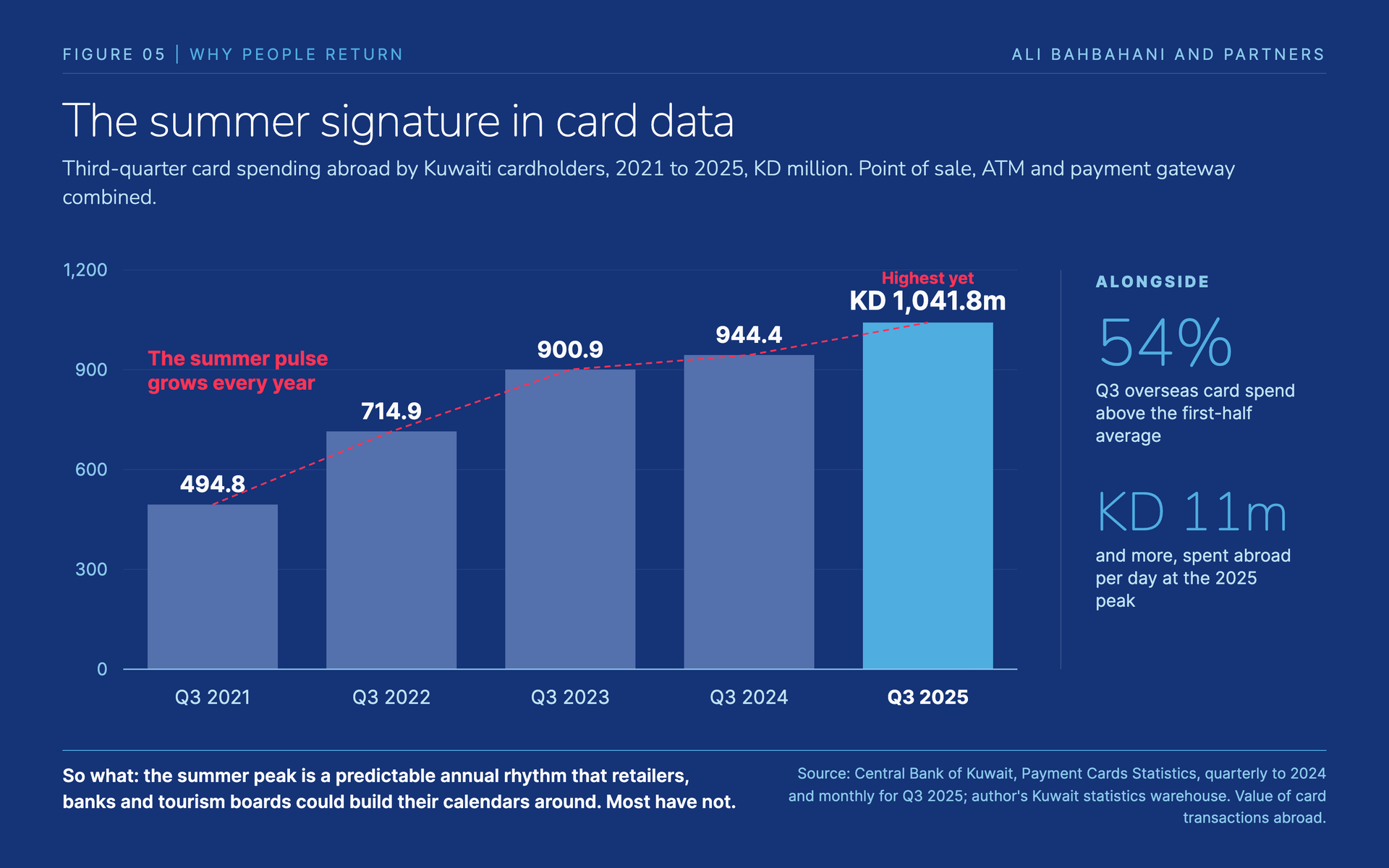
That push now has a measurable economic signature in Central Bank of Kuwait data. As I have written elsewhere, Kuwaiti card spending abroad has spiked in the third quarter every year since 2021: KD 495 million in 2021, KD 715 million in 2022, KD 901 million in 2023, KD 944 million in 2024 and KD 1.04 billion in 2025, the highest yet. Q3 overseas card spend now runs roughly 54 per cent above the first-half average; at the 2025 peak, Kuwaitis were spending over KD 11 million a day abroad. The summer travel peak is a predictable annual rhythm that retailers, banks and tourism boards could build their calendars around. Most have not. The longer-run trajectory tells the same story at higher altitude: total Kuwait card spending grew from KD 569 million in 2010 to KD 4.64 billion in 2024, a 716 per cent rise across fifteen years.
The pattern repeats at the airport gate. At Kuwait International Airport, departing passengers in August 2025 reached 926,785, against 461,254 in the slowest month of the year, a two-to-one ratio between peak and trough inside a single calendar year. The Q3 monthly average runs roughly 35 per cent above the first-half average. And it reappears at the destination end: 35 per cent of Kuwaiti UK arrivals in 2023 fell between July and September, against 19 per cent from April to June, on VisitBritain's seasonal-spread data. Card swipes, departure stamps and arrival stamps are three independent instruments, and they tell the same story.
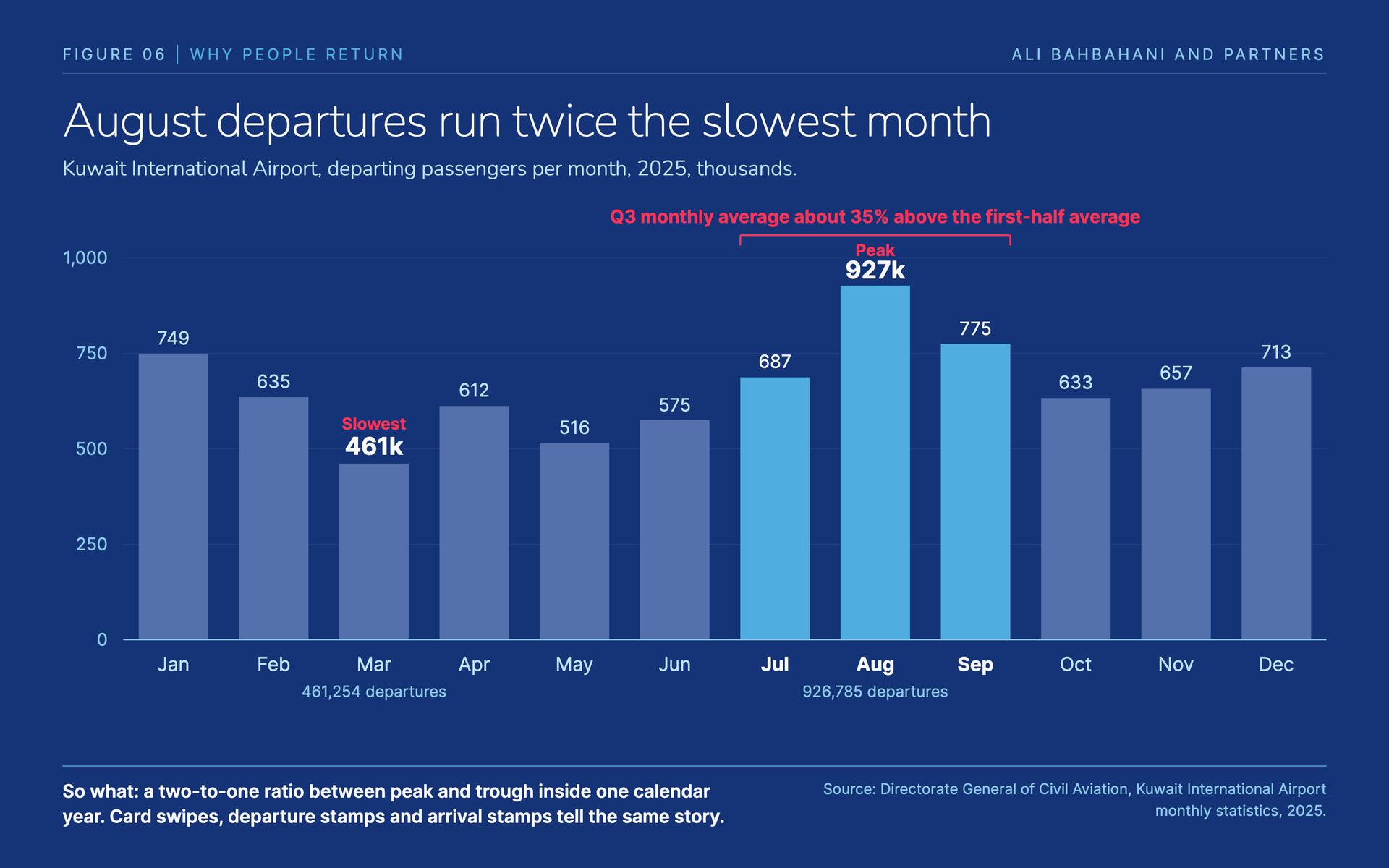
Travellers leaving fifty-degree heat are not seeking adventure or hardship. They are seeking the inverse of what they left: pleasant weather, walkability, green space, good food, civility, service that recognises them, a language they can manage. The pull factors that win Gulf families year after year are reliable, comfortable and easy.
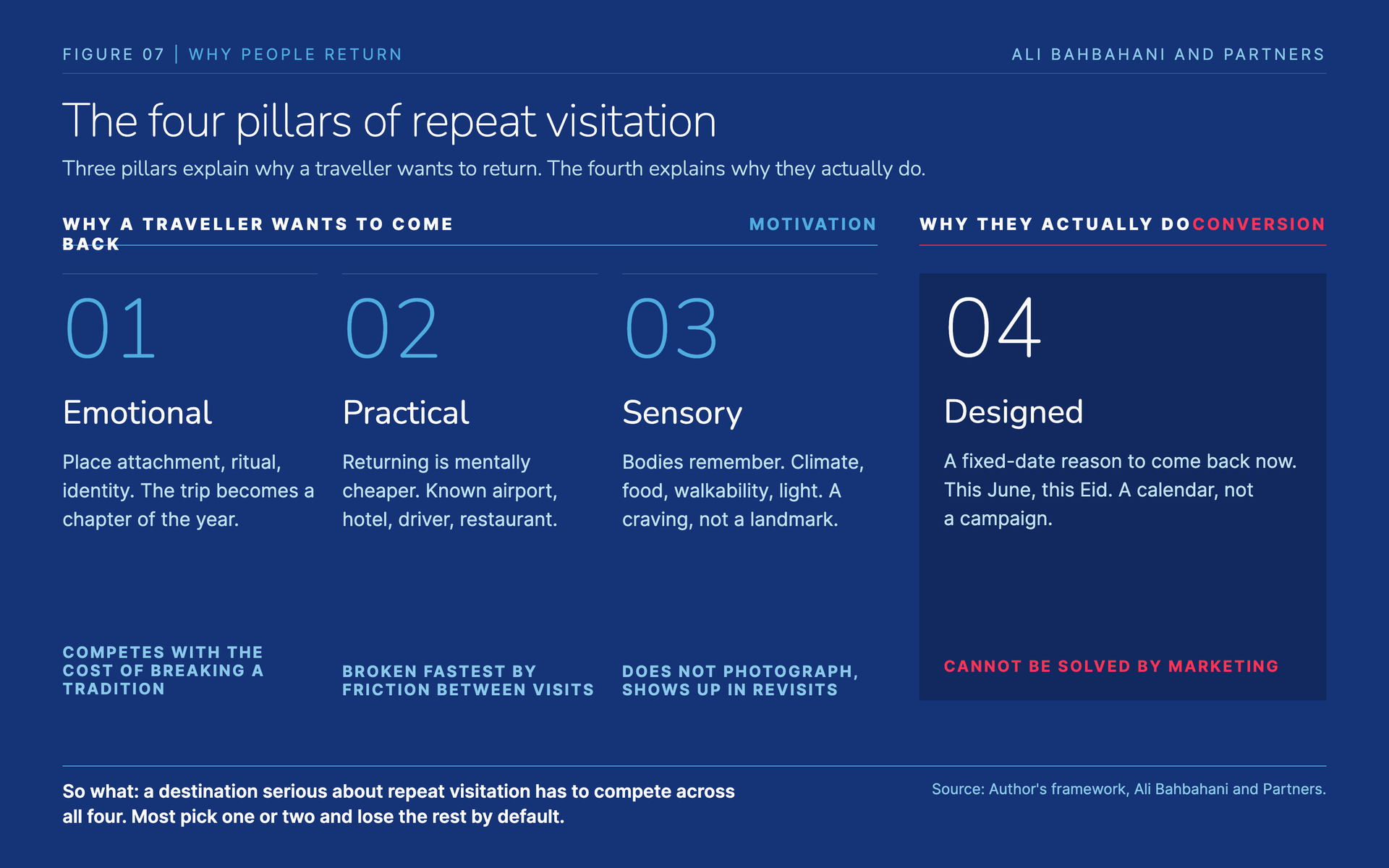
This is why a framework matters here, and why it needs to be tight. The reasons people return are not nine, and not twelve. When you cluster the literature, the practitioner observation and the field evidence honestly, they collapse into four families: the emotional, the practical, the sensory, and the designed. The first three answer why a traveller wants to come back. The fourth answers why they actually do. I will derive each in turn rather than assert the count, but the discipline of four is itself the point. A destination serious about repeat visitation has to compete across all four. Most pick one or two and lose the rest by default.
04. What the research says, and what it does not
The academic literature on revisit intention is substantial, but it answers a narrower question than most practitioners assume. It is rich on drivers, on what makes someone want to return. It is much thinner on measurement: whether they actually do, how often, and what triggered each return.
The strongest finding across the field is the central role of place attachment: the emotional bond a traveller forms with a destination, distinct from any rational assessment of its attributes. Recent meta-analytic work positions it as the dominant construct in destination marketing precisely because it shapes attitudes and behaviour, including revisit intention. Studies across cultural heritage, ecotourism, culinary and urban tourism repeatedly find that affective bonds (memory, nostalgia, identity, ritual) predict return behaviour more reliably than satisfaction with specific attributes does.
The cleanest theoretical breakthrough comes from research separating cognitive image from affective image. The cognitive image is the rational knowledge a traveller holds about a place: its climate, its infrastructure, the quality of its hotels, the accessibility of its airport. The affective image is the visceral response the place evokes: how it feels, what it reminds them of, who they were when they were last there. Multiple structural-equation-modelling studies find affective image to be among the strongest predictors of destination loyalty, for first-timers and repeaters alike. Cognitive image still matters, largely as a precondition. Rational evaluations enable emotional responses, and emotional responses drive behaviour.
That finding is harder on most DMO budgets than it first sounds. The majority of destination-marketing money builds cognitive image: telling people what is in the destination, what they can do, what it costs, how to get there. Building affective image is a different exercise. Storytelling that activates memory, content that prompts identification, post-trip engagement that turns a visit into a chapter of someone's life. It is closer to brand work for a beloved consumer product than to a tourism campaign. I have written separately about how this kind of emotional precision turns ordinary moments into hospitality memory, what the research calls kama muta, the feeling of being moved by connection. Destinations work by the same mechanism, at a larger scale.
The research is also clear on what protects loyalty in a crisis. Travellers with strong pre-existing emotional attachment show markedly higher behavioural resilience during shocks: pandemics, conflict, economic disruption. They fall back on repeat visitation as a risk-mitigation strategy; a familiar, previously vetted destination feels safer than an unknown one. It is part of why some destinations recover faster than others, and why the region's 2026 tourism shock under the Iran conflict has separated operators with deep repeat bases from those who depended on first-visit campaigns.
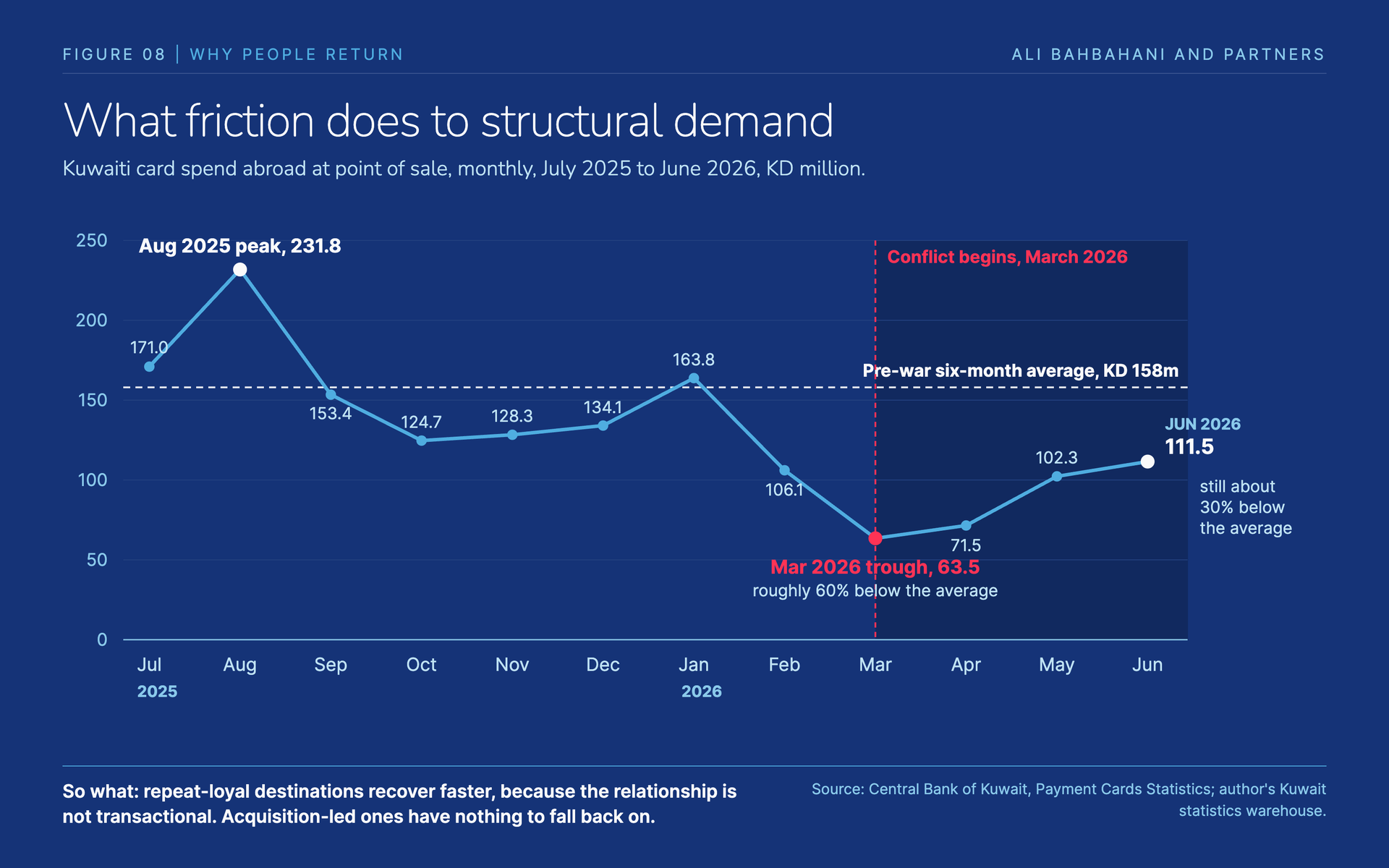
The mirror image of that resilience is what happens when friction wins. In March 2026, the first month of the conflict, Kuwaiti outbound card spending collapsed to KD 63.5 million from a pre-war six-month average near KD 158 million, roughly a 60 per cent compression in a single month. The structural Q3 travel pulse can be cut by more than half when border, airspace and security friction suddenly make the cost of leaving higher than the push to leave. That is the volatility a destination is exposed to when its entire economic model rests on a single annual demand spike. By June 2026, three months after the shock, Kuwaiti card spend abroad had climbed back to KD 112 million a month, still roughly 30 per cent below the pre-war average. Repeat-loyal destinations recover faster, because the relationship is not transactional. Acquisition-led destinations recover slower, because there is no relationship to fall back on.
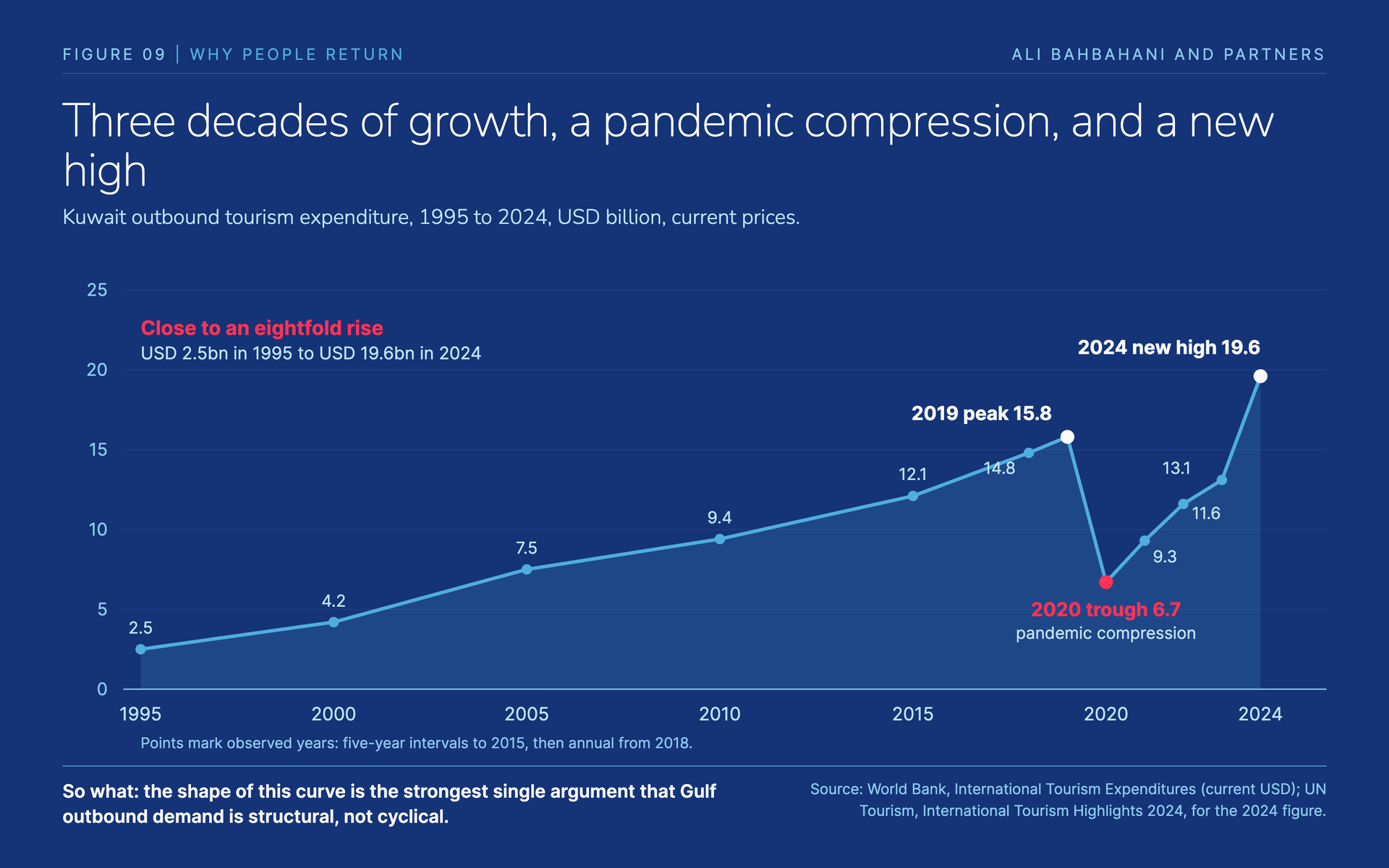
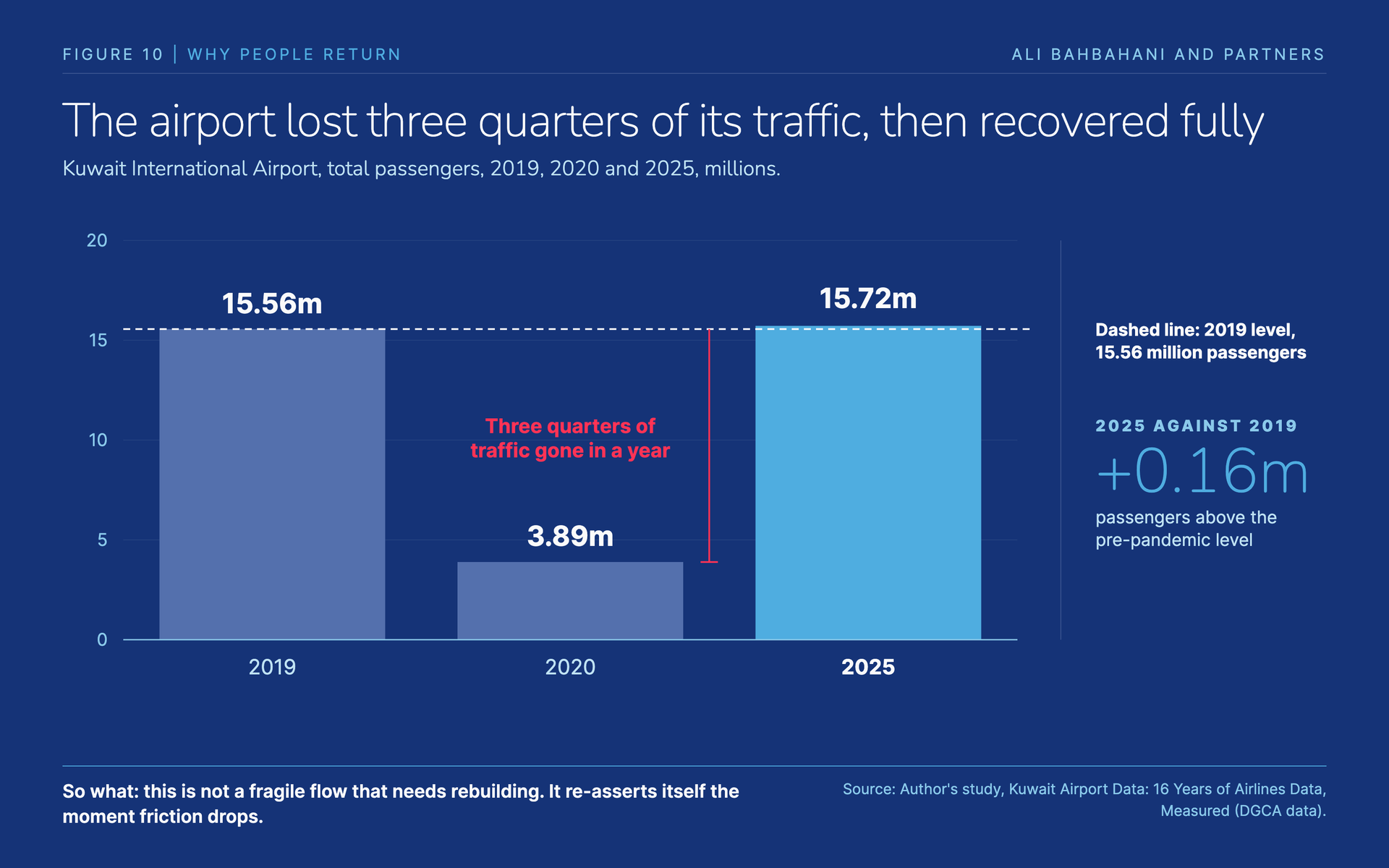
The longer-run picture confirms how structural this is. Kuwait's outbound tourism expenditure grew from USD 2.5 billion in 1995 to USD 19.6 billion in 2024, close to an eightfold increase across three decades. The pandemic compressed it sharply; then it snapped back. Kuwait International Airport tells the same story in passenger terms, as I set out in Kuwait Airport Data: 16 Years of Airlines Data, Measured. Total passengers fell from 15.56 million in 2019 to 3.89 million in 2020, then recovered to 15.72 million in 2025, above the pre-pandemic level. This is not a fragile flow that needs rebuilding. It re-asserts itself the moment friction drops.
The cross-country comparison is where the global scale of the asymmetry becomes visible. On the World Bank's outbound-tourism-expenditure-to-imports indicator, once micro-states, financial centres and small island economies are filtered out, Kuwait ranks first among major economies in the last comparable pre-pandemic year, 2019. Among economies of meaningful size, Kuwait exports more travel demand, relative to its imports, than almost any other.
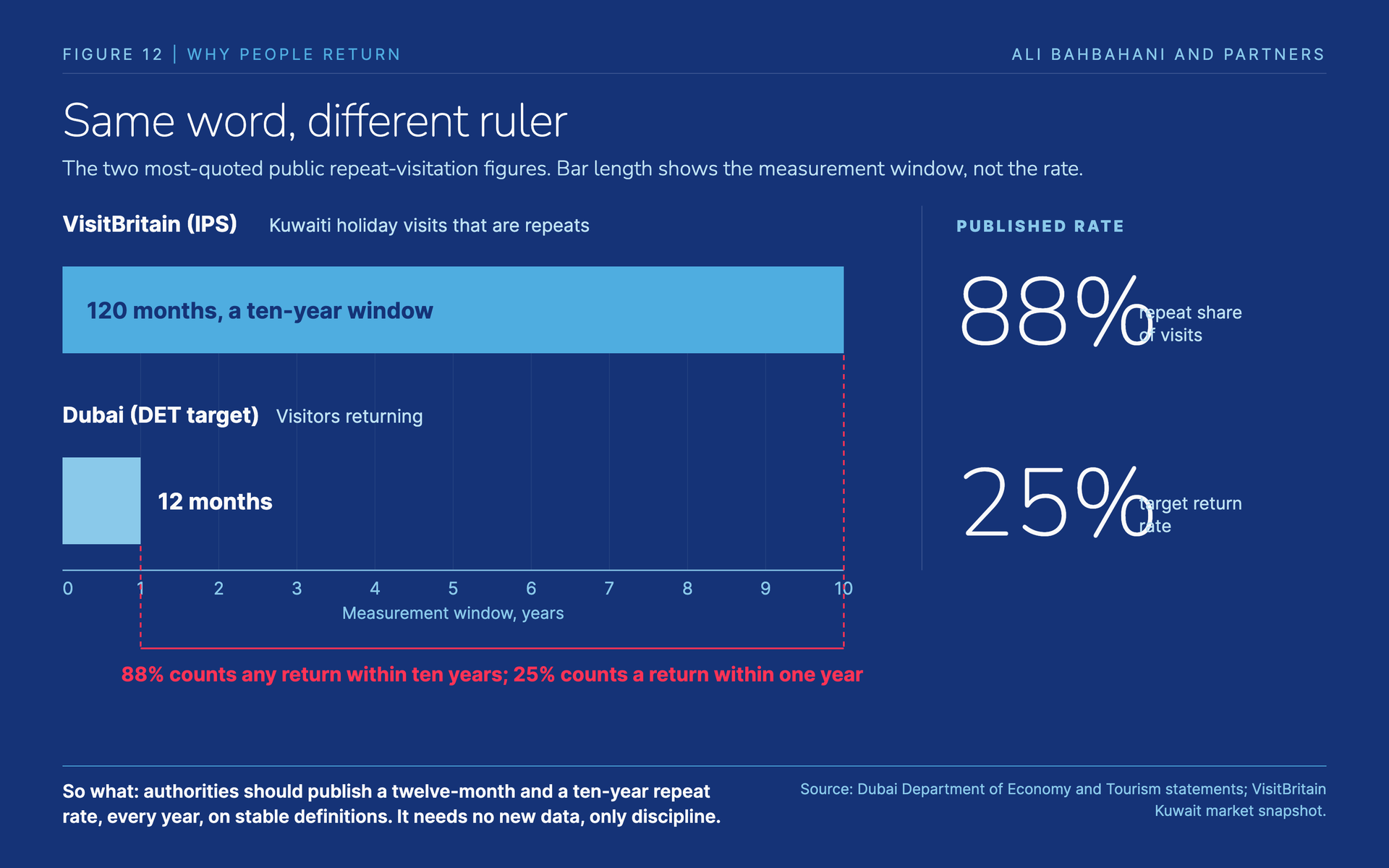
Where the research is much less helpful is measurement. A 2023 methodological review in the Journal of Big Data notes there is still no consistent automated way to measure revisit intention, and that most studies rely on questionnaires using different constructs and time windows. Public statistics make it worse. VisitBritain reports repeat visits within a ten-year window. Dubai's tourism authority targets repeats within twelve months. Academic studies typically use Likert-scaled intention scores that may or may not predict actual return. Cross-destination benchmarking is therefore weak. A destination that wants to manage repeat visitation cannot rely on the existing public dataset. It has to build its own, a point I will return to in detail.
05. The first pillar: the emotional
The first family of reasons is the one academic research has measured most carefully and most marketing teams have understood least. People return to places that have become part of their personal story. The visit stops being a holiday and becomes a tradition, a routine, a memory the family keeps.
The mechanism works on two levels. Functional attachment is fragile. It breaks the moment a competing destination offers a more convenient alternative. Emotional attachment is different. When a traveller forms an emotional bond with a place, the destination becomes a vessel for memory: this is where we honeymooned, this is where the children grew up, this is where I always come in February. At that point the destination is no longer competing with other destinations. It is competing with the cost of breaking a tradition, a far higher bar.
From the field: what twenty years builds
For me this is Mayfair. I have stayed there on almost every London visit for over twenty years. We eat at Gymkhana so often that the staff know our order before we sit; my wife has the same arrangement at Kai. I do not consult a guide to find a restaurant in London. I decide whether to walk to Marylebone or down through Green Park to Westminster, and that decision is itself part of the routine.
Here is the point I promised at the start. London earned this loyalty without ever aiming a campaign at me. But "without a campaign" is not the same as "without design." The hotel that kept its standards across two decades made a choice. Gymkhana choosing to remember its regulars is an operating decision. Royal Ascot fixing itself to the same week every June is the most deliberate calendar in British sport. What looks, from my side, like loyalty that simply accumulated is, from the destination's side, hundreds of small deliberate acts by independent operators. Acts that were never coordinated, and therefore never owned, by anyone.
That is the gap, and it is also the opportunity. What London got by uncoordinated accident, a destination can now get on purpose, faster, if a single body takes responsibility for the things that produce return: continuity, recognition, a calendar, the removal of friction. The accident is not a counter-argument to designing for repeat visitation. It is the proof of concept. The work is to make it intentional.
What this means for destination marketing is that building emotional attachment is largely the work of building rituals. Storytelling does not end at awareness. The DMO's job, alongside the operator's, is to help travellers convert a destination into their place: a recurring tradition, a family ritual, a seasonal memory, a neighbourhood-level routine. The destinations that have done this best (London, Geneva, Marbella, Cap-Ferrat, more recently Bodrum) share a pattern. They have signature seasons. They have neighbourhoods that families inhabit rather than visit. They have hotels that maintain continuity across decades. And they have small businesses, the same restaurant, the same driver, the same pharmacist, that survive long enough to become part of the visitor's memory architecture.
The strongest destination brands are not remembered as locations. They are remembered as chapters in a life.
06. The second pillar: the practical
The second family is the most underestimated. People return to places because returning is mentally cheaper than going somewhere new. That is not the same as financially cheaper, and the distinction is the whole point.
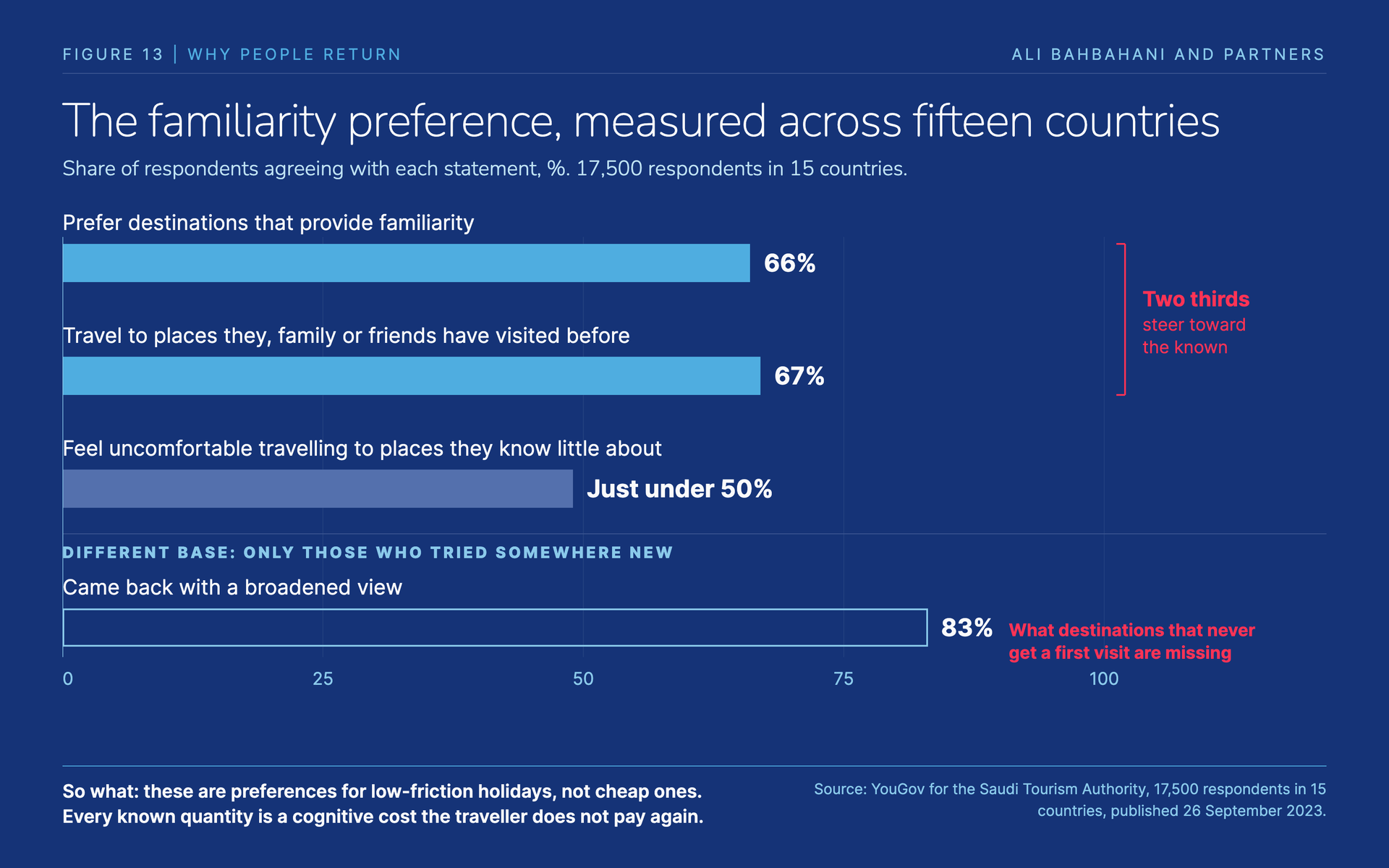
A multi-country survey commissioned by the Saudi Tourism Authority in 2023, 17,500 respondents across 15 countries, found that 66 per cent of travellers prefer destinations that feel familiar, and 67 per cent travel to places they have already visited or know through family and friends. Just under half said they feel uncomfortable travelling to places they know little about. These are not preferences for cheap holidays. They are preferences for low-friction ones. The familiar destination wins because the traveller already knows the airport, the neighbourhood, the hotel, the restaurants, the driver, what to pack, what to expect, what to skip. Every one of those known quantities is a cognitive cost the traveller does not have to pay again.
For Gulf travellers, the practical pull factors that consistently rise to the top are concrete: a pleasant climate, walkability, ease in English, reliable services, good food, safety, clean transport between the points that matter. London scores strongly on almost all of them. Geneva and Zurich win on most. Marbella and Bodrum win on climate and food and lose only marginally on language. The destinations that have earned twenty years of Gulf loyalty are competent, reliably and even boringly competent, and competence compounds.
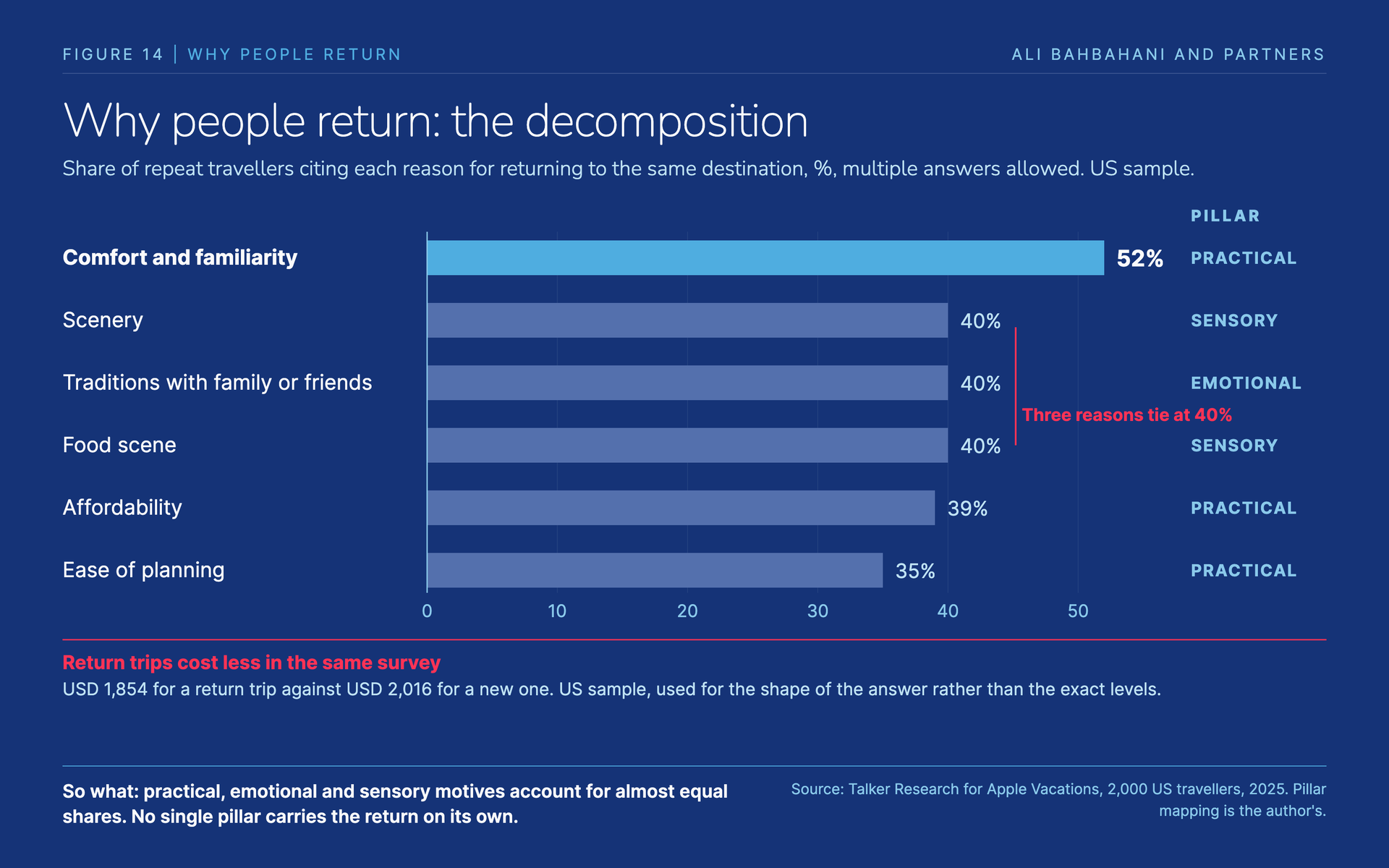
The practical pillar is also where destinations break repeat visitors fastest, because they punish loyal customers in ways they would never punish strangers. The visa policy that changes between trips. The airport queue that gets worse every year. The taxi rank that has not been fixed in five visits. The favourite restaurant that closed without warning. The hotel that raised prices twenty per cent and quietly stopped including breakfast. None of these would deter a first-time visitor; they would not notice. Every one of them deters the repeat visitor, who will simply book somewhere else and never explain why.
This is the same problem I described in my work on multi-destination travel: friction multiplied across properties and across years. At the property level I have called it the Touring Hotel problem, where every new check-in resets the relationship. At the destination level the same dynamic plays out across years. Every visit that asks a loyal customer to start over erodes the loyalty itself.
07. The third pillar: the sensory
The third family is the one tourism strategists most easily dismiss and the data most reliably confirms. People return to destinations because their bodies remember them. It sounds soft. The economics are not.
Food is the clearest case. A landmark earns the first visit; a craving earns the annual one. A traveller may see a museum once and never return, yet eat at the same restaurant every year for a decade. Culinary-tourism research consistently finds that food experiences contribute to place attachment and revisit intention, often more strongly than any single attraction-based driver.
Climate works the same way. The body remembers a December in Beirut, a March in Marrakech, a June in London. These are sensations a traveller will pay to repeat. For Gulf travellers leaving fifty-degree heat, the sensory pull of cool, walkable European weather is its own structural pull factor. We do not just want to leave Kuwait in summer. We want to feel the specific climate of southern France in August, of southern Spain in late September, of London in June. Atmosphere behaves the same way: the smell of a particular souk, the light on a particular bay, the sound of a specific neighbourhood at night. None of it is captured in standard destination marketing, because none of it photographs convincingly. All of it shows up in revisit decisions.
From the field: a family that is not mine
I want to step outside my own habits here, because my Ascot routine is the rarefied end of this market and not the centre of it. The centre looks more like a Bahraini family I know well. Not horse owners, not Mayfair regulars, just a household an hour's flight from three or four destinations they cycle through across the year.
Their loyalty is built almost entirely on the sensory pillar. They return to the same stretch of the eastern Mediterranean coast not for an event and not for a landmark, but because the children associate it with a particular beach, a particular grilled-fish lunch, a particular evening temperature. The mother can name the bakery. The father books the same apartment because he knows which way it faces at sunset. They have done a version of this trip three times a year for years, and if you asked them why, they would not say "the marketing." They would describe a smell, a meal, a light.
This is the repeat traveller most GCC destinations should be designing for: not the once-a-decade European discovery trip, but the regional family whose return is anchored in body memory. It is cheaper to earn than a landmark and far stickier once earned. Almost nobody is packaging for it.
Kuwait, for its part, has real sensory assets and underuses most of them badly. The country's dining culture, the late-night cafés, the seafood at Souk Sharq, the family weekend chalet kitchens, the regional bakeries, the post-Ramadan iftar economy, is among the most distinctive in the Gulf. None of it is currently packaged as a reason to come to Kuwait. The marketing leans on infrastructure, on real estate, on Vision 2035 keywords, while the sensory hooks that would bring a regional family back four times a year sit unused. A culinary calendar would do more for repeat visitation than another set of investment-promotion brochures.
A landmark earns the first visit. A craving earns the annual one.
08. The fourth pillar: the designed
The first three pillars explain why a traveller might want to come back. The fourth explains why they actually do. It is the one most destinations get most wrong, because it cannot be solved by marketing at all.
Repeat visitation does not happen because a destination is loved. It happens because there is a specific, time-bound reason to come back now. Not in general. This June, this Eid, this Ramadan, this long weekend. The destinations that have built durable repeat economies have, almost without exception, built calendars: annual programmes of reasons to return that compound over years.
From the field: Royal Ascot, the third week of June
This is what a fixed-date event does to a traveller. Twenty-something Royal Ascots, the same week every June, the same morning ritual: the grey morning suit, the top hat, the black coffee over the race card. By the time I land in London the trip is structured before I have arrived. The hotel knows me. Gymkhana knows me. The driver knows the route to the racecourse. Whether my horses are running that year or not, the trip is already running.
What Ascot has built is a fixed-date economy of reasons to be in London, and Wimbledon, the Chelsea Flower Show, Notting Hill Carnival, the West End season and the summer cricket calendar all reinforce it. A Gulf family that has done one of these once does not need to be sold on the destination again. They need to know which weekend the next one falls on. The trip is then assembled around it: airport, hotel, restaurants, shopping, school-holiday timing. The event is the spine; everything else hangs from it.
This is the model the GCC has not yet built for itself, and it is the single biggest gap in the region's repeat-visit story. There is not yet a Kuwait event that occupies the place in any GCC family's annual calendar that Royal Ascot occupies in mine. Bahrain has the Grand Prix. Dubai has its Shopping Festival and its sporting season. Riyadh has Riyadh Season. Kuwait has National Day, Liberation Day, Ramadan, and a long summer that much of the country spends elsewhere. What it does not yet have is a repeatable regional tourism season.
The clearest working comparator in the region is Dubai. Issam Kazim, CEO of the Dubai Corporation for Tourism and Commerce Marketing, has stated the strategy plainly: the city wants to stay dominant in repeat visitation and get a quarter of its visitors to return within twelve months, and the sooner it reaches that, the better. That target is a function of the city being scheduled, more than of the city being loved. The official Dubai calendar publishes restaurant weeks, shopping festivals, culinary festivals, fitness challenges, sporting fixtures, hotel deals, attraction passes and seasonal openings as a single packaged stream of recurrence. A traveller who left six months ago has eight new reasons to return now, and the city has done the work of telling them. The same logic underwrites London's tourism calendar, Singapore's events programming, and the repeatable model behind Riyadh Season's annual pull.
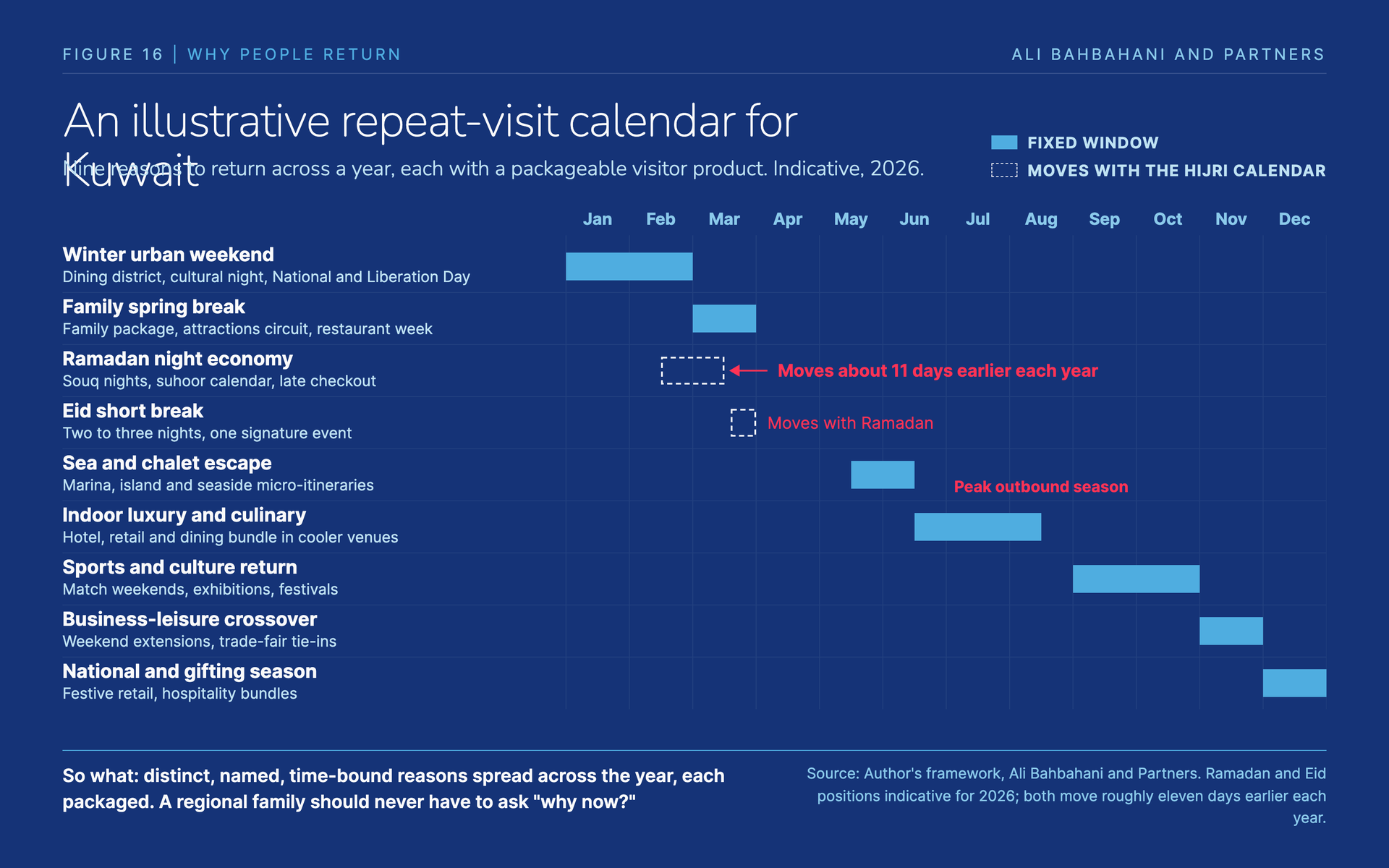
The contrast with most GCC destinations is stark. A Saudi family that visits Kuwait once is given essentially no temporal reason to visit again. There is no widely promoted seasonal programme that says: come back in March for this, come back in October for that. The calendar exists only in pieces (National Day, Liberation Day, Ramadan, summer chalet season, the football season, the cooler-weather window from November to March) and none of it is packaged as a coherent visitor product. Set that against the explicit operating model of Dubai's Calendar of Events, or the Saudi Tourism Authority's Riyadh Season programming, both constructed to give the same traveller several distinct reasons to return inside a single year.
A campaign produces an arrival. A calendar produces a return. They are not the same instrument, and most destinations own only the first.
09. Newness inside familiarity
One paradox runs underneath all four pillars, and most destinations get it wrong, so it deserves its own short section. The repeat visitor does not want everything to stay the same.
This sounds obvious stated cleanly, and it is mishandled constantly in practice. An operator notices a guest returns annually and concludes the guest wants an identical experience each time, so the offering is held still. The data says the opposite. Repeat visitors want the bones of the destination to be familiar: the airport, the neighbourhood, the staff who recognise them, the streets they remember. They want the tissue around those bones to be fresh: new restaurants, new exhibitions, new openings, a walk they had not done before, a reason this trip is distinct from the last. Familiar bones, fresh tissue. A destination that holds everything still feels stale by the fourth visit. A destination that changes everything feels unrecognisable. The craft is in the calibration.
Villa Igiea in Palermo is a textbook case. Its night manager remembered my room and my preferences without a CRM, simply by paying attention and writing things in a logbook. That was the familiarity. But the property also rotated its menus seasonally, refreshed its art programming and ran new cultural collaborations with the city. When I returned, the staff who recognised me had also organised something I had not seen. The property has an unusually strong repeat-guest culture for its class. I do not think that is a coincidence.
For a destination, the same principle scales. The next time a Saudi family visits Kuwait, the hotels they remember should still be there, the restaurants still open, the drivers and staff still recognising them. But there should also be a new exhibition at JACC, a new restaurant in Salmiya, a new event in Souk Mubarakiya, a new pop-up at The Avenues. Without the new tissue, familiarity decays into boredom. With it, familiarity compounds into preference.
The repeat visitor wants the destination to feel familiar, but not finished.
10. What DMOs should measure instead
None of this works without measurement. A destination that cannot tell you its repeat rate cannot manage its repeat strategy, and most cannot tell you.
The public statistics expose how unevenly this is done even across mature destinations, as Figure 12 showed. Dubai targets a repeat rate within twelve months. VisitBritain reports repeat shares within a ten-year window. Academic studies typically measure intention rather than behaviour. None of these numbers are wrong. But they cannot be benchmarked against one another, which means the average DMO cannot answer the single most important strategic question on its own dashboard: are we getting better at this, or worse?
The fix is structural. Tourism authorities should publish two repeat-visitation series: a twelve-month repeat rate that captures short-break and regional behaviour, and a five-year or ten-year rate that captures long-haul loyalty. Both, every year, on stable definitions. This is the single largest measurement reform the industry needs and the cheapest to deliver. It does not require new data collection; most of it already sits in the immigration and arrival surveys DMOs commission. It requires the discipline to standardise reporting, which is harder than it sounds, because nobody currently looks bad on their own preferred metric.
Beyond the headline rate, the operational dashboard needs a small set of behavioural KPIs that are missing from most DMO reports today.
MetricWhat it tells youWhere the data sitsRepeat share of arrivalsThe behavioural baseline. Are repeat visitors growing as a share of total demand?Immigration surveys, loyalty matchingRepeat share of spendThe economic baseline. Repeaters spend more, so spend-share grows faster than arrival-share.Payment-data partnerships, merchant networksTime between visitsMedian months from one visit to the next. Drives calendar design and offer timing.CRM, payment data, mobility dataCohort retentionShare of a visit cohort that returns at 6, 12 and 24 months. Tells you whether a campaign produced durable demand or a one-off spike.CRM, ticketing, booking integrationsEvent-to-return conversionShare of event attendees who come back for a non-event leisure trip. The KPI for sport, culture and festivals.Ticketing, CRM, post-event surveysFriction scoreComposite measure of visa clarity, airport ease, transport reliability, safety and booking simplicity.Visitor exit surveys, service-performance dataExperience attach rateShare of visitors who buy at least one local experience beyond lodging and transport. A proxy for depth.Ticketing, attraction data, dining platforms
None of these metrics are exotic. They are what every retention-focused consumer business measures as a matter of course. The fact that destination authorities largely do not measure them tells you which discipline tourism marketing has been borrowing from for the last twenty years: broadcast advertising, not customer-relationship management. The shift the industry needs is a different operating model, not a new tactic.
The first visit is an acquisition event. The second visit is a systems test. Most destinations have built the first system and skipped the second.
11. The Kuwait test
The frame so far has been deliberately broad, because the principles apply across destinations. But the question I planted at the start was specific. What would it take to make Kuwait a repeat-visit destination? I have left it until now on purpose, because everything before it is the equipment needed to answer it properly. A reader who has followed the four pillars and the measurement argument can see why the usual Kuwait tourism conversation is asking the wrong question.
The honest starting point is that the question itself has barely been asked. Kuwait's tourism conversation has been organised around different questions for several years: how to grow inbound visitors, how to attract international hotel brands, how to position the country alongside its larger Gulf neighbours. These are reasonable questions. They are also first-visit questions. They presuppose an audience encountering Kuwait for the first time. They are silent on the visitor who has been here before and is deciding whether to come back.
I have written about the underlying friction problem before. Kuwait's traveller experience, from visa to airport to hotel to dining, is built around assumptions that punish loyal customers as much as new ones. Kuwait's tourism contribution sits near 5 per cent of GDP, well below the global average, while outbound tourism reached roughly 12 per cent of GDP at its 2019 peak on Oliver Wyman's analysis. The Central Bank's own balance of payments puts the same asymmetry in dinars. In 2025, travel debits (what residents spent abroad) came to KD 3.9 billion; travel credits (what visitors spent in Kuwait) came to KD 0.65 billion. Six dinars out for every one in, and the ratio has narrowed only slowly since 2019. Combined with Kuwait's position at the top of the World Bank's outbound-tourism-to-imports ranking, this is the clearest indictment of the current model: travellers from Kuwait are spending billions of dinars a year on destinations that have worked out something Kuwait has not.
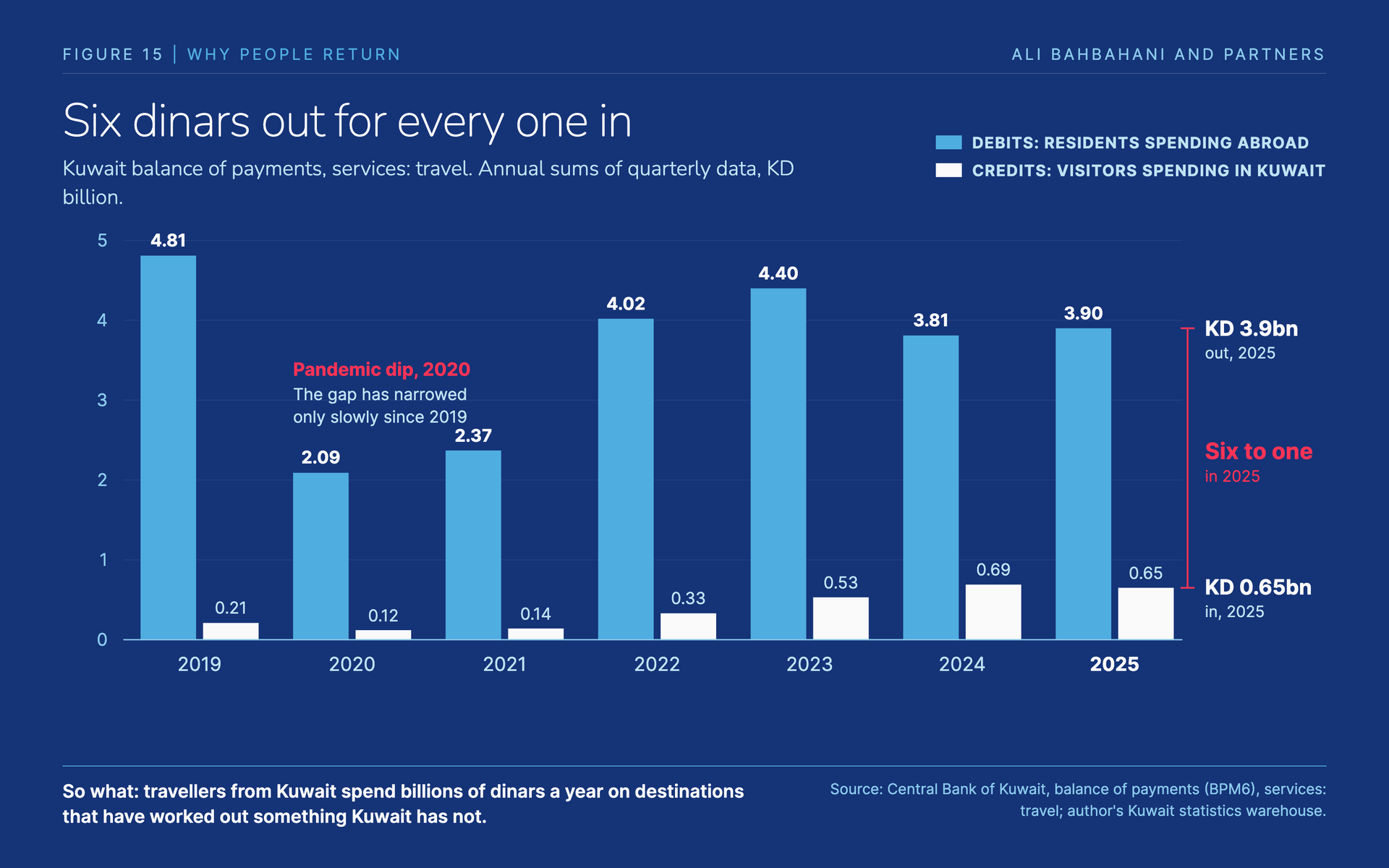
The data argues the question itself is the wrong way round. The most obvious high-value addressable market for Kuwait tourism is the GCC neighbour an hour's flight away, already wired for repeat travel and currently spending most of that loyalty on London, Geneva, Bodrum and Marbella. The Kuwaiti who visits the UK ten times in a decade is not unusual. The Saudi family that returns to the same European hotel for fifteen consecutive Augusts is not unusual. The Bahraini household that takes the same regional weekend three times a year, the family from the sensory section, is not unusual. These are some of the most loyal repeat travellers in the world, and the only real question is what share of that loyalty Kuwait can take back from the destinations that currently own it.
A practical answer looks like a calendar, not another campaign: a coordinated annual programme of reasons for a regional visitor to return. The version below is illustrative, but it shows the shape of the thing. Distinct, named, time-bound reasons spread across the year, each one packaged rather than left implicit.
The Khaleeji Zain 26 tournament, the 26th Arabian Gulf Cup, hosted in Kuwait from 21 December 2024 to 3 January 2025, was a useful test of what happens when the demand spike arrives without the system behind it. Fifteen matches, a sixty-thousand-seat stadium, and tens of thousands of fans from across the Gulf filling Souk Mubarakiya between fixtures: by any reading, the tournament produced arrivals. The strategic lesson is the one every event-driven destination eventually learns. A tournament can produce arrivals, but not repeat visits, unless the destination captures first-party data, builds a post-event journey, and gives those attendees a non-event reason to come back. Kuwait got the spike. Whether it converted into a repeat-visit pipeline is the open question, and at the time of writing, the data to answer it does not exist in the public domain.
Which is the deepest issue. Kuwait's repeat-visit problem is not, in the end, a marketing problem. It is a measurement problem stacked on a calendar problem stacked on a friction problem. The published tourism arrivals series, under 200,000 recorded arrivals in 2023, has no GCC line at all, because GCC nationals enter without a visa and are counted nowhere. The visitor this article is about is invisible in the national statistics. The country needs a published annual repeat-visitation rate. It needs a coordinated national events calendar that gives a regional visitor at least four distinct reasons to return in a year. It needs a frictionless airport-to-hotel-to-restaurant-to-departure pipeline that does not punish the loyal customer for coming twice. And it needs a CRM spine across hotels, attractions, dining and events, one that lets the country recognise a returning visitor at the second arrival rather than the seventh.
None of this is technologically hard. The difficulty is organisational. The tourism authority does not own the full calendar. Hotels do not share a CRM. The airport does not coordinate with the restaurants. Event organisers do not always connect their demand spikes to a post-event tourism journey. The result is a destination built around the first visit, with nobody responsible for the second.
The opportunity is unusually clear, and it is the through-line of this whole argument. The regional travellers who would form Kuwait's repeat base are already loyal repeaters by behaviour; they have demonstrated it in every other major destination they touch. The next Gulf destination to treat repeat visitation as an operating discipline rather than a marketing slogan will not be competing for new audiences. It will be competing for loyalty those audiences have already given to someone else.
12. Closing
For most of the last twenty years, destination marketing has behaved as if its job ended when the visitor arrived. The data has been quietly making that position untenable. Keeping a visitor costs a fraction of winning a new one; the exact multiple is contested, the direction is not. Returning visitors to Dubai spend USD 890 a trip against USD 540 for first-timers. Eighty-eight per cent of holiday visits from Kuwait to Britain are repeats, a number that should be read as both a celebration and a warning, because almost none of that loyalty was earned by a campaign. It was earned by a destination that built a calendar, removed friction, and gave the same visitor reason after reason to come back.
I am one of the data points in that statistic. Twenty-something Royal Ascots, twenty-something Junes in Mayfair, twenty-something dinners at the same restaurant. London did not run a campaign at me. It earned my loyalty through hundreds of small, well-handled decisions made by independent operators who each chose continuity over churn. What no one did was coordinate those decisions, or claim them, or measure them. That is the entire opening for a destination willing to do on purpose what London did by uncoordinated habit.
A destination becomes powerful when people start building personal rituals around it: when the place becomes a chapter in the visitor's own story, a slot on the family calendar, a habit that compounds across decades. The real goal of destination marketing is the reason to return.
For the Gulf, and for Kuwait specifically, the addressable market is not in question. The most loyal repeat travellers we know, the families who have made London, Geneva and the Côte d'Azur permanent fixtures of their year, live in our own neighbourhood. They are us. The only question is whether the destination is ready to design for them: to measure repeat behaviour, build seasonal calendars, remove the small frictions that compound across visits, and treat the second arrival as the system working rather than a coincidence.
Repeat visits look like luck from the visitor's side. From the destination's side, they are built.
Designing for the second visit
At Ali Bahbahani & Partners we work with hospitality groups, tourism authorities and destination operators across the GCC on the operational discipline of repeat visitation: customer-journey audits, retention strategy, calendar design, friction audits, and the cross-operator measurement systems that make repeat behaviour visible. If you are building a destination, a hotel group or a hospitality concept where the second visit matters more than the first, we would like to hear from you.
Sources and methods
This article draws on seven categories of evidence. (1) VisitBritain's Kuwait market snapshot (2023 IPS data, May 2024 release) and the corresponding GCC market snapshots for Saudi Arabia, the UAE and Qatar; VisitBritain notes that more recent IPS trend data is published as "official statistics in development" and should be used with caution. (2) Visa's 15 December 2025 press release on its Dubai destination programme (VisaNet card-spend data), which states both the USD 890 and USD 540 per-trip figures and a "45% more" comparison that the dollar figures do not reproduce; this article uses the dollar figures. Dubai Department of Economy and Tourism public statements, including remarks attributed to Issam Kazim. (3) Central Bank of Kuwait Payment Cards Statistics, drawn from the author's earlier published analysis of Kuwaiti payment patterns and of the March 2026 monetary release. (4) World Bank development indicators, specifically International Tourism Expenditures (current USD) and outbound tourism expenditure as a share of total imports (ST.INT.XPND.MP.ZS), plus UN Tourism's International Tourism Highlights (2024 edition) for the 2024 outbound figure, DGCA Kuwait International Airport statistics as published in the author's airport data study, and the Central Bank of Kuwait balance of payments (BPM6, services: travel) and CBK monthly payment-card data as held in the author's Kuwait statistics warehouse. (5) Industry research from Skift Research, McKinsey, the OECD's Tourism Trends and Policies and Oliver Wyman; the customer-economics multiplier is sourced to Reichheld and Sasser's 1990 Harvard Business Review article "Zero Defections" and subsequent Bain & Company research, and is presented as directional and as drawn from outside tourism. (6) The YouGov survey of 17,500 respondents in 15 countries commissioned by the Saudi Tourism Authority (September 2023); the Talker Research survey of 2,000 US travellers for Apple Vacations (2025); and academic literature on destination loyalty, place attachment, revisit intention, push-pull theory (Dann, 1977) and tourist familiarity. (7) Field observation from the author's consulting practice, personal travel, and the author's own published research on multi-destination travel. The per-capita outbound-spend figure of roughly USD 3,086 is in wide circulation but could not be traced to a primary dataset; it is presented as colour, not evidence. Figures 04, 07 and 16 are the author's syntheses and frameworks rather than measured data, and are labelled as such. The "major economies" comparison in Figure 11 filters out micro-states, financial centres and small island economies; the full-sample ranking is published by the World Bank.
Related reading
- Insights from Multi-Destination Travel Academic Research
- Kuwait Airport Data: 16 Years of Airlines Data, Measured
- Kuwait's Payment Revolution in 2025
- Kuwait Absorbed a War in March: What the Data Shows
- Ahla Leila, Ahla Nas: The Summer Anthem Nobody Cashed
- Villa Igiea Palermo: A Forward-Thinking Review
- From Empty Tables to Cultural Hubs for Kuwaiti Hotels
- Luxury That Moves With You: The Touring Hotel Model
- Unveiling Kuwait: Transforming Traveller Experiences
- The Business of Goosebumps: Kama Muta and CX
- The Hotel Customer Journey: Six Phases That Build Loyalty
- The Price of Dining in Mayfair: A Tale of Two Restaurants
- Geneva's Quiet Charm: Hospitality Lessons from Les Armures
- Kuwait Airways: A Brand Repositioning Case Study