What a Car Actually Costs in Kuwait: 185 Models Over Ten Years
.webp)
A Toyota Land Cruiser costs 15,000 dinars in Kuwait. A Jetour T2 costs 12,170.
Pay cash for both, keep them ten years, and the Land Cruiser is the cheaper car by 1,254 dinars. It costs more to service and burns more petrol, and over the decade those two lines run 2,308 dinars against it. None of that saves the Jetour, because it gives up 3,570 dinars more in value, and it only saved you 2,830 at the showroom.
Borrow the money at 3 percent and the two cars finish level. At 5 percent the Jetour wins by 688.
The cost of owning a car in Kuwait over ten years runs from 6,506 dinars for a Suzuki Dzire to 55,272 for a Mercedes G-Class, and on 101 of the 185 models on sale the purchase price ranks the cars in the wrong order. Both statements above come out of the same model. I costed every passenger vehicle sold in Kuwait over ten years, and what it produces is not one answer but a boundary.
- 101 of 185 models cost more to own than a car that cost more to buy, for a cash buyer. Weighted by 2025 registrations, that is 49 percent of the market
- 73 of 185 once the capital tied up in the car is charged at 5 percent, a third of units
- 16,666 kilometres a year is what the median Kuwaiti car covers, measured from 1,234 odometer readings rather than assumed
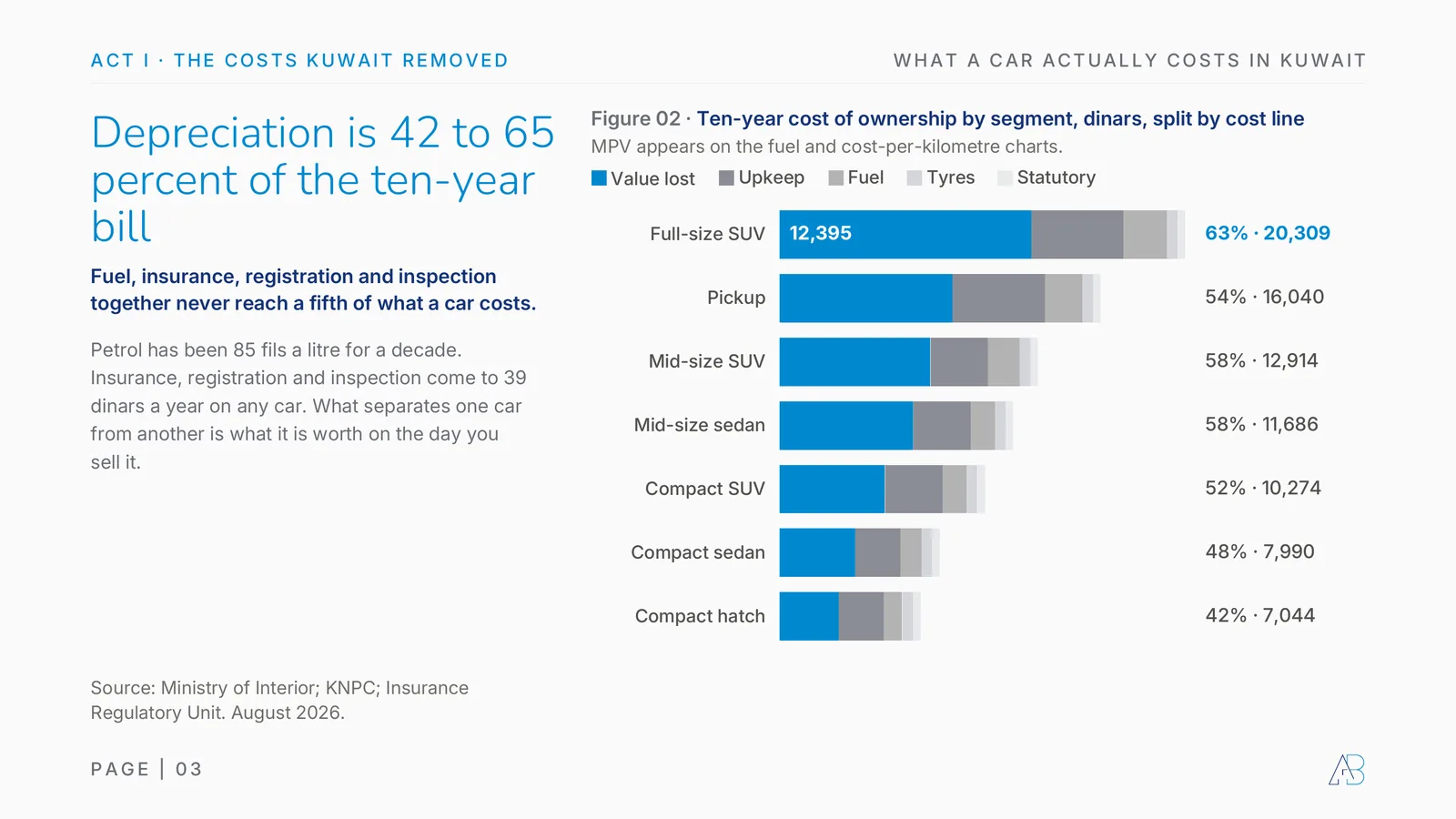
- 42 to 65 percent of the ten-year bill is depreciation. Fuel, insurance, registration and inspection together never reach a fifth
- 52 percent of its list price is what a Toyota Prado still holds at ten years old. A Nissan Sunny loses 20.9 percent a year
- 26 to 48 percent is the discount a Chinese car would need to break even on depreciation against a Japanese rival. The discount offered is 9 to 11
Data collected 1 July to 31 August 2026 from 2,483 used listings, 1,769 historical list prices, 3.25 million ownership transfers and the Ministry of Interior's model-level registrations for 2024 and 2025. Prices are asking prices, reduced 7.5 percent, because Kuwait publishes no closed transaction prices. Everything that follows is built on that adjustment, and the section on method says what it cannot see.
What is in this study
- The costs Kuwait took off the table
- How far Kuwaitis drive, counted
- Fifty-one fils a kilometre, seven of them petrol
- The sticker price gets the ranking wrong 101 times
- What changes when the money is not yours
- Two cars at the same price, 8,000 dinars apart
- The cheapest and dearest cars to own in Kuwait
- Depreciation, from negative to 30 percent a year
- What the odometer does to a price
- The Chinese discount, in one calculation
- Who the cost falls on
- Five used cars change hands for every new one
- Where the money goes
- The roads underneath all of it
- What I would tell a buyer
- Common questions, answered with the numbers
- Method and sources
The costs Kuwait took off the table
Start with what a car costs to run here, because the answer is very little, and it has been very little for a long time.
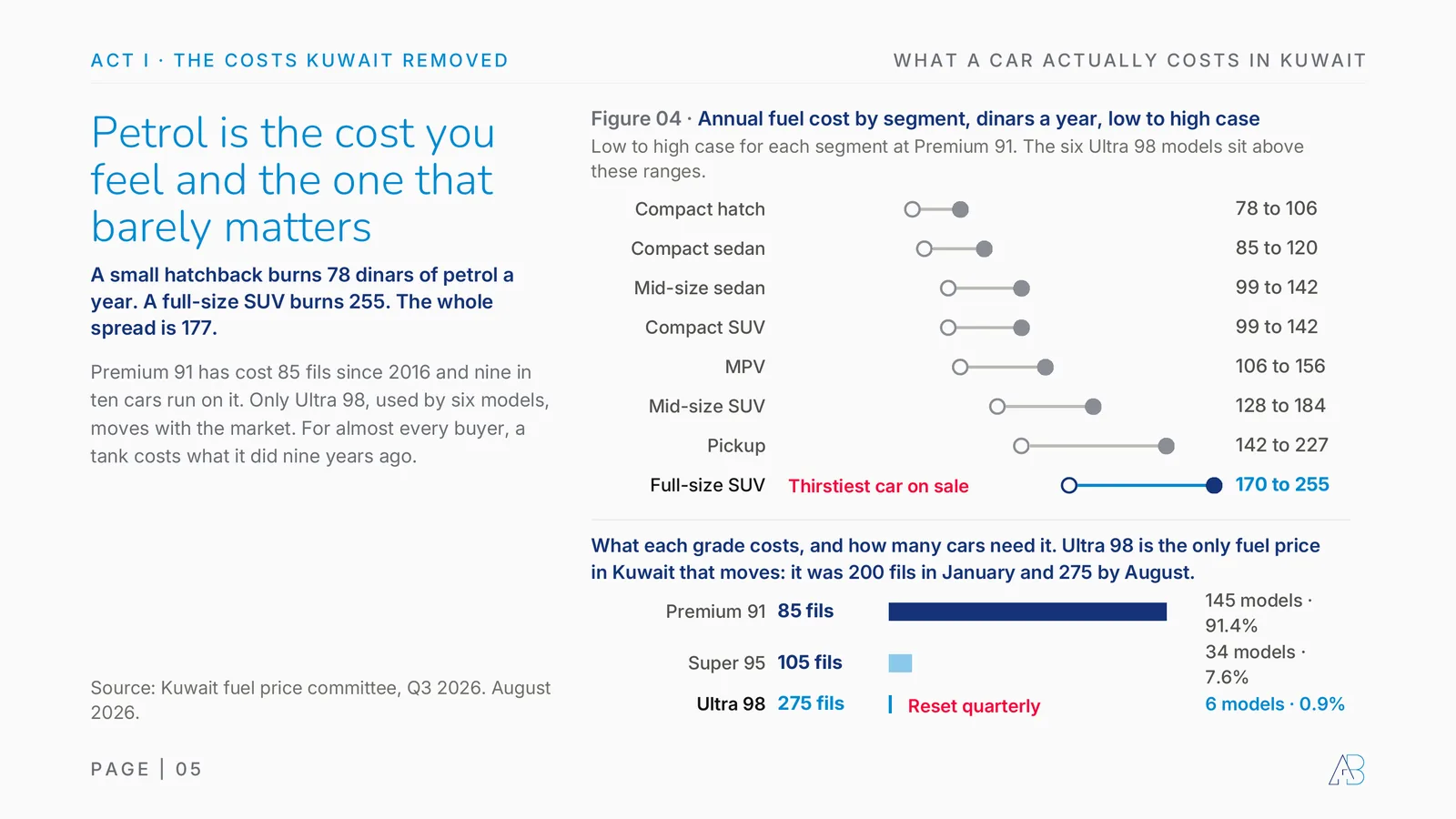
Premium 91 has been 85 fils a litre since September 2016. Not roughly 85 fils, not 85 on average. The same number for nine years, and it is what 145 of the 185 models in this study, 91 percent of what Kuwait bought last year, are built to run on. Super 95 sits at 105 fils and has been just as steady. Only Ultra 98, which six models require, is reset every quarter by the fuel price committee. It was 200 fils in January 2026 and 275 in August.
Compulsory insurance is 32 dinars a year, registration is 5, inspection is 2. That comes to 39 dinars, and it is identical whether you are registering a Land Cruiser or an MG3.
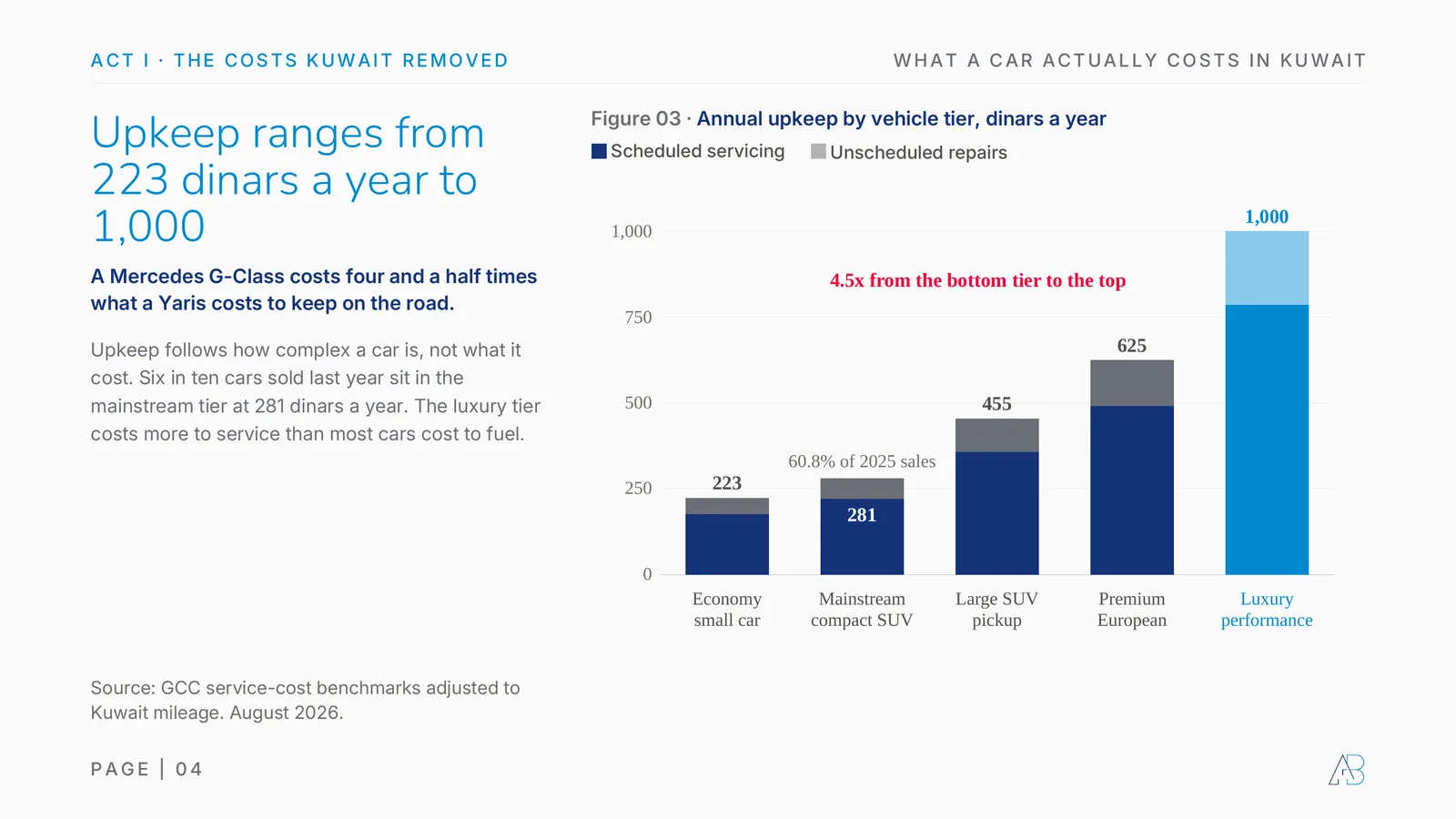
The only running cost that varies with the car is upkeep, and its range is narrow in absolute terms. An economy small car costs about 223 dinars a year to service and repair. A Mercedes G-Class costs about 1,000. Four and a half times, on a base of a few hundred dinars. Six in ten cars sold in 2025 sit in the mainstream tier at 281 dinars a year.
Petrol is the cost drivers feel, because it is paid at a counter every week. A small hatchback burns 78 dinars of petrol a year. A full-size SUV burns 255. The whole spread across every car in the country is 177 dinars.
Add all of it together over a decade and you are looking at somewhere between 4,000 and 12,000 dinars, depending on what you drive and how heavily. Now look at what the same cars lose in value over the same decade: between 2,900 and 37,000.
Kuwait compressed almost every running cost into a narrow band. It left one free to move, and that is the one buyers rarely see quantified.
How far Kuwaitis drive, counted
Before any of this works you need to know how far people drive, and almost every Gulf study guesses at it.
I did not want to guess, so I counted. Every used listing I collected that showed both an odometer reading and a model year got divided out. That gave 1,234 measurements. The middle car covers 16,666 kilometres a year.
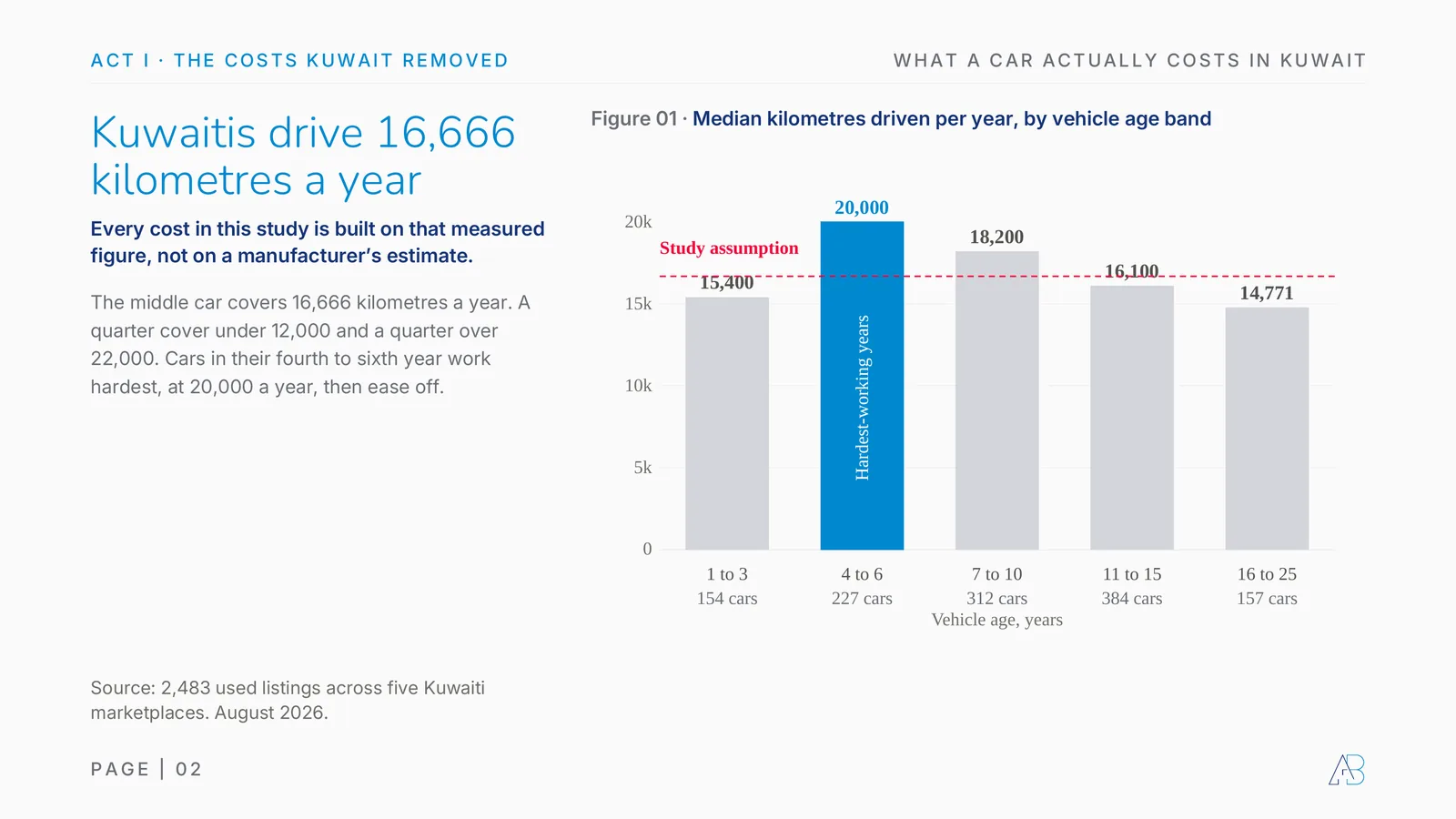
The distribution behaves sensibly, which is the useful part. A quarter of cars cover less than 12,031 kilometres and a quarter cover more than 22,200. Cars aged four to six work hardest, at 20,000 a year. Cars over sixteen work least, at 14,771. They may be secondary household cars by then; the listing data cannot say why.
Every cost figure in this piece is built on that number, over 166,660 kilometres in ten years.
Fifty-one fils a kilometre, seven of them petrol
At 16,666 kilometres a year, a compact sedan costs 51 fils per kilometre to own and run. The petrol inside it costs about 7.
Fuel is roughly a seventh of what the car costs its owner. The other 44 fils are the car losing value, being serviced, insured and registered. Fuel economy is printed on the window and discussed in the showroom. Depreciation usually is not, and none of these larger costs ever arrives as a bill.
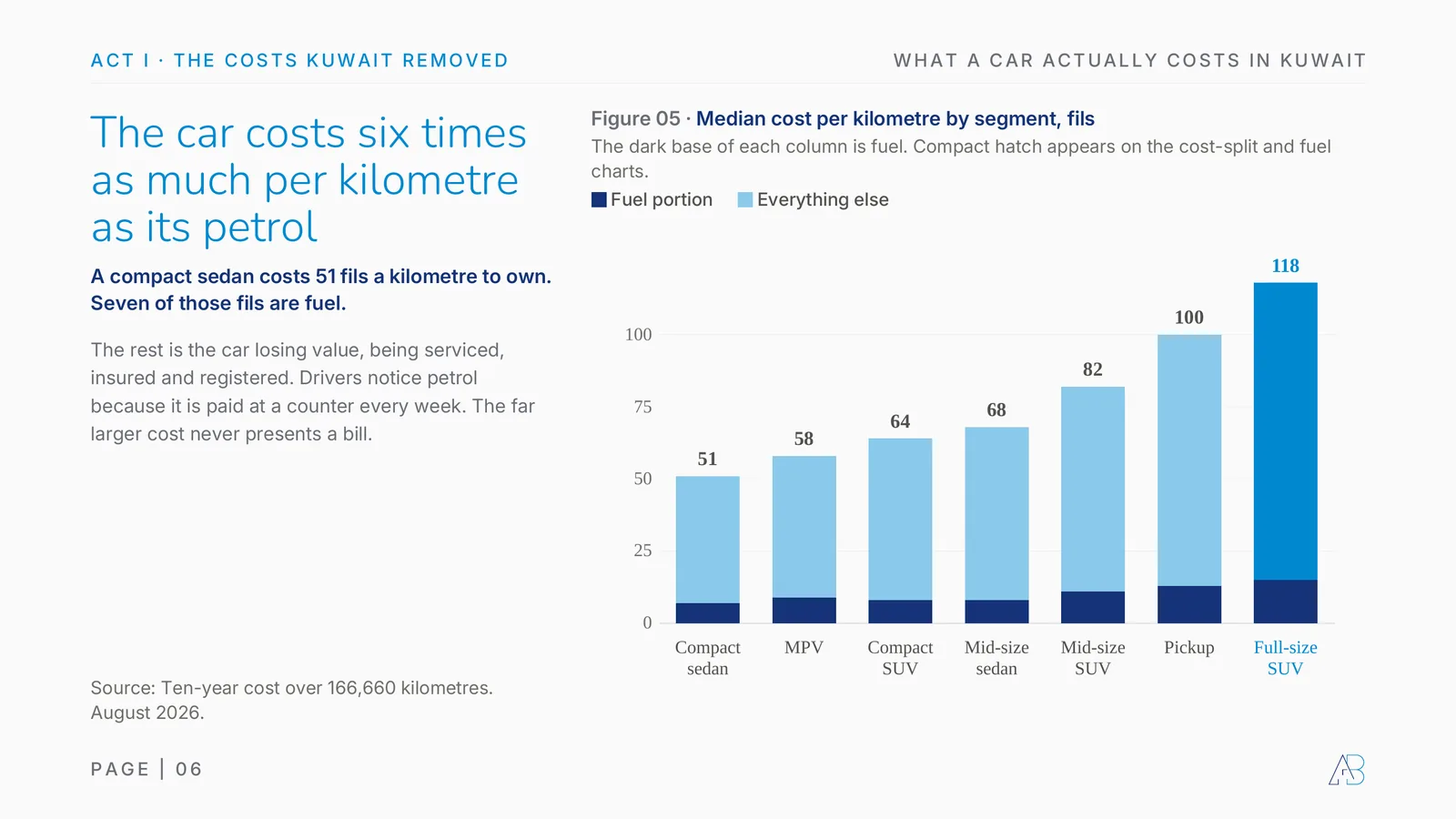
A compact SUV, the segment Kuwait buys most, runs at 64 fils. A full-size SUV runs at 118, of which 15 is petrol. Whatever you drive, fuel is the smallest line and the car is the largest, and the ratio barely moves. It moves most for the six cars that need Ultra 98, and even a Porsche Cayenne only reaches 30 fils of petrol against 193 for everything else.
One year of depreciation on a mid-size SUV is 744 dinars. The gap between the thirstiest and most frugal car on sale is 177 dinars a year. The whole fuel-economy question is worth about a fifth of one year of depreciation.
The sticker price gets the ranking wrong 101 times
Purchase price ranks cars one way. Ten-year cost ranks them another. Across the 185 models the two disagree 101 times, and by units sold those disagreements cover 49 percent of what Kuwait bought in 2025.
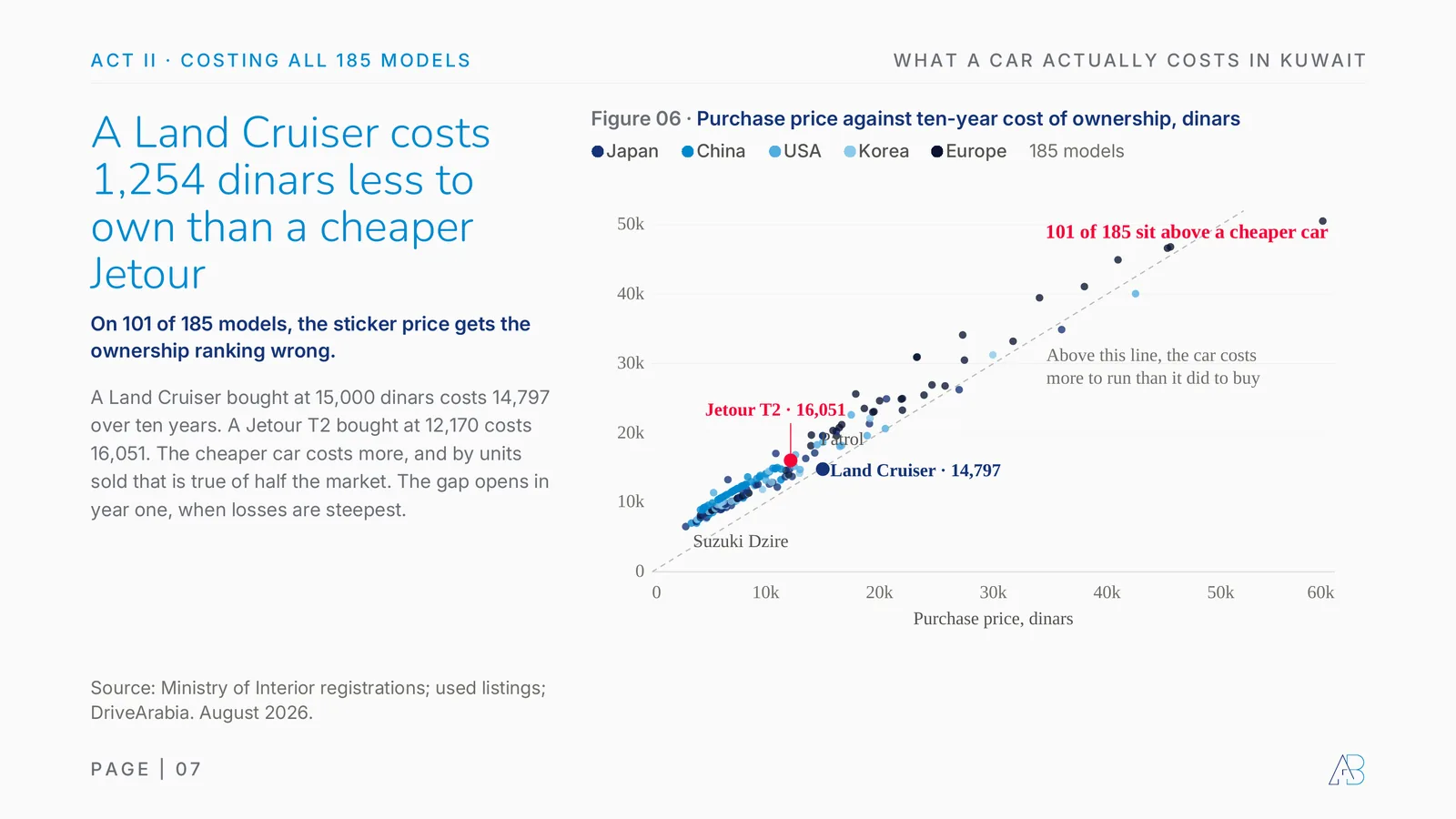
A Land Cruiser bought at 15,000 dinars costs 14,797 over ten years. A Jetour T2 bought at 12,170 costs 16,051. The gap opens in year one, when losses are steepest, and it never closes. In the study's own definition this is an inversion: a model that costs more to own than a car that costs more to buy.
The models that invert are not exotic. They are the compact and mid-size SUVs that make up the bulk of Kuwaiti registrations, which is why the unit-weighted share sits so close to half. The 2025 market study and the SUV piece cover what those segments are; this study prices them.
What changes when the money is not yours
Everything above assumes you paid cash, and that assumption does more work than it looks like it does.
A car that holds its value is money you are holding, and holding it has a cost, because that money is not somewhere else earning something. The Land Cruiser ties up 2,830 dinars more than the Jetour on day one and hands most of it back in year ten. The model as I first built it credited the Land Cruiser for the resale without charging it for the wait.
Charge it properly and the ranking moves.
- Cash: Land Cruiser 14,797, Jetour T2 16,051. Land Cruiser cheaper by 1,254. The dearer car wins on 101 of 185 models, 49 percent of units.
- 3 percent cost of capital: 15,676 against 15,634. Level. 85 of 185, 44 percent.
- 5 percent: 16,077 against 15,389. Jetour by 688. 73 of 185, 33 percent.
- 7 percent: 16,370 against 15,169. Jetour by 1,201. 47 of 185, 23 percent.
- 5 percent plus comprehensive cover: 18,505 against 16,392. Jetour by 2,113. 30 of 185, 16 percent.
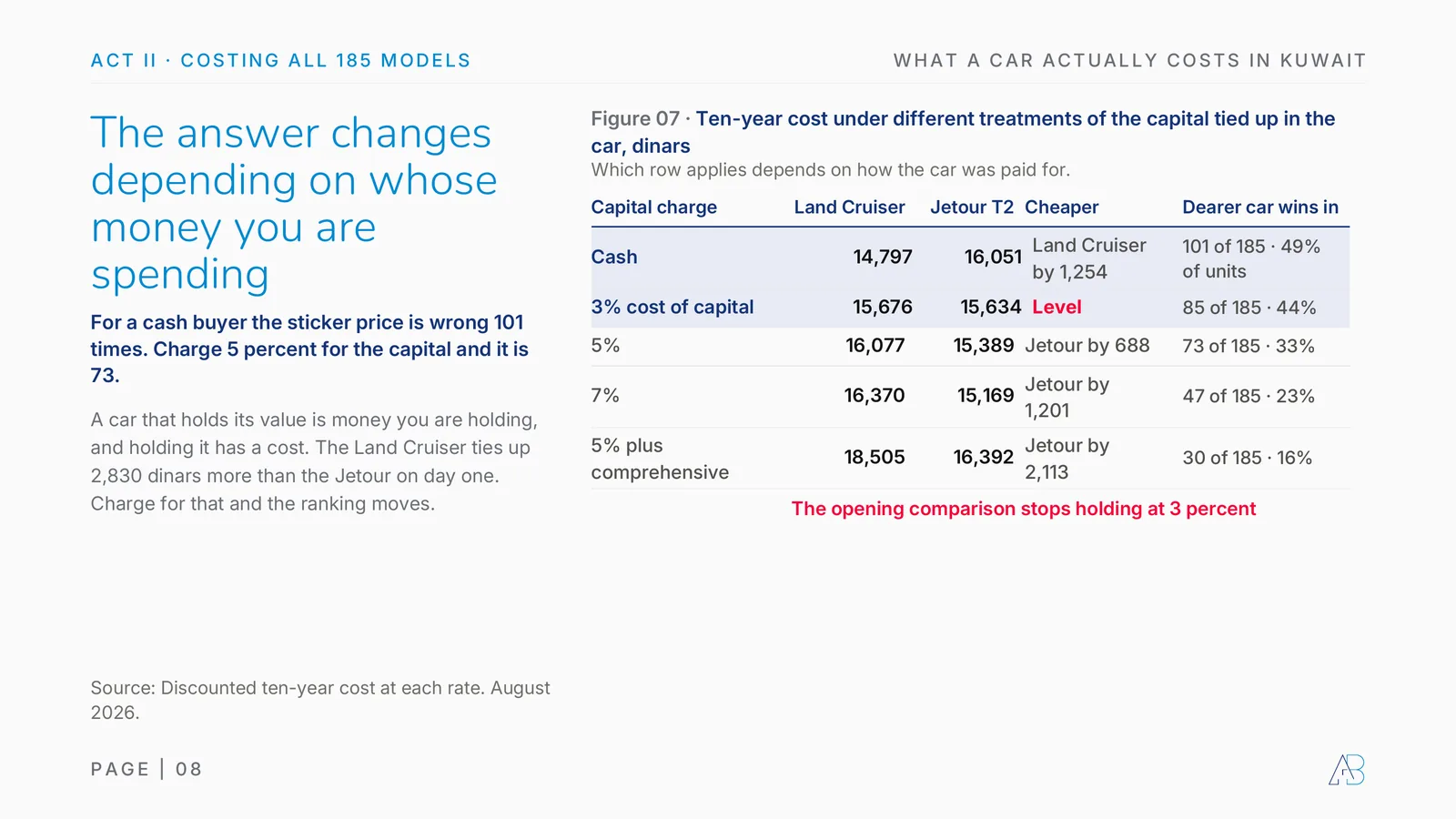
The comparison I led with holds only for a cash buyer. Somewhere around 3 percent it stops holding. That is not a footnote and I am not going to put it in one.
The sticker price gets the ownership ranking wrong for half the market if you pay cash, and about a third of it if you borrow at 5 percent.
What survives at every rate is smaller and more specific. Seventy-three models still invert at 5 percent, and a handful invert even at 7: a GMC Yukon beats a Porsche Macan by 3,279 dinars at that rate, and a Lexus LX beats a Cayenne by 2,682. Those are not the comparisons most Kuwaiti buyers are making, which is itself worth knowing. The mainstream reversals are the ones that depend on paying cash.
Two things the table does not do. It does not model an actual Kuwaiti car loan, where the structure and the deposit change the arithmetic again. And I have no data on how many Kuwaiti buyers pay cash, so I cannot tell you which row describes the market. I can only tell you which row describes you.
Two cars at the same price, 8,000 dinars apart
Put two cars side by side at the same price and the only thing left to compare is what happens after you drive away.
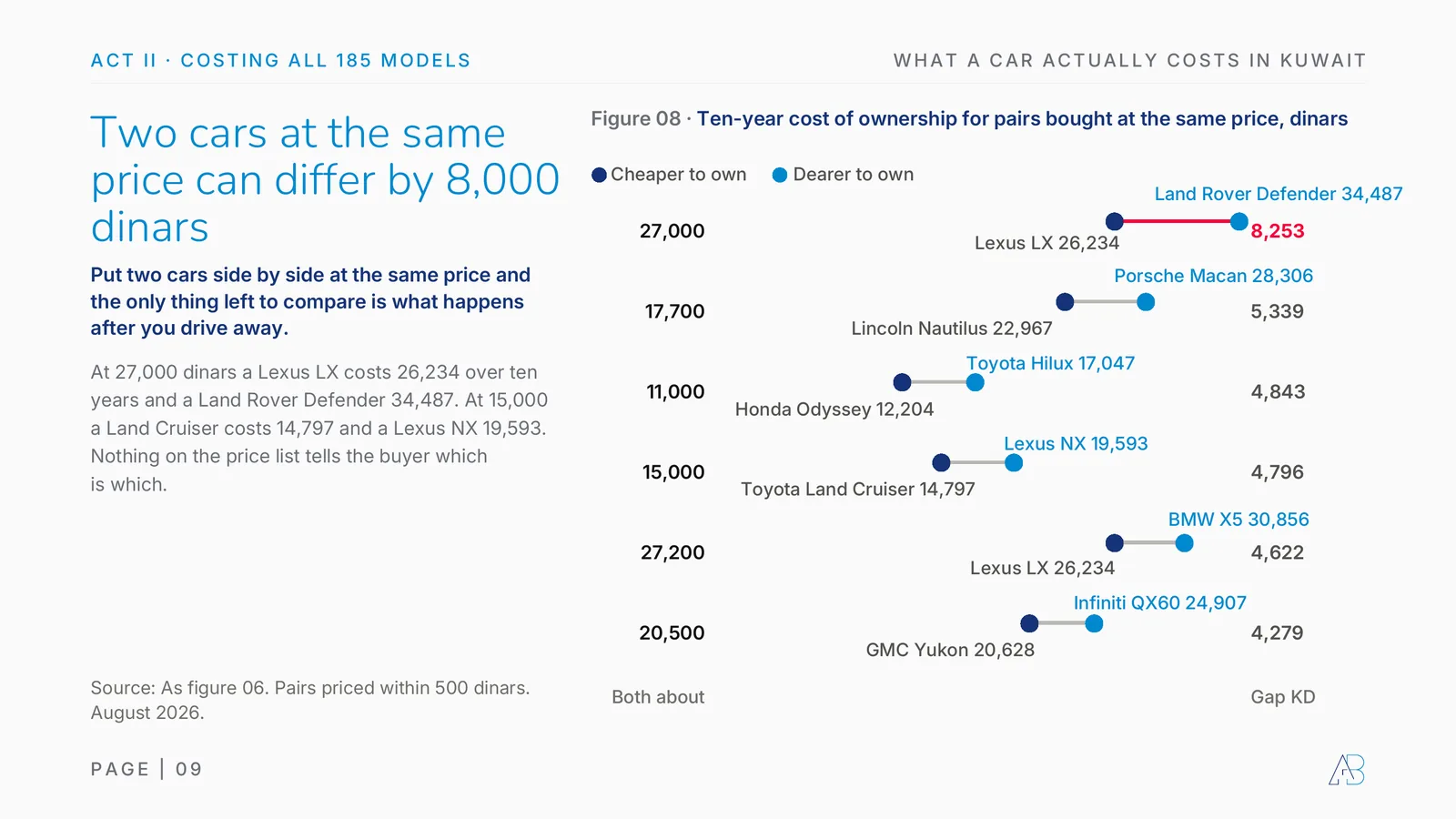
At 27,000 dinars a Lexus LX costs 26,234 over ten years and a Land Rover Defender 34,487. At 15,000 a Land Cruiser costs 14,797 and a Lexus NX 19,593. At 11,000 a Honda Odyssey costs 12,204 and a Toyota Hilux 17,047. Nothing on the price list tells the buyer which is which.
Widen the lens to whole budget bands and the spread grows with the budget.
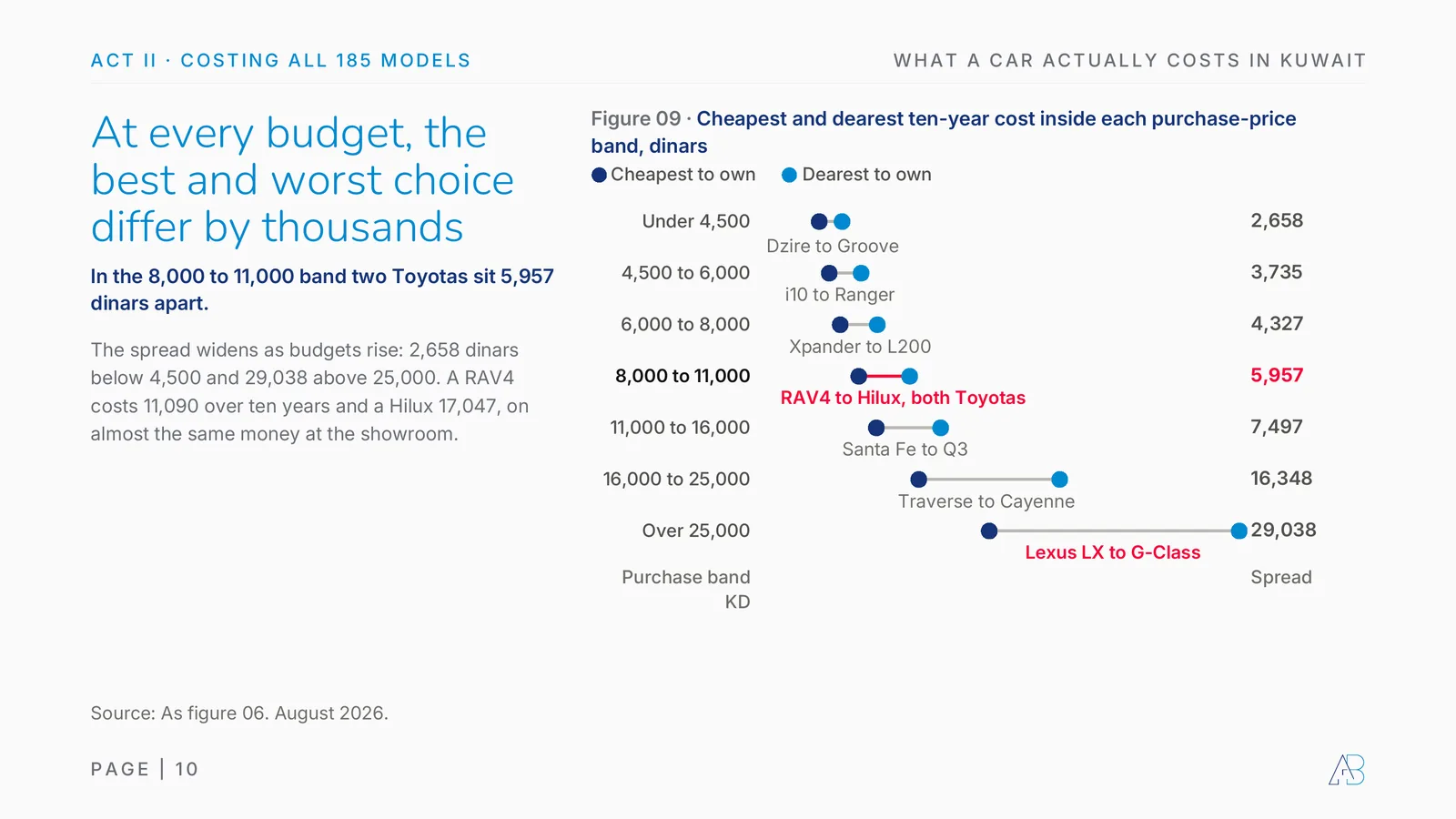
Below 4,500 dinars the best and worst choice differ by 2,658 over ten years. Above 25,000 they differ by 29,038. In the 8,000 to 11,000 band, where a large part of Kuwait shops, a RAV4 costs 11,090 over ten years and a Hilux 17,047, on almost the same money at the showroom. Both are Toyotas.
The cheapest and dearest cars to own in Kuwait
The cheapest car to own in Kuwait is a Suzuki Dzire, at 6,506 dinars over ten years, or 54 dinars a month, or 39 fils a kilometre. The cheapest twelve all sit between 6,500 and 8,300 dinars.
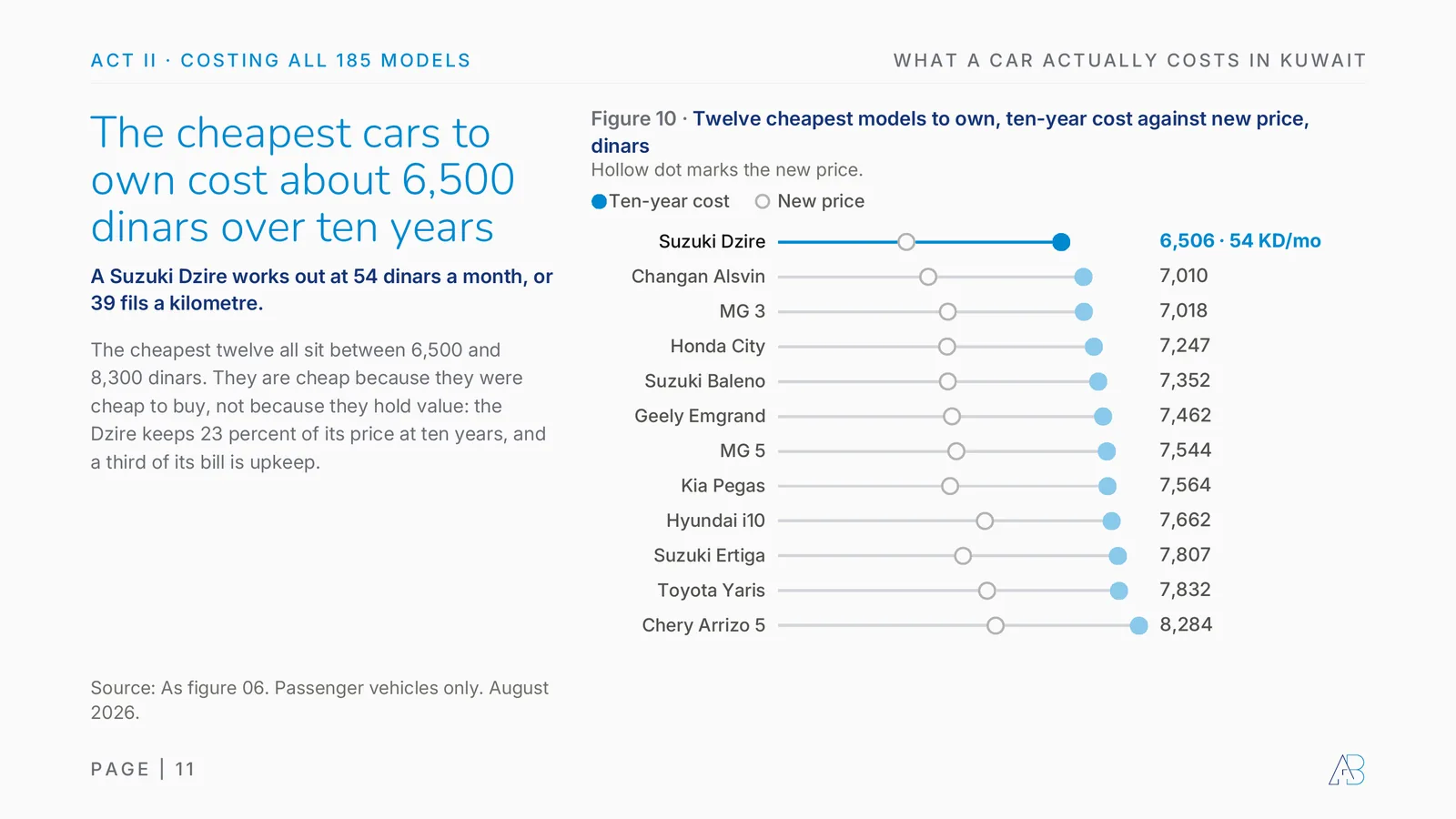
They are cheap because they were cheap to buy, not because they hold value. The Dzire keeps 23 percent of its price at ten years, and a third of its bill is upkeep. Cheap to own and slow to depreciate are different lists, and the Dzire is on the first one only.
At the other end, a Mercedes G-Class loses more value in ten years than any of the cheapest twenty cars cost in total. It costs 55,272 to own, and 37,428 of that is value gone.
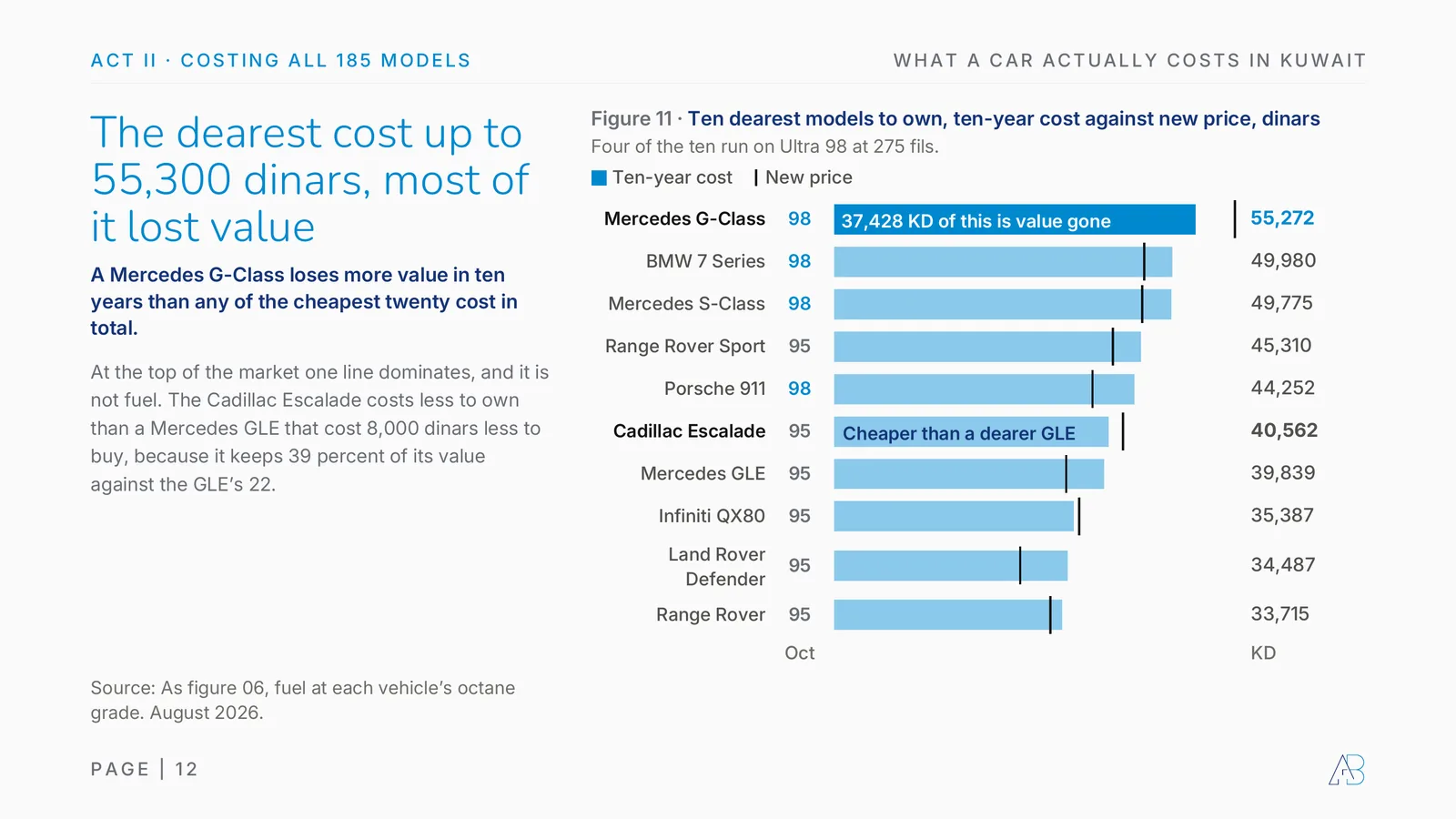
At the top of the market one line dominates, and it is not fuel. The Cadillac Escalade costs less to own than a Mercedes GLE that cost 8,000 dinars less to buy, because it keeps 39 percent of its value against the GLE's 22.
Depreciation, from negative to 30 percent a year
Every other cost sits in a narrow band. This one runs from cars advertised above their new price to cars losing nearly a third of their value a year.
Every buyer knows a car loses value the moment it leaves the showroom. For one group of vehicles in Kuwait, that is simply false. Two-year-old Toyota Prados are advertised at about 115 percent of that model year's published starting price. Four-year-old ones at 101 percent. Asking prices cross back under the starting price around year five, then fall so gently that a ten-year-old Prado is advertised at 61 percent of what it listed for new, 52 percent once the study's transaction adjustment is applied. At eighteen it still holds 24.
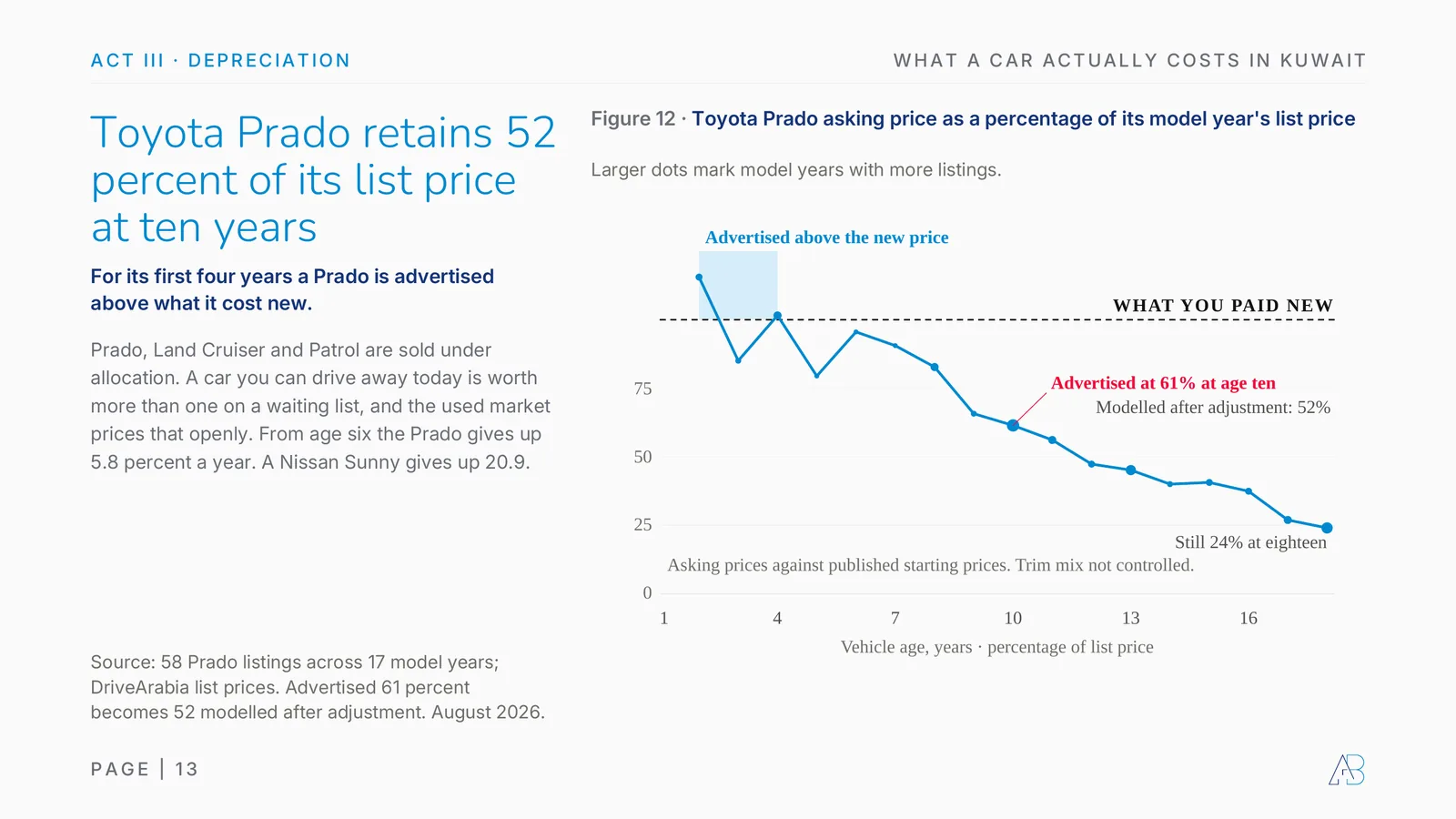
One thing to be careful about, because it is the number a dealer would go after first. The denominator is the published starting price for that model year, and a Prado is not one product. If the cars that survive into the used market skew toward higher grades, some of that apparent appreciation is trim, not scarcity. I match model and model year; I cannot match engine and grade, because Kuwait's historical price data is published at starting-price level only.
What is not in doubt is the direction, and there is a reason for it. These models are sold under allocation. Dealer waiting lists run to months, and a car that exists today is worth more than one ordered for delivery in the spring.
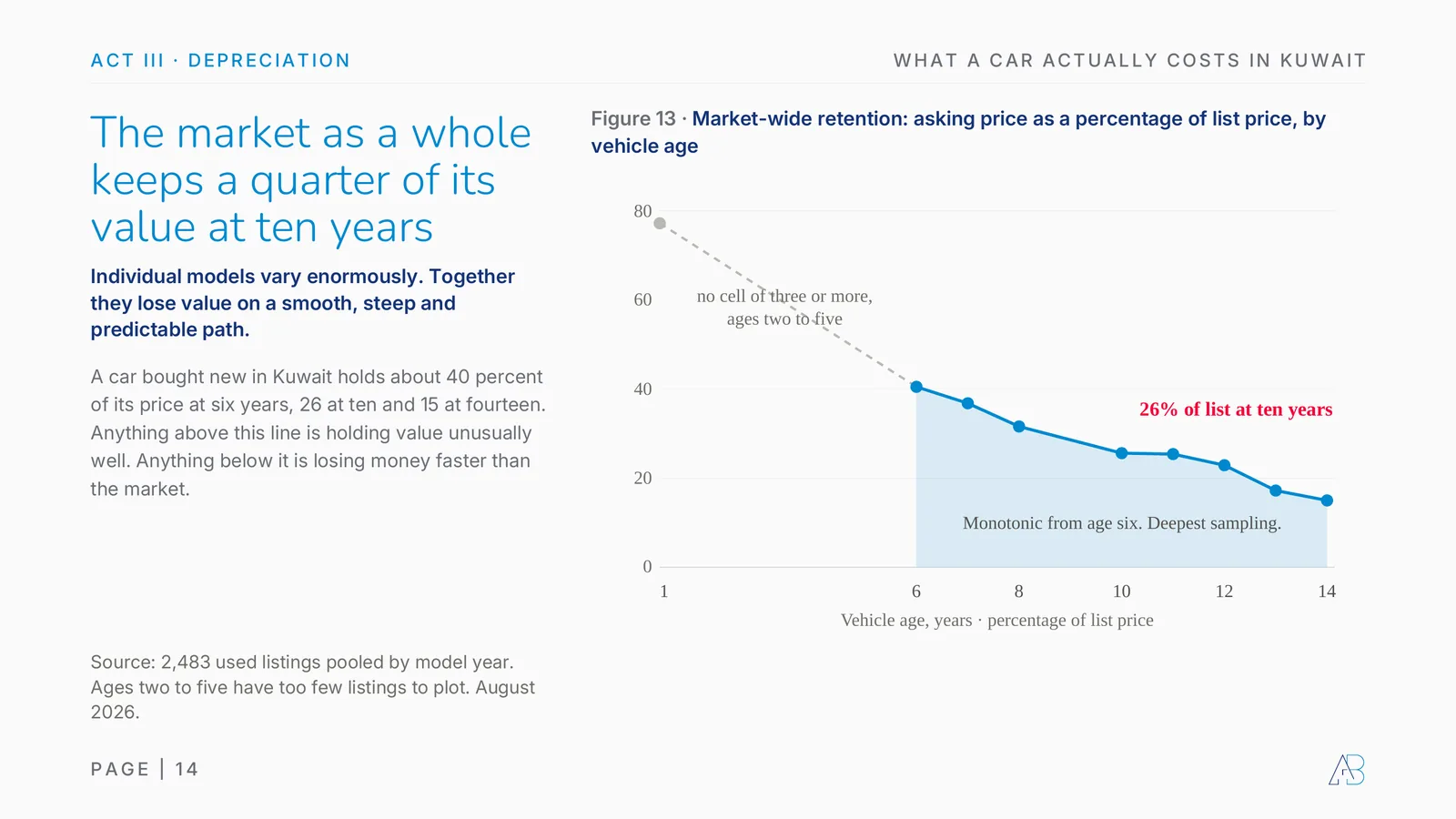
The market as a whole is steeper and smoother. A car bought new in Kuwait holds about 40 percent of its price at six years, 26 at ten and 15 at fourteen. Anything above that line is holding value unusually well.
Then the two tails. The slowest-depreciating cars in Kuwait lose 7 to 11 percent a year, and the list is not what a showroom would predict.
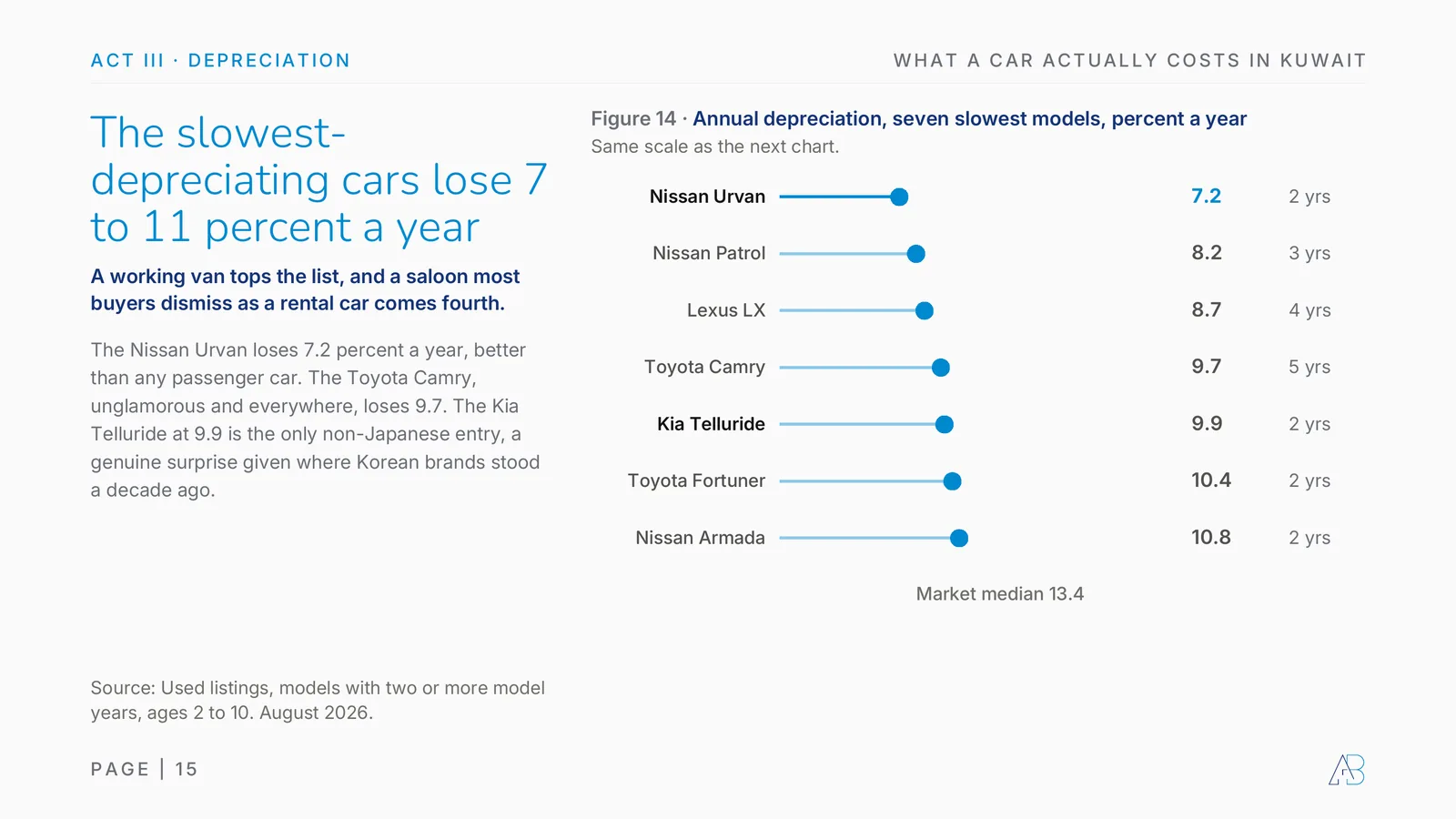
The Nissan Urvan loses 7.2 percent a year, better than any passenger car. The Toyota Camry, unglamorous and everywhere, loses 9.7. The Kia Telluride at 9.9 is the only non-Japanese entry, a surprise given where Korean brands stood in Kuwait a decade ago.
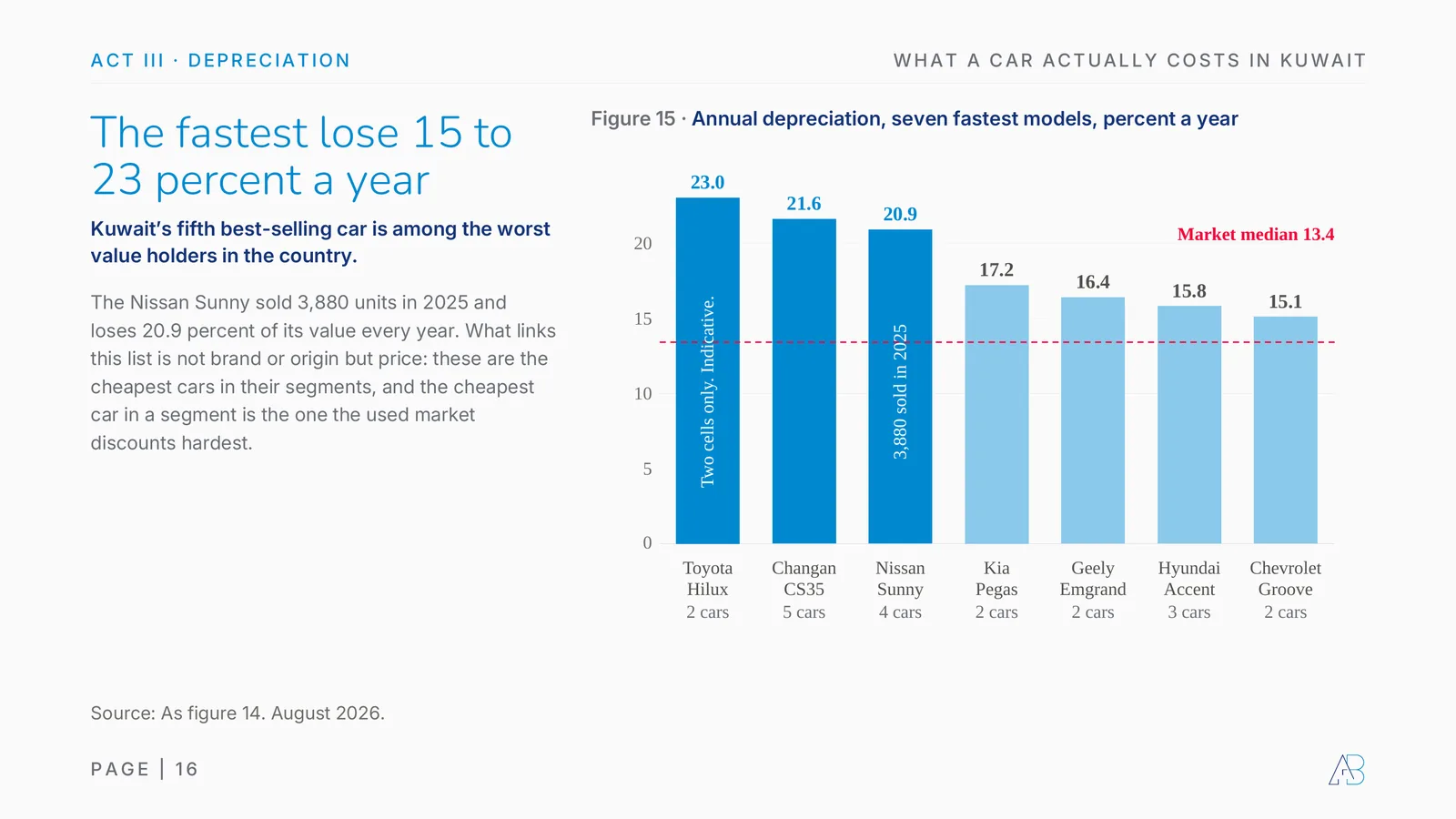
The Nissan Sunny sold 3,880 units in 2025, fifth in the country, and loses 20.9 percent of its value every year. What links this list is not brand or origin but price: these are the cheapest cars in their segments, and the cheapest car in a segment is the one the used market discounts hardest.
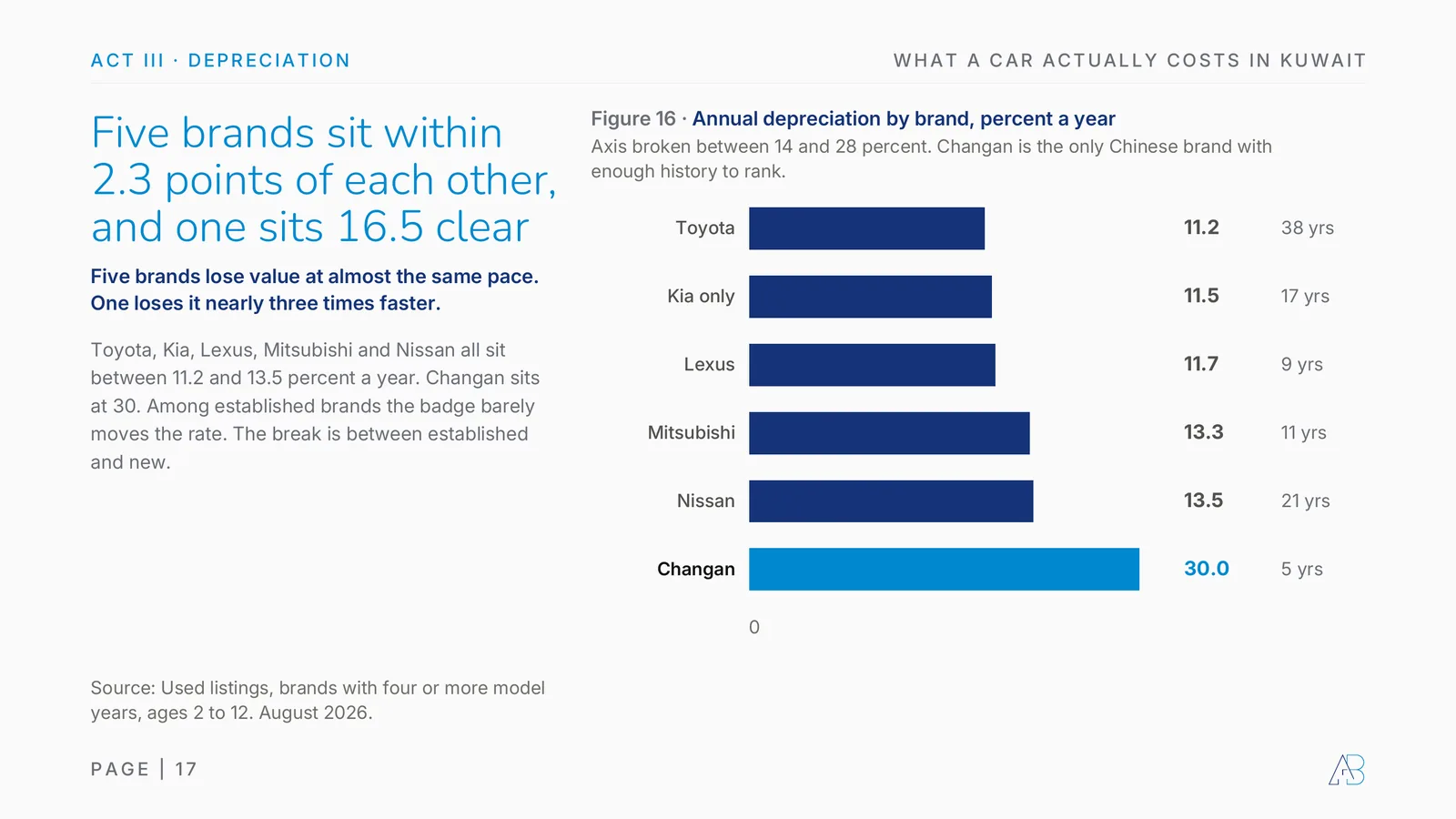
By brand, the established names barely differ from one another. Toyota, Kia, Lexus, Mitsubishi and Nissan all sit between 11.2 and 13.5 percent a year. Changan sits at 30. Among established brands the badge barely moves the rate; the break is between established and new.
What the odometer does to a price
Old cars are advertised 8.7 times below new. High-mileage cars, 3.7 times. Old cars also have high mileage, so neither number isolates its own cause; both fall steeply, and age falls further. Age is the one thing no owner can manage, which is why the decision that matters most is made on the day of purchase.
Hold the badge constant and the odometer becomes a confidence test.
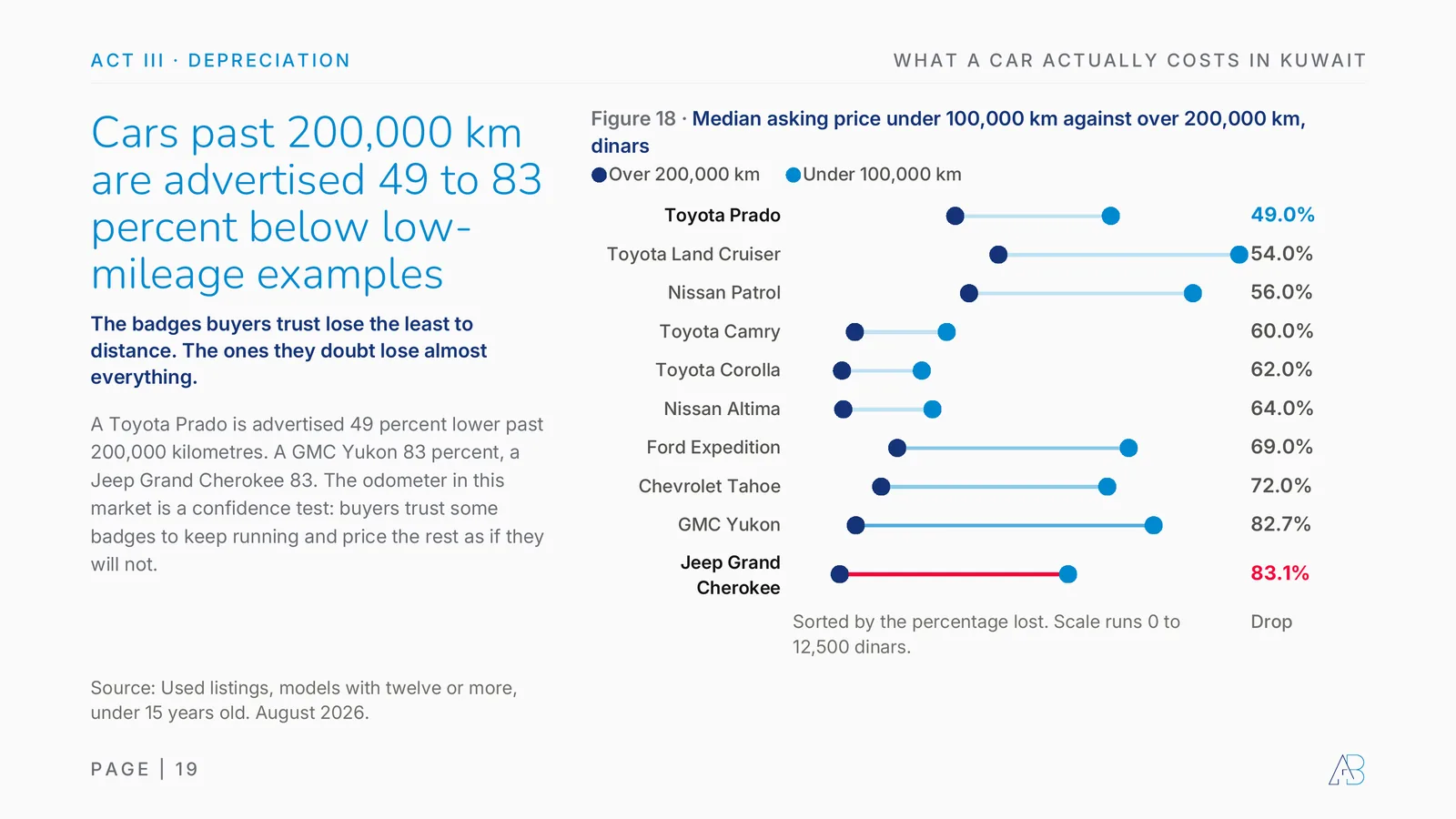
A Toyota Prado is advertised 49 percent lower past 200,000 kilometres. A GMC Yukon 83 percent, a Jeep Grand Cherokee 83. Buyers trust some badges to keep running and price the rest as if they will not.
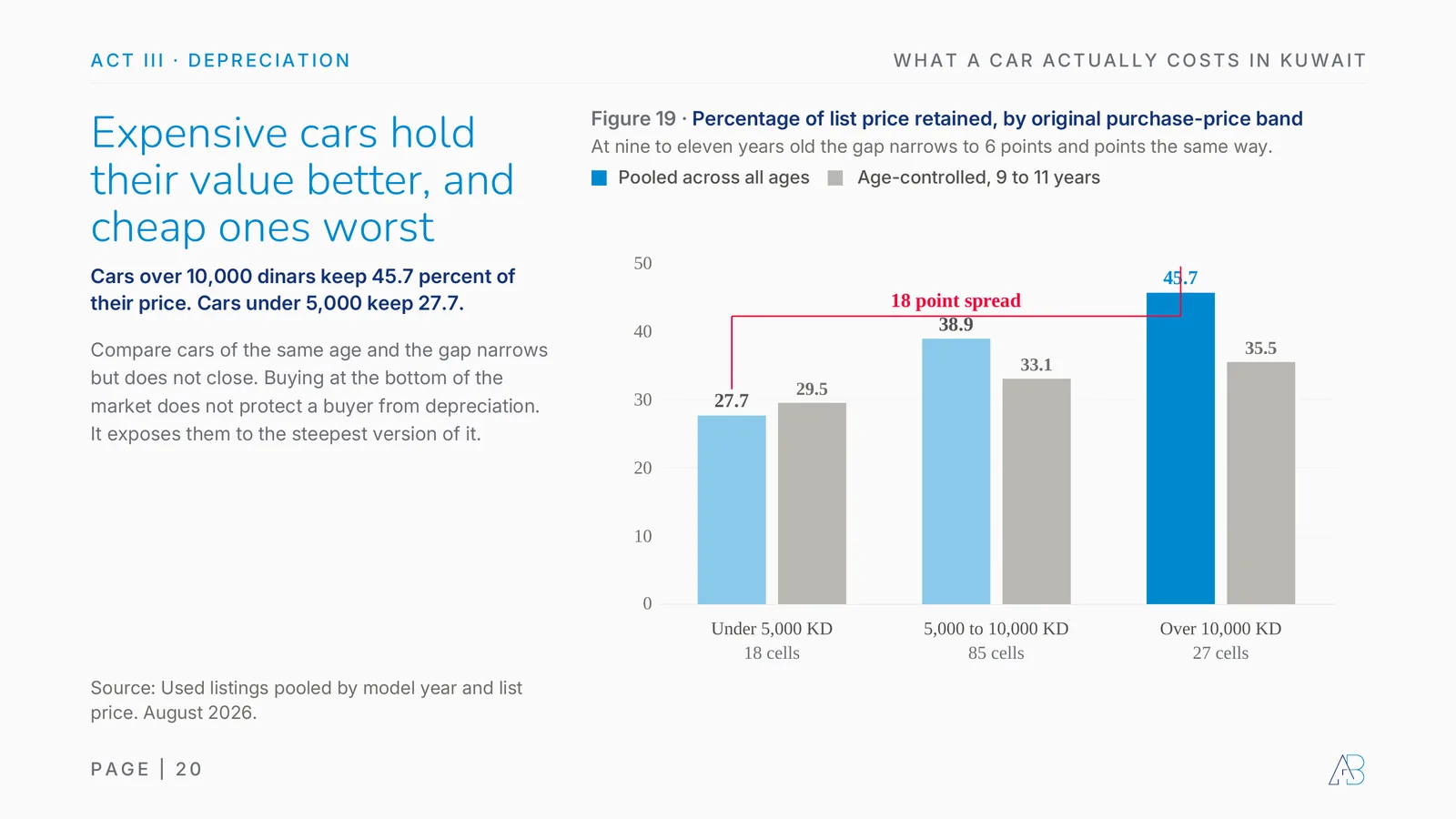
Price does the same thing in the other direction. Pooled across all ages, cars listing under 5,000 dinars new keep 27.7 percent of their price and cars over 10,000 keep 45.7. Age is doing some of that work, since dearer cars survive longer in the listings, so hold age constant: among nine-to-eleven-year-old vehicles the cheapest keep 29.5 percent and the dearest 35.5. The gap narrows to six points and points the same way.
The Chinese discount, in one calculation
Chinese brands took a quarter of the Kuwaiti market in under five years, and they did it on price. The price advantage is real. It is also much smaller than the reputation suggests, and it does not survive contact with resale value.
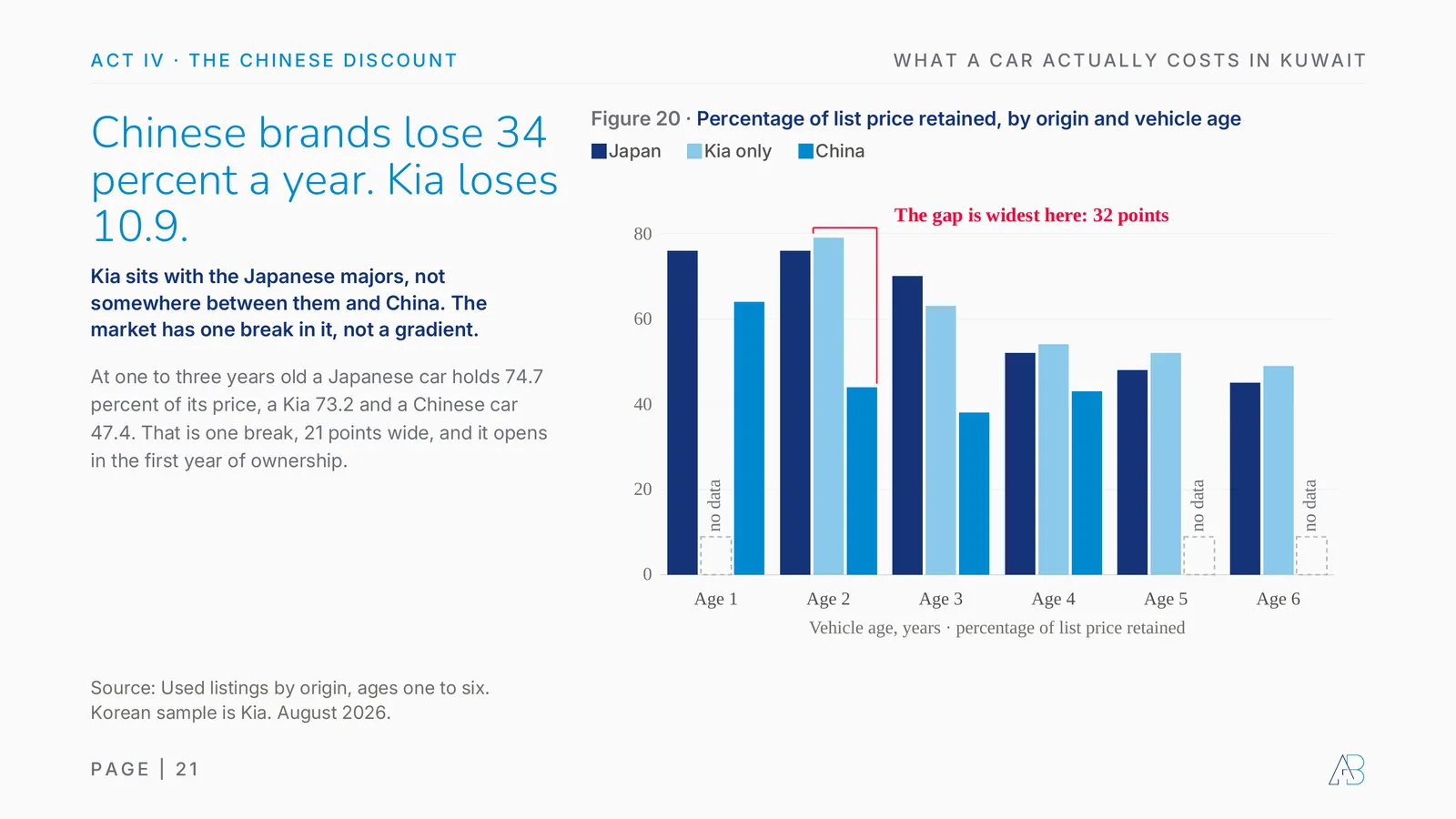
At one to three years old a Japanese car holds 74.7 percent of its price, a Kia 73.2 and a Chinese car 47.4. That is one break, 21 points wide, and it opens in the first year of ownership. Kia sits with the Japanese majors, not somewhere between them and China. The market has one break in it, not a gradient.
Compare same-segment, which is the only comparison that means anything. A Chinese compact SUV lists at a median 6,174 dinars against 6,950 for a Japanese one, an 11.2 percent discount. Chinese compact SUVs in this dataset lose 33.1 percent of their value a year against 12.2 for the Japanese ones. Hold both three years and the Chinese owner has lost 4,464 dinars of value against the Japanese owner's 2,599. The 776 saved at the showroom is repaid two and a half times over before the car turns three.
Mid-size SUVs are closer. The discount is 8.9 percent, the annual rates are 21.0 against 13.6, and the three-year depreciation gap is 857 dinars.
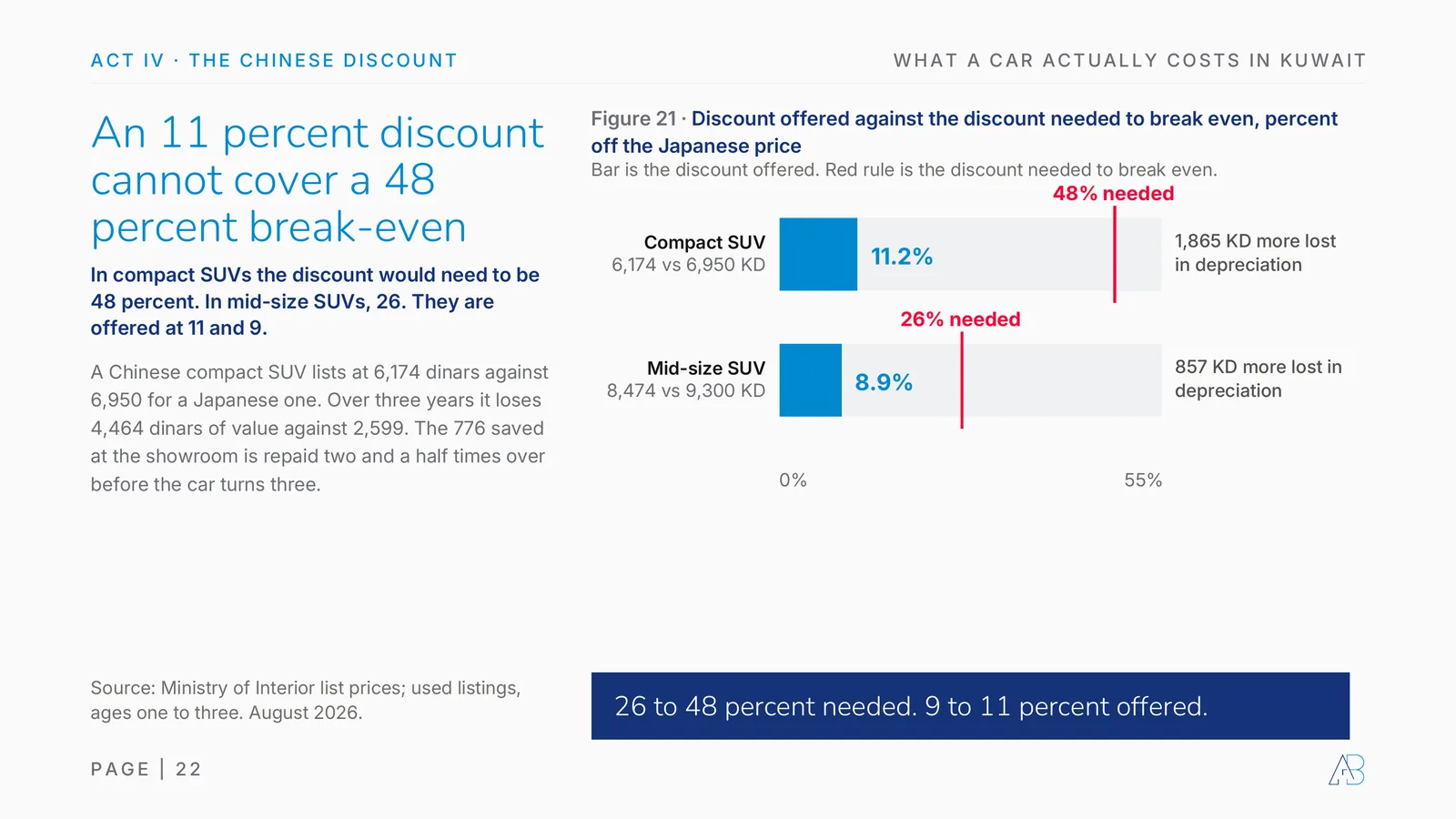
Run it backwards and ask how large the discount would need to be for the trade to break even on depreciation alone. In compact SUVs it is 48 percent. In mid-size SUVs it is 26. The discounts actually offered are 11.2 and 8.9.
An 11 percent discount cannot cover a 21-point gap in annual depreciation.
Chinese cars have been sold in Kuwait since well before this decade; what changed in the early 2020s was the pace. The 2024 GCC rankings show how fast the volume came. The discount that carried it has narrowed as the brands gained confidence, and it is now past the point where the arithmetic works for the buyer. For a dealer or importer weighing a Chinese franchise, that resale gap is the first number a feasibility study has to clear, before the showroom, the stock and the fit-out.
Averaged across everything sold, a Chinese car costs 157 percent of its purchase price to own over ten years. A Japanese car costs 128. The average Chinese car cost 7,266 dinars to buy and will cost 11,407 to own; the average Japanese car cost 9,711 and will cost 12,471. The Japanese car costs 2,445 more to buy and only 1,064 more to own. Most of the price gap comes back at resale.
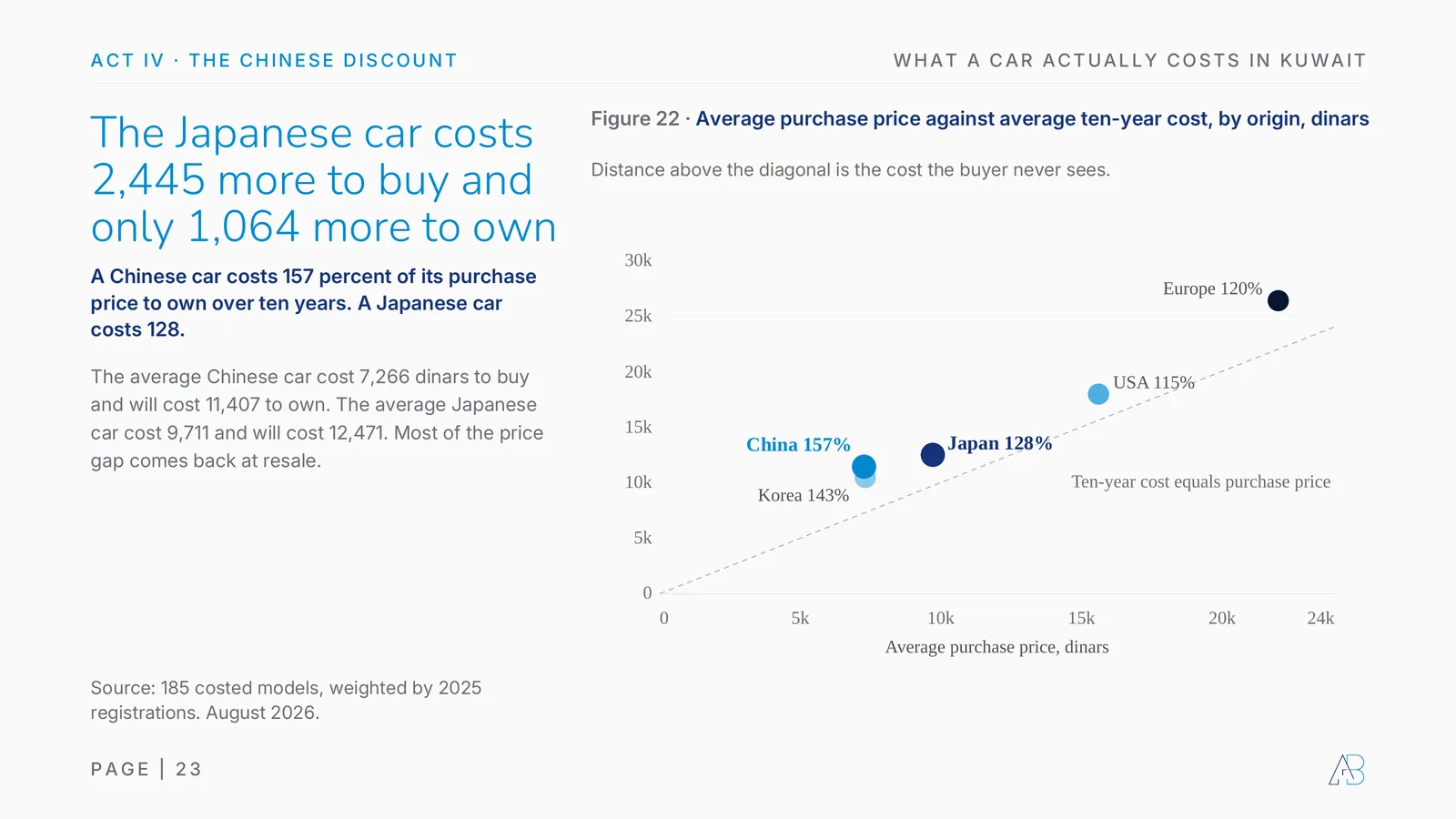
One result worth publishing because it is negative. Sales volume shows no relationship to resale value. Models selling under 600 units a year depreciate at a median 13.4 percent; models selling 600 or more depreciate at 14.0. Six tenths of a point, inside the noise. The Kia Telluride at 2,100 units a year sits at 9.9 percent; the Nissan Sunny at 3,880 sits at 20.9. Popularity does not protect a car.
Who the cost falls on
Kuwaiti households spent 4,139 dinars a month in 2021 and non-Kuwaiti households 1,071, per the Central Statistical Bureau's Household Income and Expenditure Survey. A Nissan Patrol at 143 dinars a month is 3.4 percent of the first and 13.3 percent of the second.
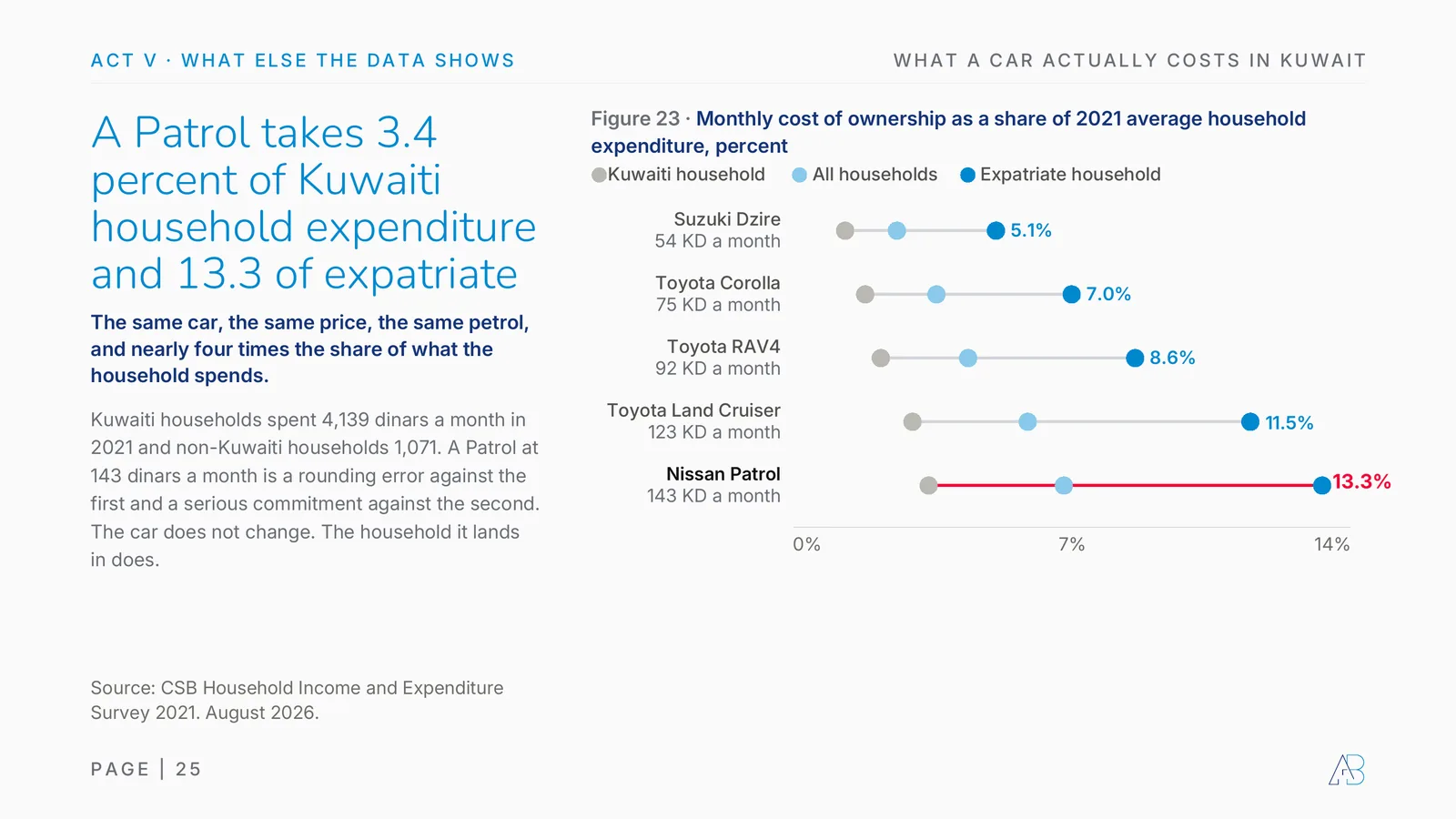
The car does not change. The household it lands in does. I have no data on who owns which car, so I will not claim this meets the earlier finding on cheap cars and steep depreciation. But buying down does not protect anyone from depreciation. It costs a larger fraction of a smaller number.
For what a car does to a Kuwaiti household over a lifetime rather than a decade, The Kuwaiti Dream, Priced puts it beside the house, the school fees and everything else.
Five used cars change hands for every new one
Kuwait sold 130,288 new vehicles in 2024. In the same year the Ministry of Interior processed 571,987 changes of ownership. Across 2019 to 2024 that is 655,200 new vehicles against 3.25 million transfers, never below 4.3 transfers per sale in any year, including 2020.
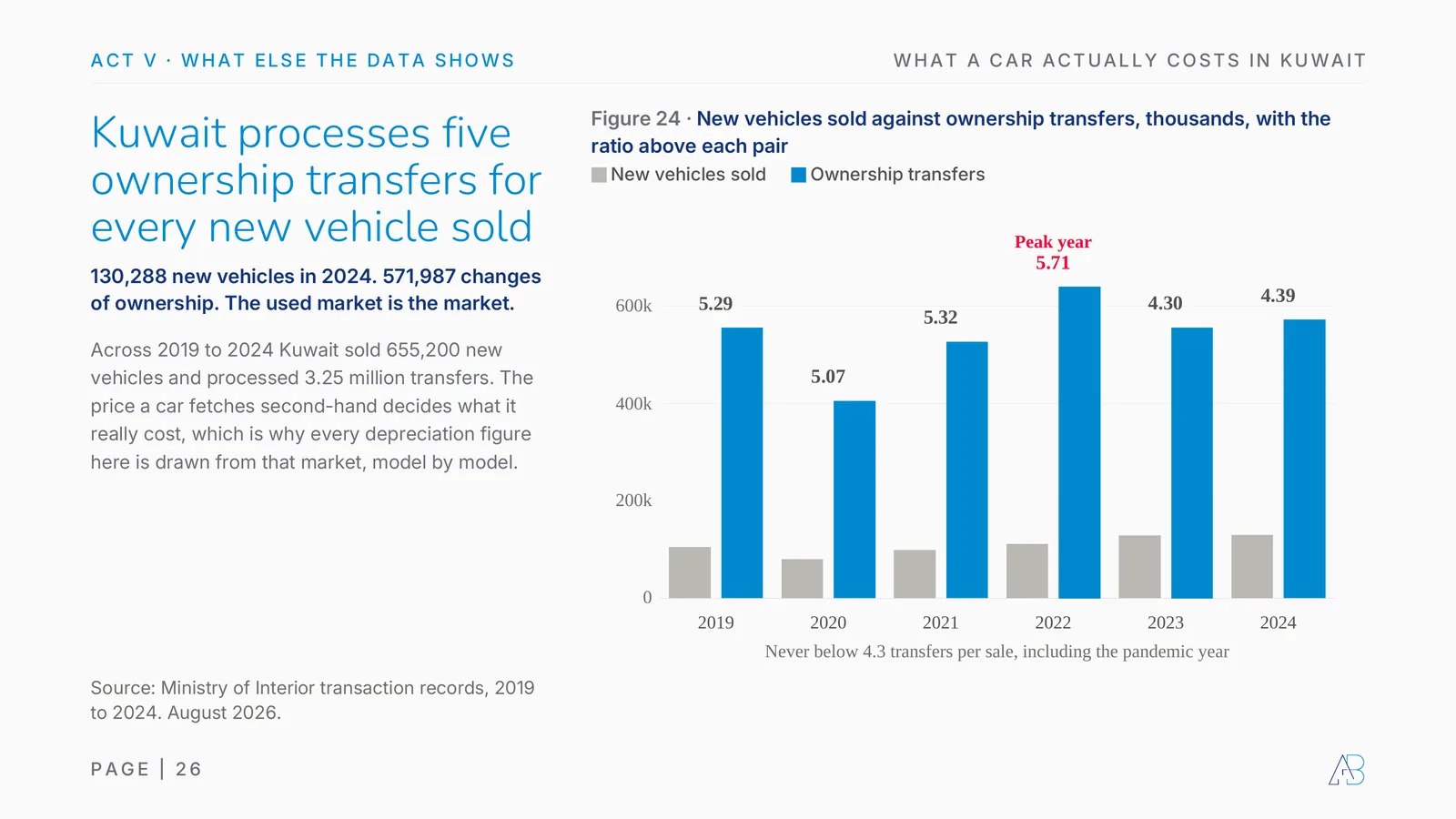
The price a car fetches second-hand decides what it really cost, which is why every depreciation figure here is drawn from that market, model by model. New and used sales rise and fall together across the six years, with a correlation of 0.73; a record year for new cars, like 2025, is a strong year for the used market too.
What the used market mostly contains is cheap, old cars. Of the 2,483 listings I collected, 1,434 are priced under 2,000 dinars and their median age is 15 years.
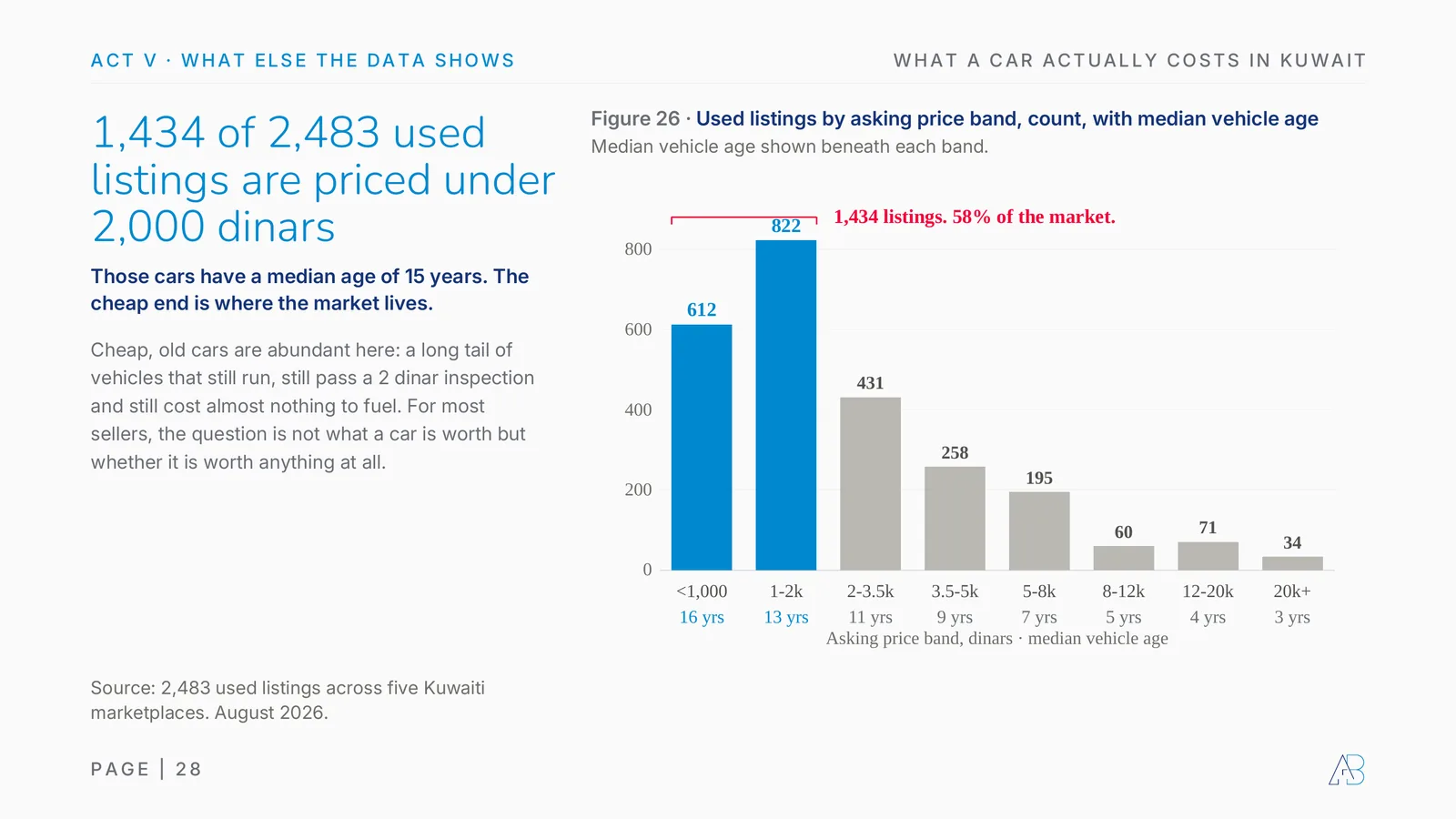
Petrol at 85 fils and a 2 dinar inspection keep a fifteen-year-old car viable long past the point where a market with real running costs would have retired it. For most sellers the question is not what a car is worth but whether it is worth anything at all.
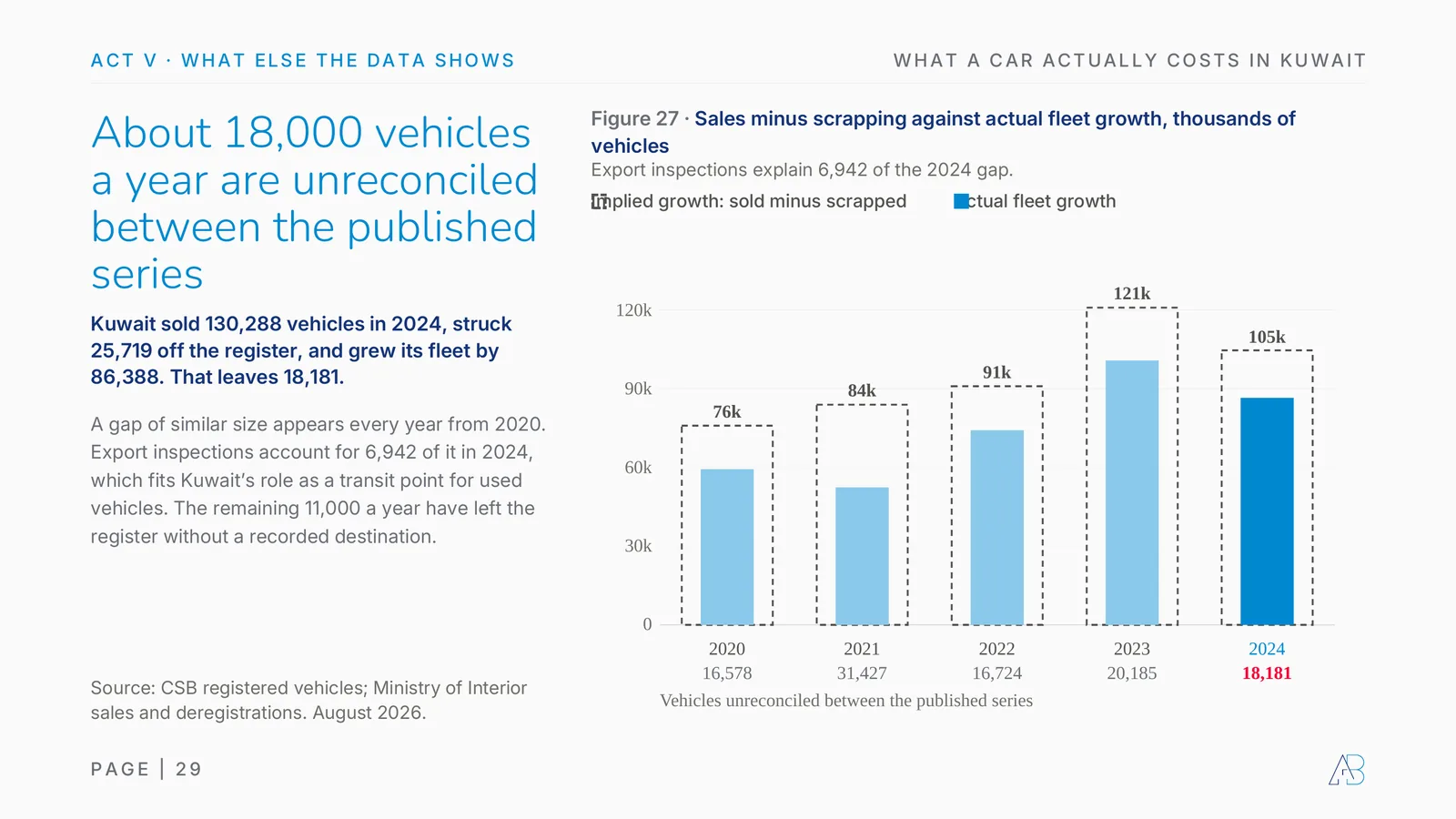
One gap in the public series belongs here. Kuwait sold 130,288 vehicles in 2024, struck 25,719 off the register, and grew its fleet by 86,388. That leaves 18,181 vehicles unaccounted for, and a gap of similar size appears every year from 2020. Export inspections explain 6,942 of the 2024 figure, which fits Kuwait's role as a transit point for used vehicles. The remaining 11,000 or so a year have left the register without a recorded destination.
Where the money goes
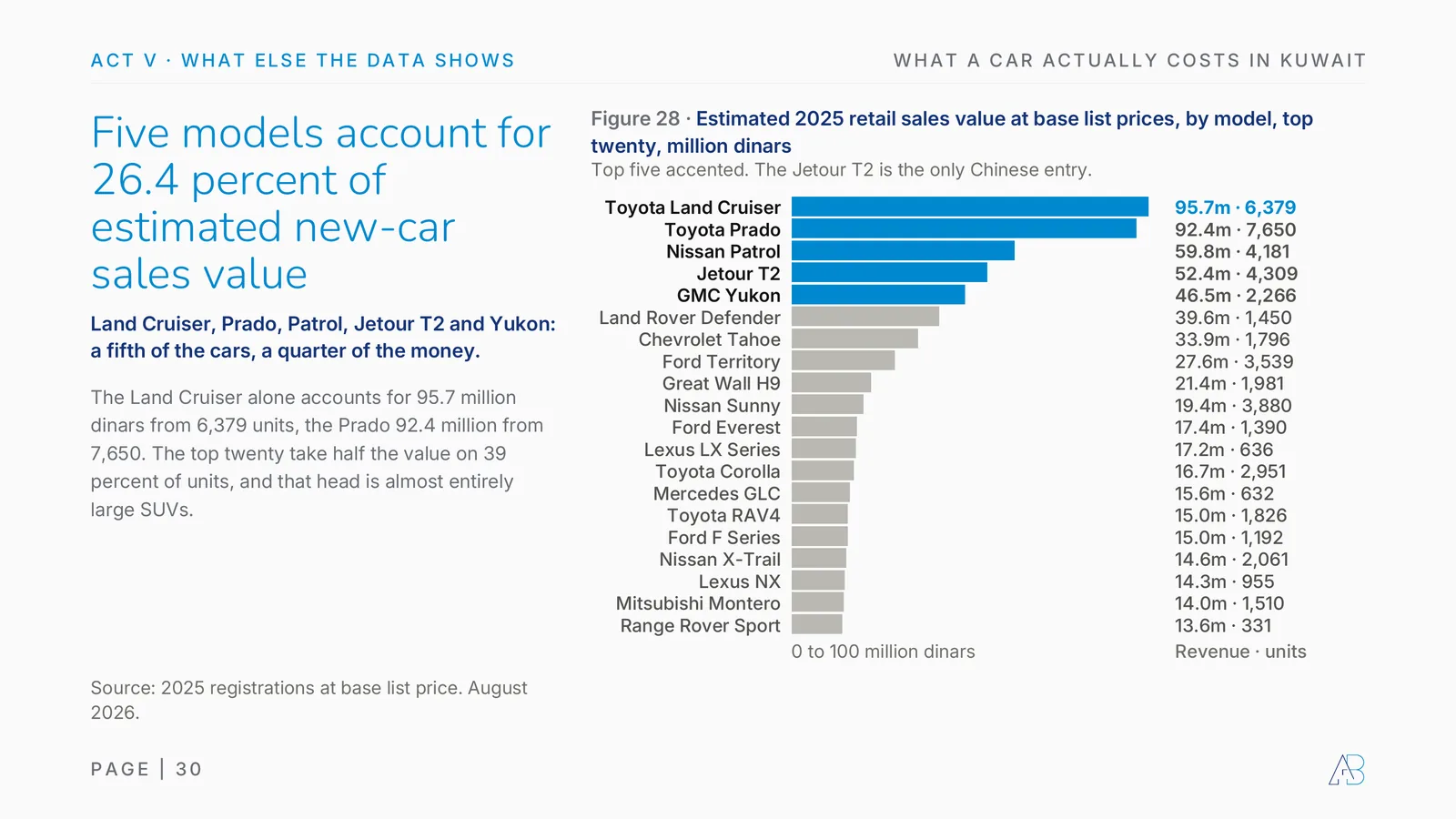
Kuwait reports its car market in units, because that is what is published. For the money moving through the market it is the wrong measure.
Five models account for 26.4 percent of estimated 2025 new-car sales value at base list price: Land Cruiser, Prado, Patrol, Jetour T2 and Yukon. A fifth of the cars, a quarter of the money. The Land Cruiser alone accounts for 95.7 million dinars from 6,379 units, the Prado 92.4 million from 7,650. The top twenty take half the value on 39 percent of units, and that head is almost entirely large SUVs.
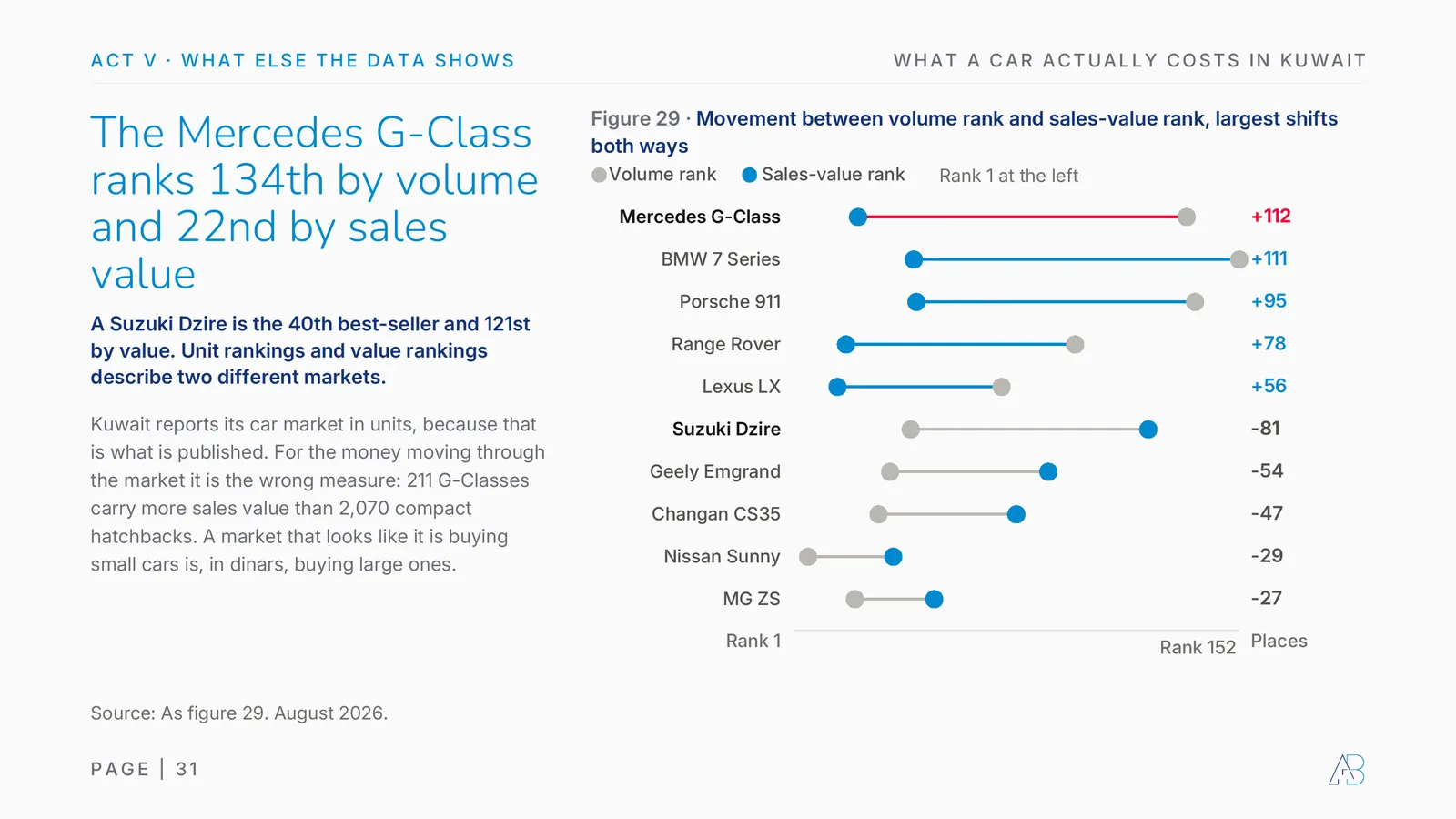
The Mercedes G-Class ranks 134th by volume and 22nd by sales value. A Suzuki Dzire is the 40th best-seller and 121st by value. 211 G-Classes carry more sales value than 2,070 compact hatchbacks. A market that looks like it is buying small cars is, in dinars, buying large ones.
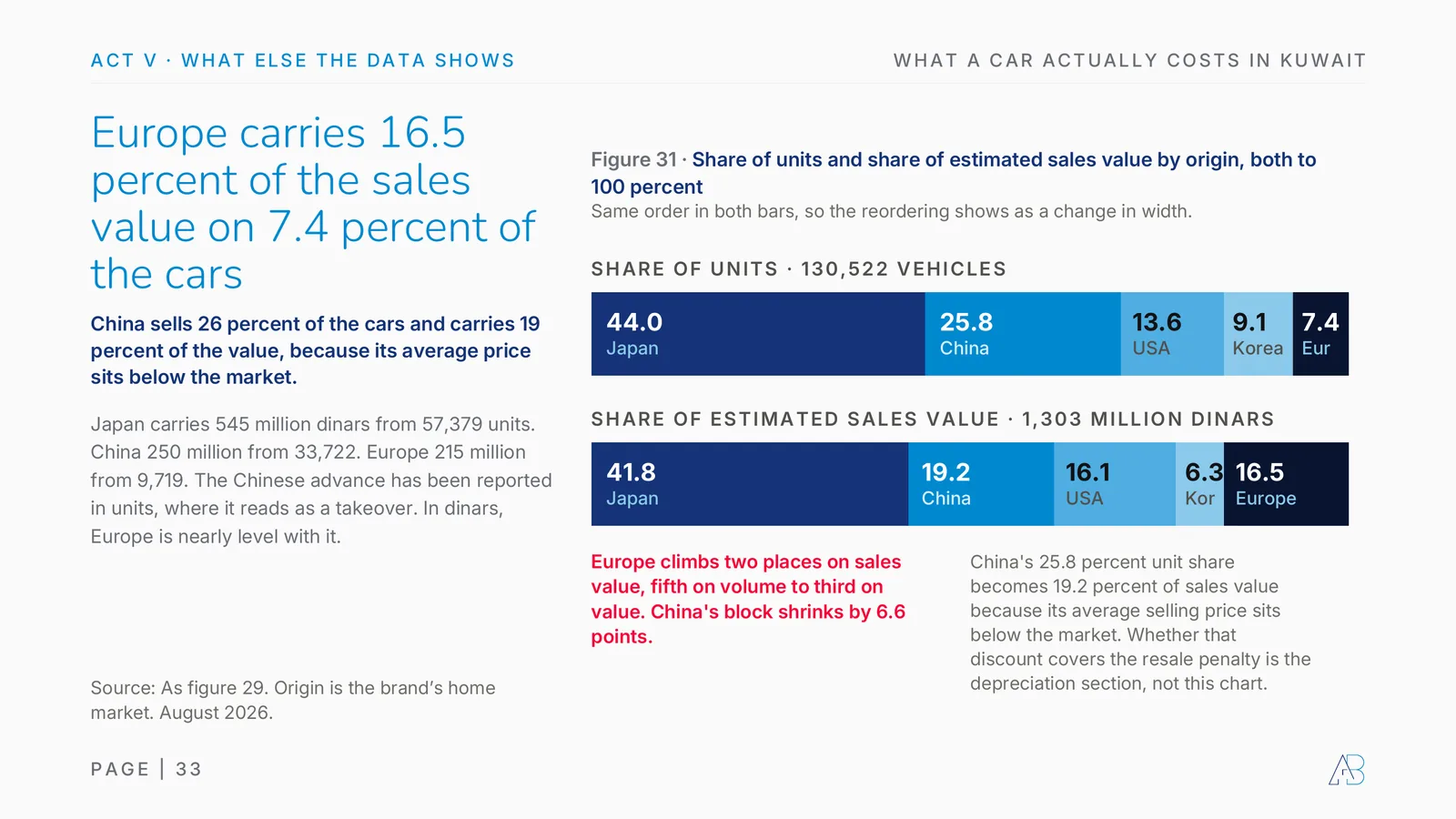
The same reordering applies by origin. Japan carries 545 million dinars from 57,379 units. China 250 million from 33,722. Europe 215 million from 9,719. The Chinese advance has been reported in units, where it reads as a takeover; in dinars, Europe is nearly level with it. China's 25.8 percent unit share becomes 19.2 percent of sales value because its average price sits below the market. Whether that discount covers the resale penalty is the section above, not this chart.
SUVs take 69 percent of what Kuwait spends on new cars, and 69 percent of what it loses owning them. A dealer plan built on unit counts misprices its own showroom; the value ranking is the one a business model has to be built on.
The roads underneath all of it
There is a second thing sitting behind the cost of ownership, and it is worth stating without a theory attached.
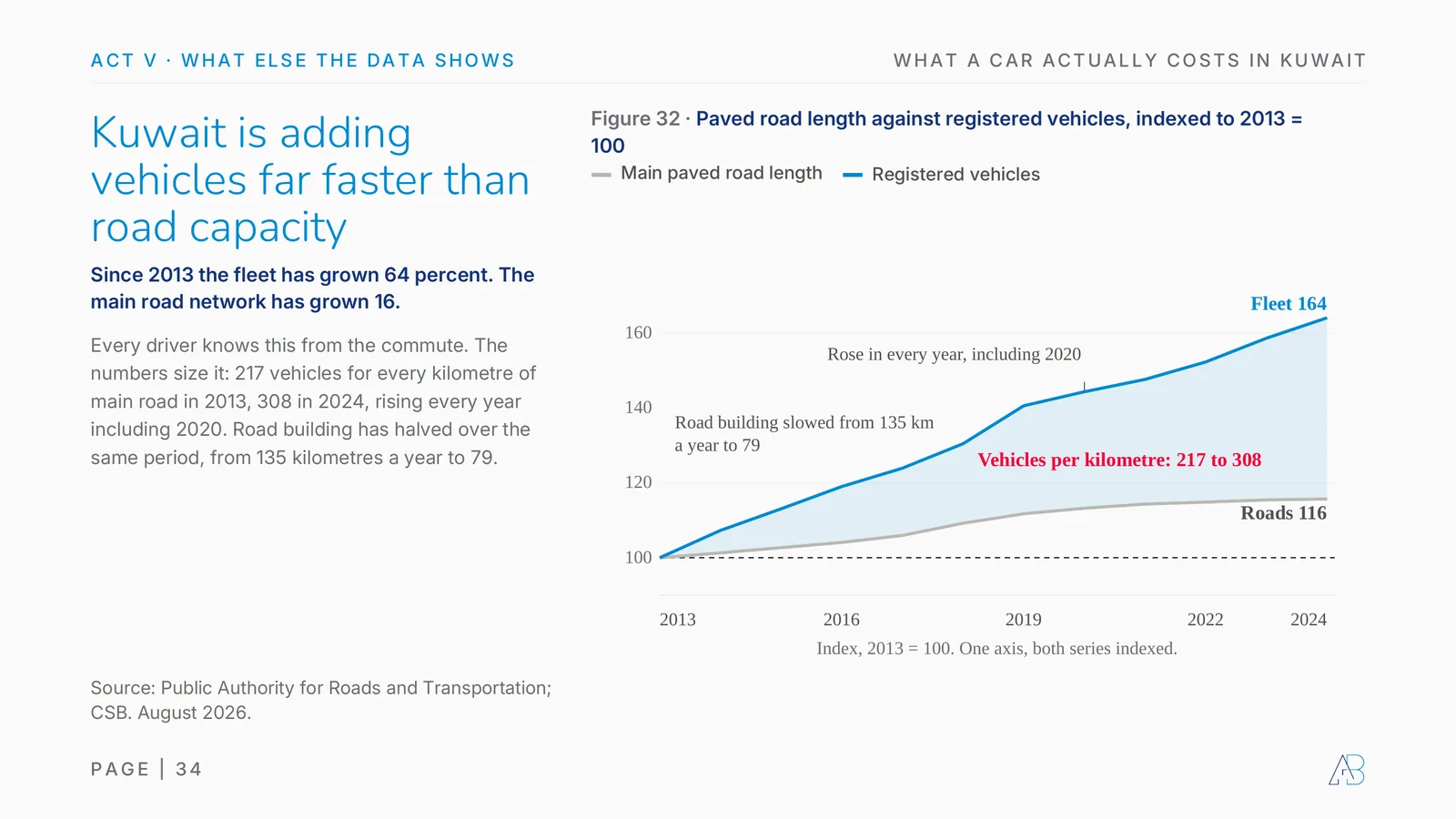
Kuwait has been adding vehicles far faster than it has been adding main-road capacity. Index both to 2013 and by 2024 the fleet stands at 164 and the main road network at 116. Vehicle density on that network went from 217 per kilometre to 308, and it rose in every year of the series, including 2020. Road building has halved over the same period, from 135 kilometres a year to 79.
What that does to how Kuwaitis choose, service and keep their cars is a reasonable question. This dataset cannot answer it. Nor does it cover the shock the market took in the spring: the March 2026 war and the Strait of Hormuz closure that followed pushed car imports overland through Jeddah, Sohar and Fujairah at higher freight and insurance cost. Kuwait Absorbed a War in March covers what the Central Bank data showed; the effect on dealer pricing sits outside a ten-year cost model and is left there.
What I would tell a buyer
None of this is hidden. The registration data is published. The used listings are public. The arithmetic is a subtraction.
What is missing is the habit of doing it. The purchase price is on the windscreen. The fuel figure is on the window sticker. The number that turns out to be larger than either is on neither, and the one input a buyer could check for themselves, how far they drive, is rarely measured before it is built into a decision.
Kuwait has spent a decade removing every variable cost from car ownership. One number is left, and it moves further than any other. A Toyota Prado keeps 52 percent of its list price at ten years and trades above list at four. A Nissan Sunny, the fifth best-selling car in the country, loses a fifth of its value every year. Between those two sit 185 models whose ten-year cost ranks nothing like their price.
The practical version fits in a sentence.
Before you sign, ask what the car will be worth in five years, and treat that answer as part of the price.
For a cash buyer that question reverses the ranking on 101 of the 185 models I costed, about half of everything Kuwait bought last year. Borrow the money at 5 percent and it still reverses 73 of them. Either way it is worth asking, and almost nobody does.
For a dealership the same number cuts the other way. Resale is where the automotive customer journey leaks: the trade-in valuation is the moment a buyer discovers what the car was worth, and it is the moment most Kuwaiti dealers lose the second sale.
Common questions, answered with the numbers
How much does it cost to own a car in Kuwait?
Between 6,506 dinars and 55,272 over ten years, on 16,666 kilometres a year, depending on the model. A Suzuki Dzire is 54 dinars a month, a Toyota Corolla 75, a RAV4 92, a Land Cruiser 123, a Nissan Patrol 143. Depreciation is 42 to 65 percent of that bill; petrol, tyres, insurance, registration and inspection together are less than a fifth. Comprehensive insurance, parking, fines and the cost of capital are excluded from those figures.
What is the cheapest car to own in Kuwait?
The Suzuki Dzire, at 6,506 dinars over ten years, or 39 fils a kilometre. The Changan Alsvin, MG 3, Honda City and Suzuki Baleno follow, all between 7,000 and 7,400. They are cheap to own because they were cheap to buy; the Dzire keeps only 23 percent of its price at ten years.
Which cars hold their value best in Kuwait?
The Nissan Urvan loses 7.2 percent a year, the Nissan Patrol 8.2, the Lexus LX 8.7, the Toyota Camry 9.7 and the Kia Telluride 9.9, against a market median of 13.4. The Toyota Prado is advertised above its new price for its first four years and holds 52 percent of list at ten. By brand, Toyota, Kia, Lexus, Mitsubishi and Nissan all sit between 11.2 and 13.5 percent a year.
What is the Toyota Prado resale value in Kuwait?
Two-year-old Prados are advertised at about 115 percent of that model year's starting price, four-year-old at 101 percent, ten-year-old at 61 percent, or 52 percent after the study's 7.5 percent adjustment from asking to transaction price. At eighteen years old a Prado still holds 24 percent. Past 200,000 kilometres a Prado is advertised 49 percent below low-mileage examples, the smallest odometer penalty of any model measured.
Which cars lose value fastest in Kuwait?
Among models with enough listings to measure: Changan CS35 at 21.6 percent a year, Nissan Sunny 20.9, Kia Pegas 17.2, Geely Emgrand 16.4, Hyundai Accent 15.8, Chevrolet Groove 15.1. The Toyota Hilux shows 23.0 on two cells only and is indicative. The common thread is price, not badge: the cheapest car in a segment is the one the used market discounts hardest.
Are Chinese cars worth buying in Kuwait?
On depreciation alone, not at current discounts. A Chinese compact SUV lists 11.2 percent below a Japanese one and loses 33.1 percent of its value a year against 12.2. To break even on depreciation the discount would need to be 48 percent in compact SUVs and 26 percent in mid-size SUVs; the discounts offered are 11.2 and 8.9. Averaged across the market a Chinese car costs 157 percent of its purchase price to own over ten years, a Japanese car 128.
How much is petrol in Kuwait in 2026?
Premium 91 is 85 fils a litre and has been since September 2016. Super 95 is 105 fils. Ultra 98 is reset quarterly and was 275 fils for July to September 2026, up from 200 in January. 145 of the 185 models on sale take Premium 91.
How much are car insurance, registration and inspection in Kuwait?
Compulsory third-party insurance is 32 dinars a year, registration 5 dinars, inspection 2 dinars: 39 dinars in total, the same for any car. Comprehensive insurance is not included in the study's headline figures and adds thousands over ten years on a large SUV.
How many kilometres a year do people drive in Kuwait?
A median of 16,666 kilometres, measured from 1,234 used listings that carried both an odometer and a model year. A quarter of cars cover under 12,031 kilometres a year and a quarter over 22,200. Cars aged four to six drive 20,000 a year, cars over sixteen drive 14,771.
Method and sources
Data. 2,483 used listings from OpenSooq Kuwait, Dubizzle Kuwait, iCartea, Oogoo and Ali Alghanim & Sons, collected July and August 2026. 1,234 of those carry both an odometer reading and a model year. 603 current new-vehicle prices covering 85.4 percent of 2025 registrations. 1,769 historical Kuwait list prices from DriveArabia back to the 2005 model year. Registration, transfer, fleet, road and inspection data from the Ministry of Interior and the Central Statistical Bureau. Fuel prices from the state subsidy committee, insurance from the Insurance Regulatory Unit, household spending from the 2021 Household Income and Expenditure Survey.
What the model contains. Measured annual mileage. Fuel priced at the octane grade each car requires: Premium 91 at 85 fils, Super 95 at 105, Ultra 98 at 275. Consumption modelled by segment. 145 models take 91, 34 take 95, 6 take 98. Servicing and repairs modelled by vehicle class from GCC service-cost benchmarks and scaled to Kuwaiti mileage. Compulsory insurance, registration and inspection. Tyres. Depreciation applied at each model's own measured rate for four years and then converging toward the market-wide curve.
What it excludes from the headline figures. Comprehensive insurance, parking and fines. The cost of the capital tied up in the vehicle is excluded from the headline totals and tested separately in its own section, because it changes the answer and buyers finance cars very differently.
Definitions. Retention is the median asking price for a brand, model group and model year divided by that model year's published starting price, never by today's price. Depreciation is compound. A model group merges trims but keeps different vehicles apart: Corolla and Corolla Cross are separate, as are Land Cruiser, LC70 and Pickup. Rates differ by age window: the depreciation section measures ages 2 to 12, the origin comparison ages 1 to 3.
What I do not know. Kuwait does not publish closed transaction prices, so used values are asking prices reduced 7.5 percent, an estimate drawn from GCC closed-deal data rather than Kuwaiti deals. Historical list prices are published at starting-price level, so retention cannot be matched by engine and grade. The Korean sample is entirely Kia. No Chinese car in Kuwait is yet ten years old, so the long-run figures for those brands are projections. Servicing is modelled rather than observed, because no Kuwaiti dealer publishes a price list. And I have no data on how many Kuwaiti buyers pay cash rather than finance, which decides which row of the capital table describes the market.
Registration figures. New-vehicle counts come from model-level Ministry of Interior registrations: 130,288 for 2024 and 151,489 for 2025. Earlier pieces on this site, including the mid-2025 review and the 2013 to 2024 decade study, quote 130,435 for 2024 from brand-level tables that treat a small number of reclassified and multi-purpose vehicles differently. The model-level count is used throughout and the difference is 0.1 percent. Deregistration, the category used for the fleet reconciliation, covers scrapping but is not limited to it; CSB scrapping inspections for 2024 numbered 26,251 against 25,719 in the transaction series. The sales-value figures report estimated retail value at base list prices, not dealer revenue or margin. Not audited.
The full study
The 36-page version carries every exhibit above plus the workbook behind it: the 185-model cost table, the listing extract, the capital sensitivity and the full source list. If you are pricing a fleet, a dealer plan or a car for yourself and want the figures checked against your own, write to ali.b@alibahbahani.com and I will send it over.