Kuwait Airport Data: 16 Years of Airlines Data, Measured
.webp)
On the morning of 28 February 2026, Kuwait International flew 62 departures and then went silent for 56 days. In May I wrote about what that shock did to the money. This piece is about what it interrupted in the sky: a contest between two Kuwaiti airlines that had narrowed to a dead heat, measured to the passenger.
In July we published a study at Ali Bahbahani and Partners called The Blue Bird, Measured: sixteen years of Kuwait airport data and airlines data, read route by route, month by month, day by day. This article is the full study, every chart of it, with the reasoning written out. If you want to know who actually flies out of Kuwait, who flies in, and what the restart will decide, the numbers below are the closest thing to an answer that exists in public data. There is also a set of quick answers at the end for the questions people ask most about Kuwait’s airport and its airlines.
The dataset: 181.8 million passenger movements over sixteen years
The study covers every recorded passenger movement through Kuwait International from 2010 to 13 May 2026: 181.8 million of them, 90.5 million departing and 91.3 million arriving, carried on 1.50 million flight movements by 132 carriers across 229 route sectors, plus 3.37 billion kilogrammes of air freight. Kuwait Airways accounts for 52.5 million of those movements, which is why the study wears its name. The operations data comes from Kuwait’s Directorate General of Civil Aviation, with company figures from Boursa Kuwait and context from the Central Bank of Kuwait and the Central Statistical Bureau.
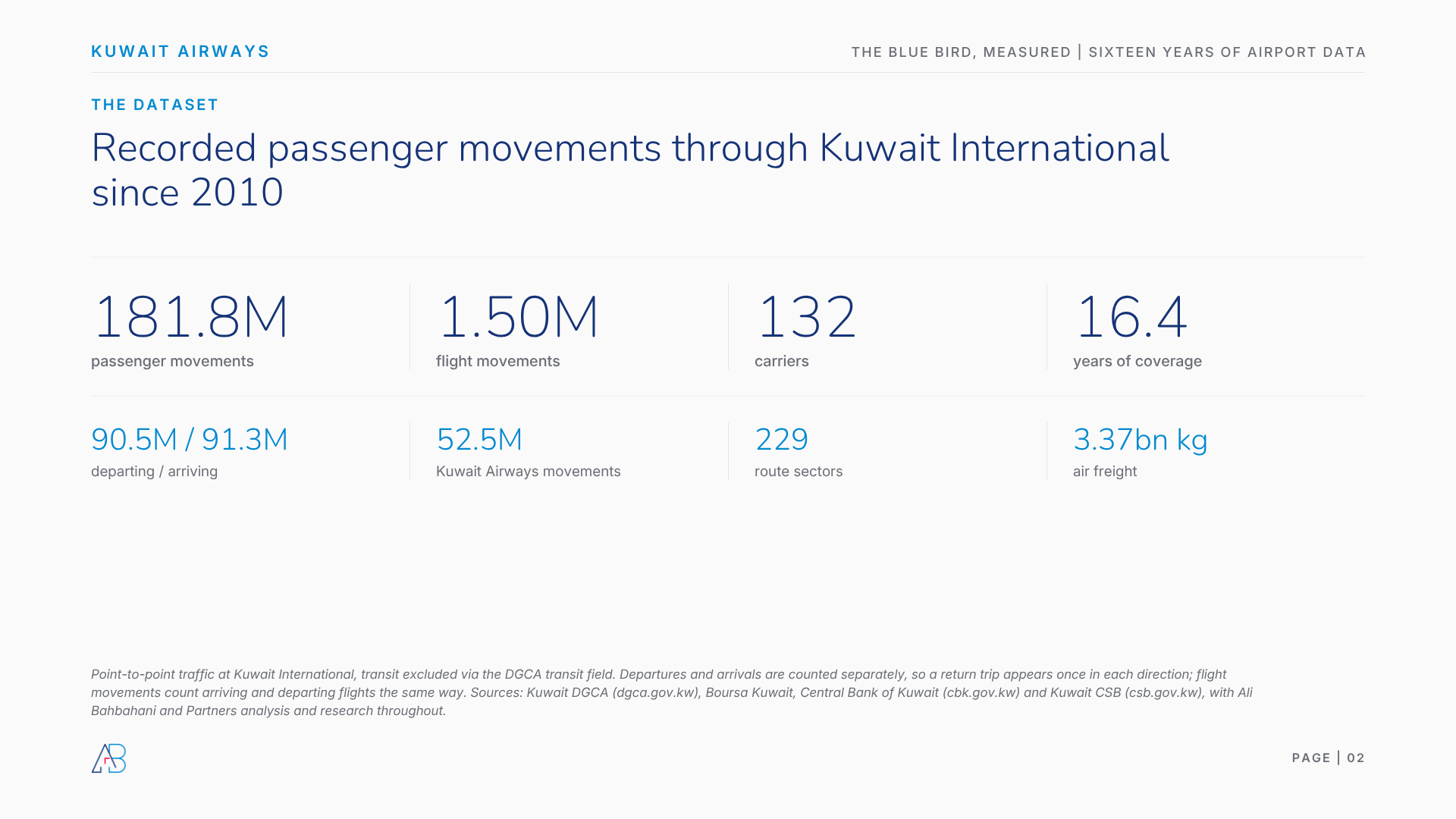
Two definitions matter before anything else. A passenger movement is one recorded arrival or departure, so a return trip produces two. And passengers per departure is a density measure, not a load factor: the source carries no seat counts, so it cannot separate larger aircraft from fuller ones. The data also records no fares, no yields, no nationality, and no trip purpose, which means findings are stated as timings, decompositions and associations; where the study interprets, it says so. City markets combine the airports serving one destination, so Istanbul includes Ataturk, the new Istanbul Airport and Sabiha Gokcen, and Cairo includes Sphinx from its 2023 opening.

The whole study compresses into three findings, and each is worth stating with its numbers. First, the market recovered and its structure did not: counting both directions, Kuwait’s traffic edged 1.8% past its 2019 level, but Kuwait Airways carried 287,000 fewer passengers than in 2019, down 5.8%, and its share fell 2.4 points while Jazeera doubled. Second, the 2025 gain came from throughput, not from flying: Kuwait Airways handled 294,000 more passenger movements in 2025 than in 2024 on 1,495 fewer flight movements, and passengers per movement rose from 141 to 158, the engine of the whole gain. Third, on the eve of 28 February 2026 the flag carrier had edged back in front, 31.3% to Jazeera’s 30.3% across the first eight weeks of the year, a lead of about 26,000 passenger movements; on departures alone the eve was a 30.6% dead heat. Then the airport closed for 56 days.

The airport: 15.7 million passengers in 2025, and more arrived than left
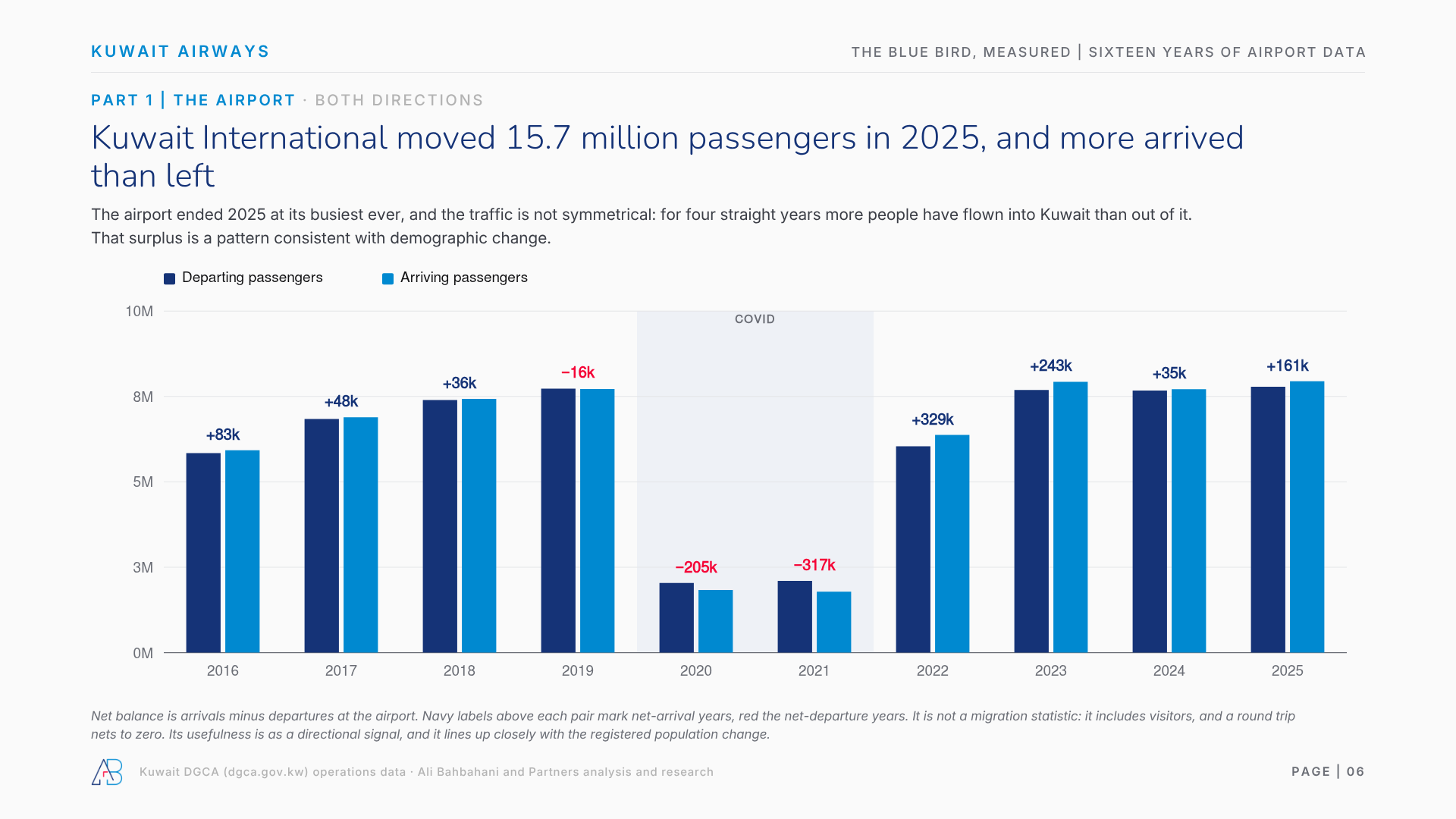
Kuwait International ended 2025 at its busiest ever, 15.7 million passengers. The detail that matters sits underneath the total: for four straight years, more people have flown into Kuwait than out of it. The yearly balances tell it plainly: net arrivals of 329,000 in 2022, 243,000 in 2023, 35,000 in 2024 and 161,000 in 2025, against net departures of 205,000 and 317,000 in the COVID years. The balance is a directional signal, not a migration statistic; it includes visitors, and a round trip nets to zero. What makes it interesting is how closely it tracks the registered population.
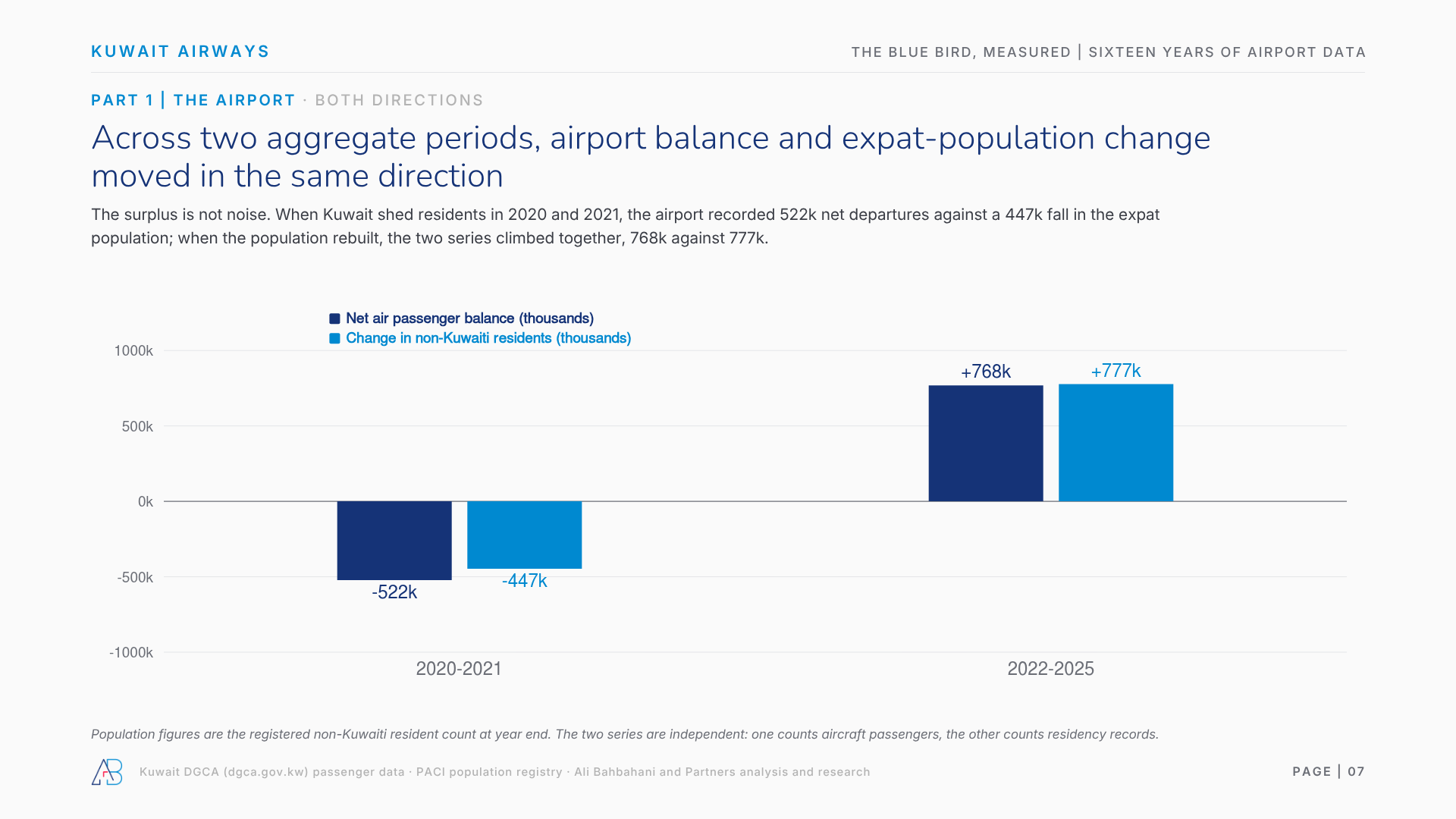
That surplus is not noise. When Kuwait shed residents in 2020 and 2021, the airport recorded 522,000 net departures against a 447,000 fall in the registered expat population. When the population rebuilt from 2022 to 2025, the two series climbed together: 768,000 net arrivals against 777,000 added residents. Two independent datasets, one counting aircraft passengers and one counting residency records, telling the same story.
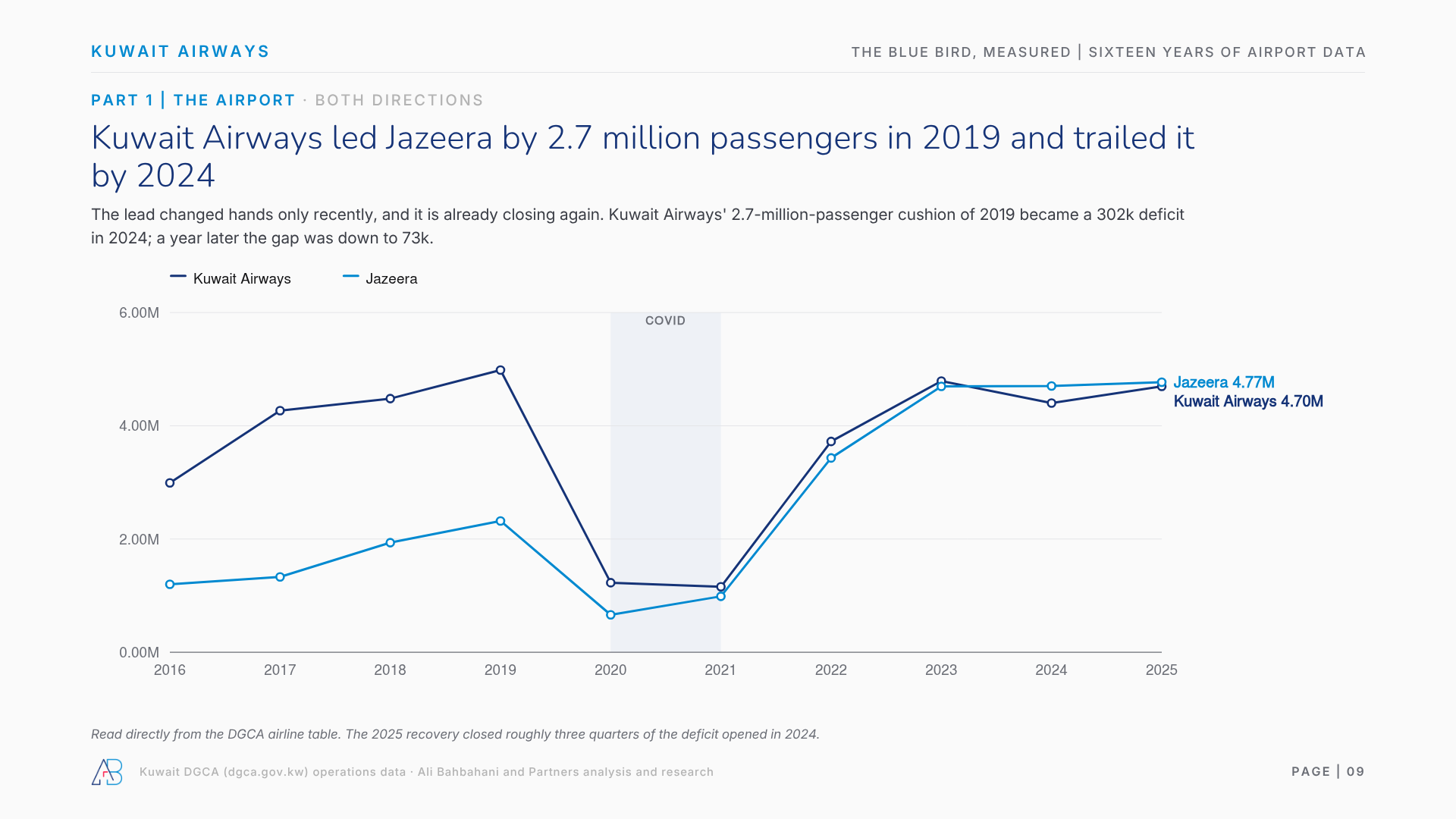
Counting both directions, the airport’s largest airline is no longer its flag carrier. Jazeera handled 4.77 million passenger movements in 2025 against Kuwait Airways’ 4.70 million, 30.32% of the airport against 29.86%. The rest of the field is small: Qatar Airways is the largest foreign carrier at 3.73%, then IndiGo at 3.58% and Emirates at 3.54%, with flydubai, EgyptAir, Etihad, Saudia and Air Cairo all at 2.34% or less. Kuwait International is, to a degree unusual among Gulf hubs, a two-airline airport. The lead changed hands only recently: Kuwait Airways held a 2.7 million passenger cushion in 2019, trailed by 302,000 in 2024, and cut the gap to 73,000 in 2025.

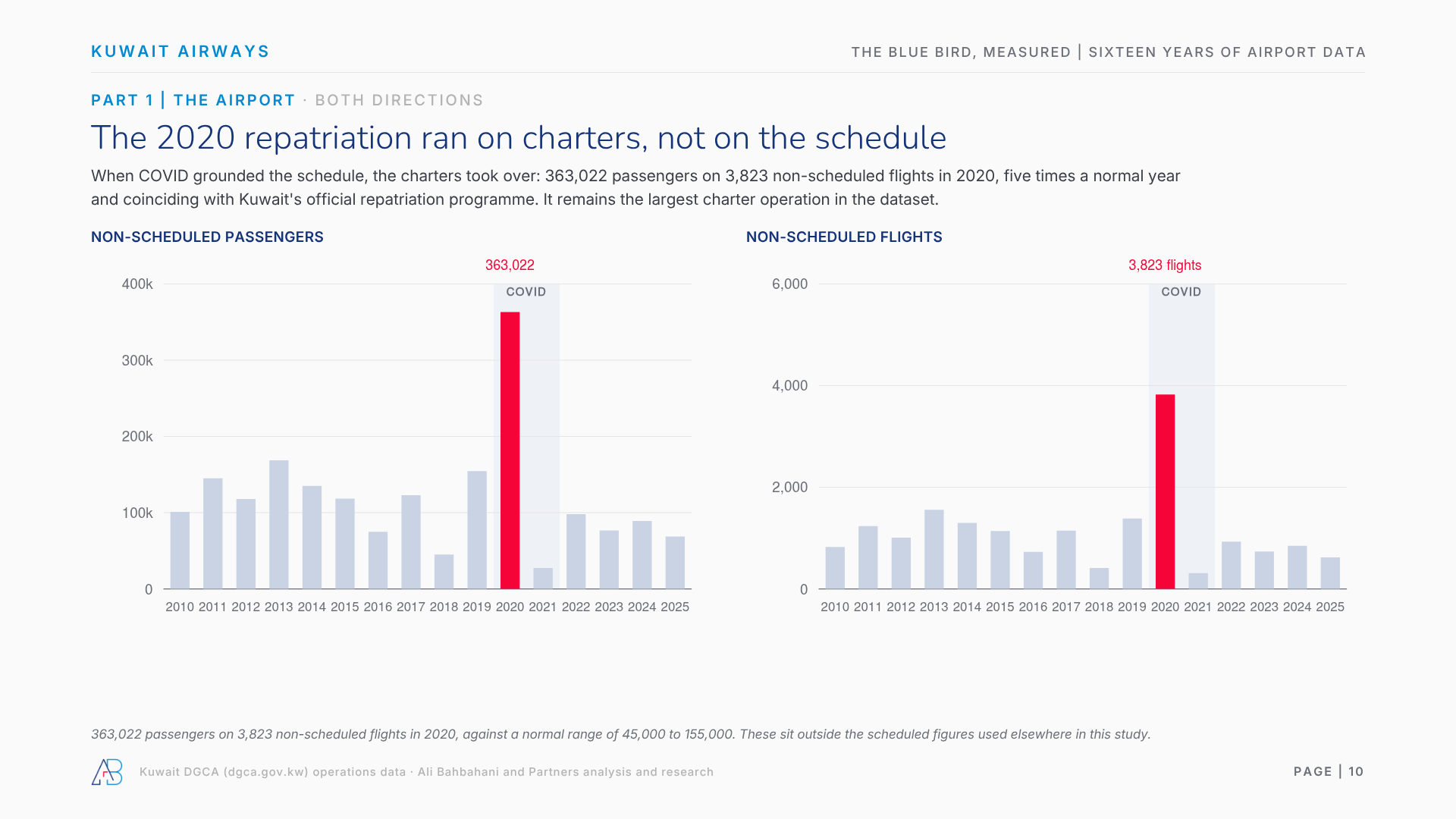
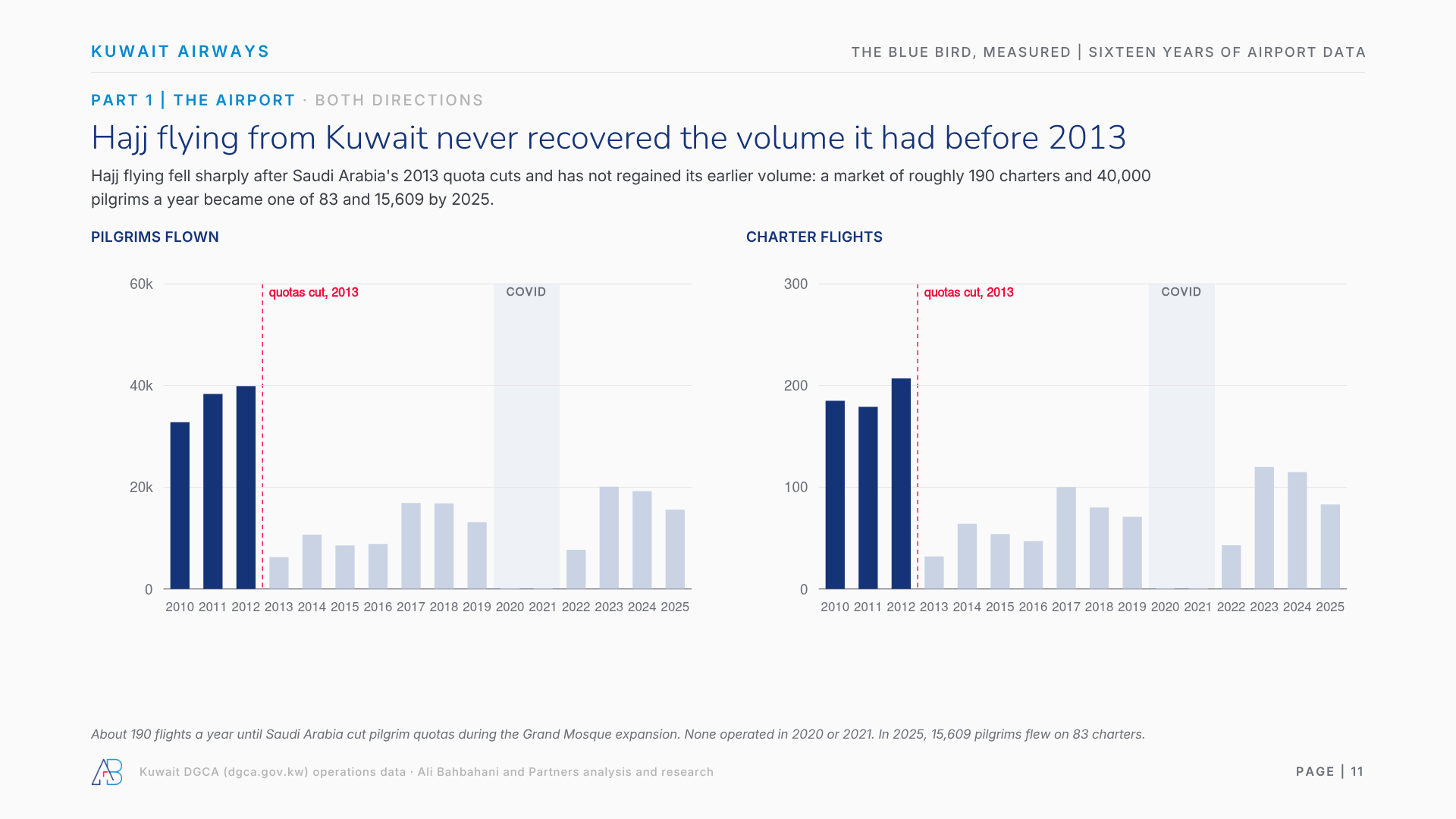
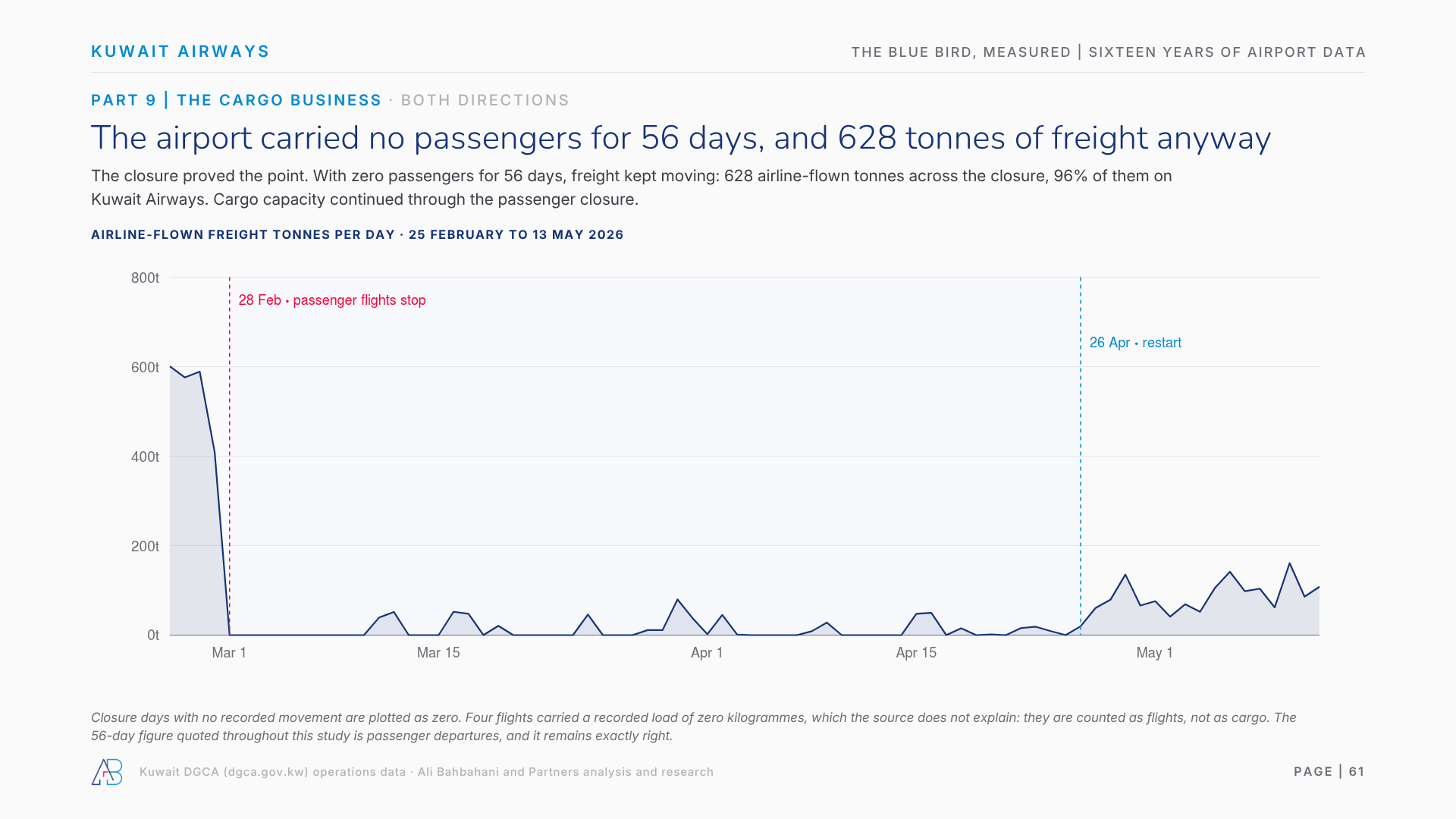
Three smaller stories complete the airport picture. The 2020 repatriation ran on charters, 363,022 passengers on 3,823 non-scheduled flights, five times a normal year, against a usual range of 45,000 to 155,000, and still the largest charter operation in the dataset. Hajj flying never recovered its pre-2013 volume: a market of roughly 190 charters and 40,000 pilgrims a year became 83 charters and 15,609 pilgrims by 2025, the legacy of Saudi Arabia’s quota cuts during the Grand Mosque expansion. And in 2020, when the passenger fleet stopped, dedicated freighters, normally an eighth of the total, carried 60% of Kuwait’s air cargo. The lifeline ran through aircraft that carry no one.

The airlines: the market recovered, its structure did not
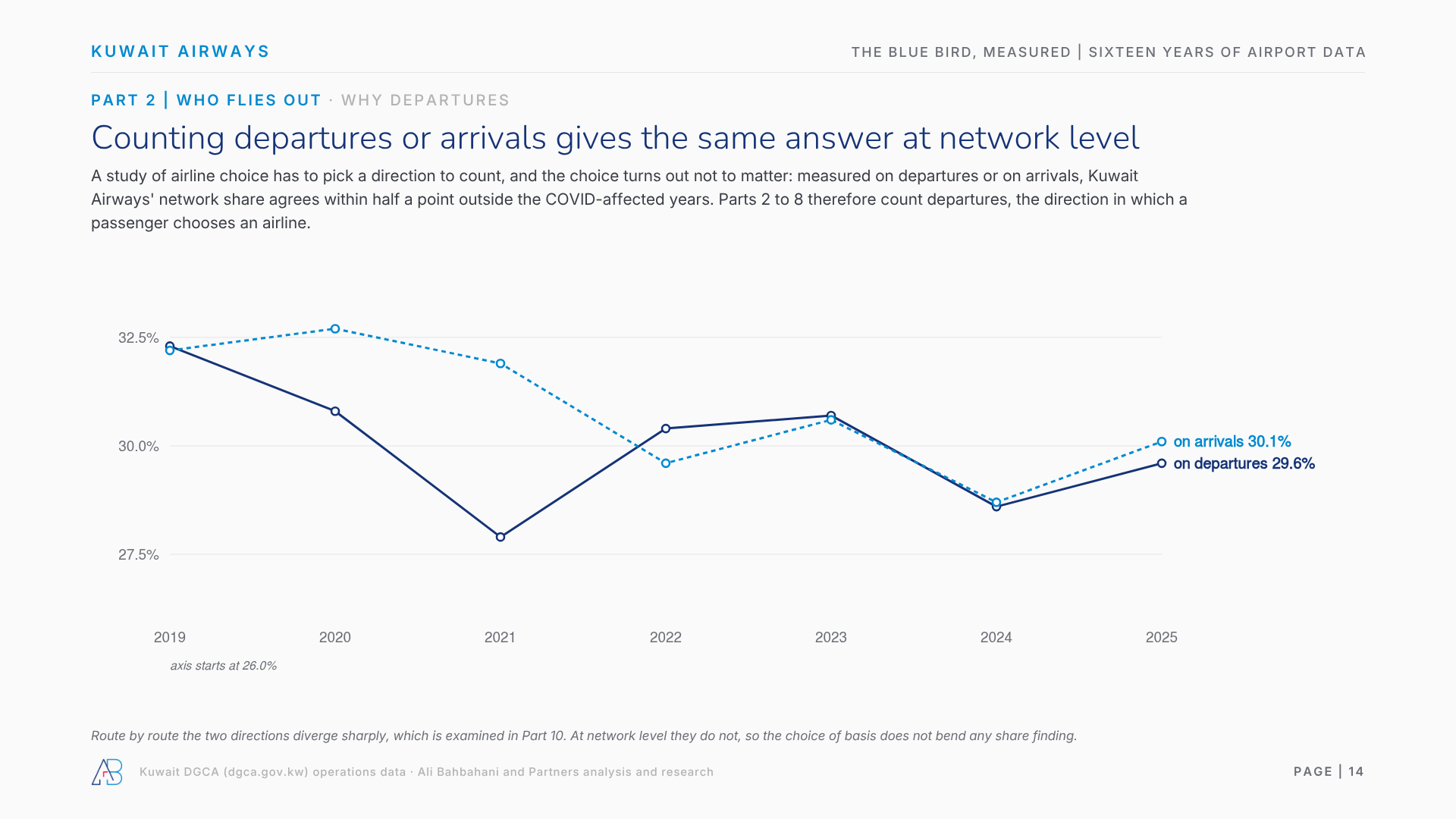
From here the study counts departures, the direction in which a passenger chooses an airline. The choice of basis turns out not to matter: measured on departures or arrivals, Kuwait Airways’ network share agrees within half a point outside the COVID years, 29.6% on departures against 30.1% on arrivals in 2025. Route by route the two directions diverge sharply, which is a finding in its own right and gets its own section below; at network level they do not, so no share finding in this study depends on the choice.
It took six years for Kuwait’s market to pass its pre-COVID size: 7.78 million departures in 2025, 0.7% above 2019’s 7.73 million. The recovery is real but shallow, thinner than the momentum Kuwait’s tourism ambitions assume, and everything that follows happened inside a market that has barely grown in six years. For scale: the market nearly doubled between 2010 and 2019, from 4.1 million departures to 7.7 million, then spent six years getting back to where it was.

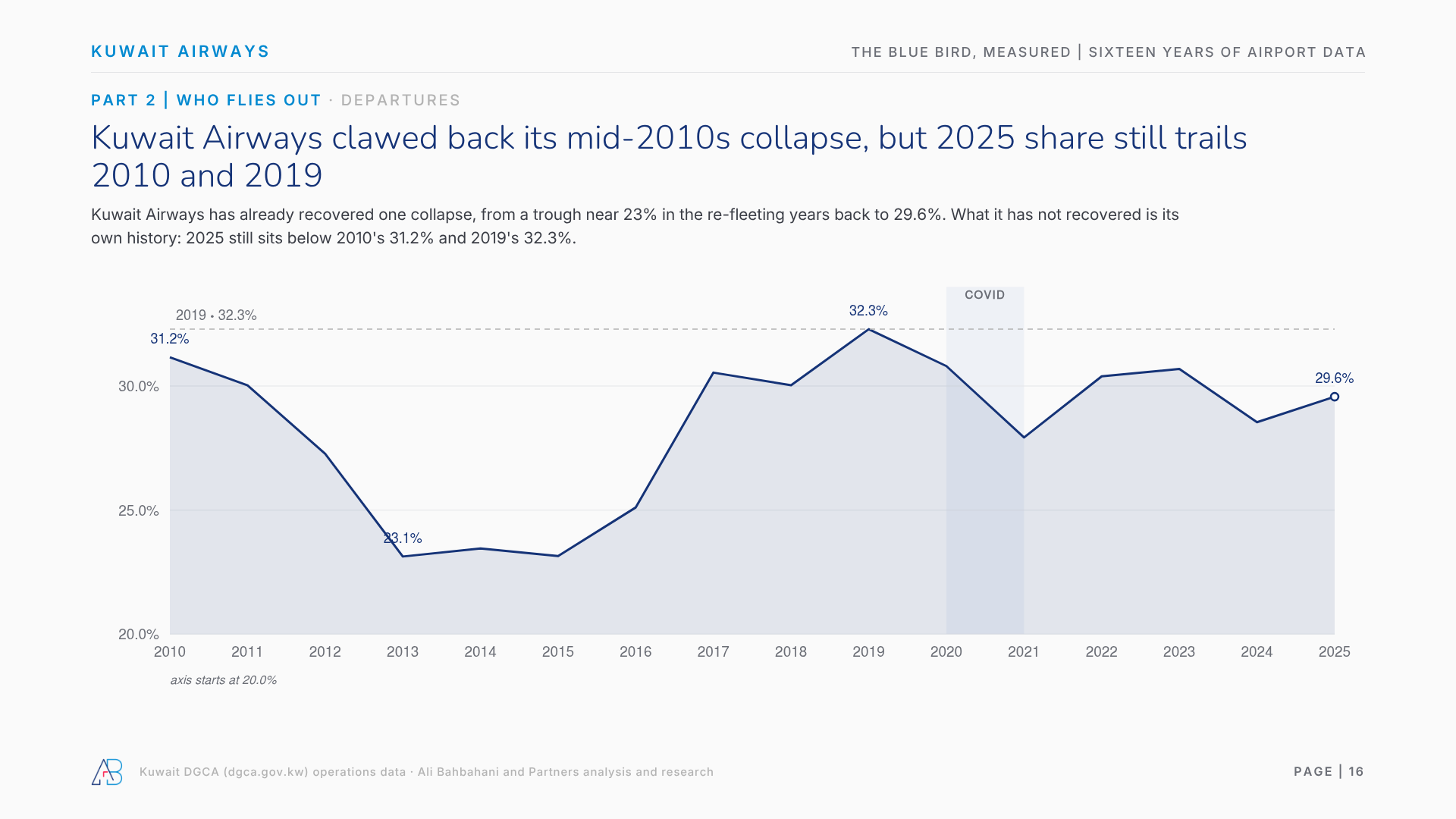
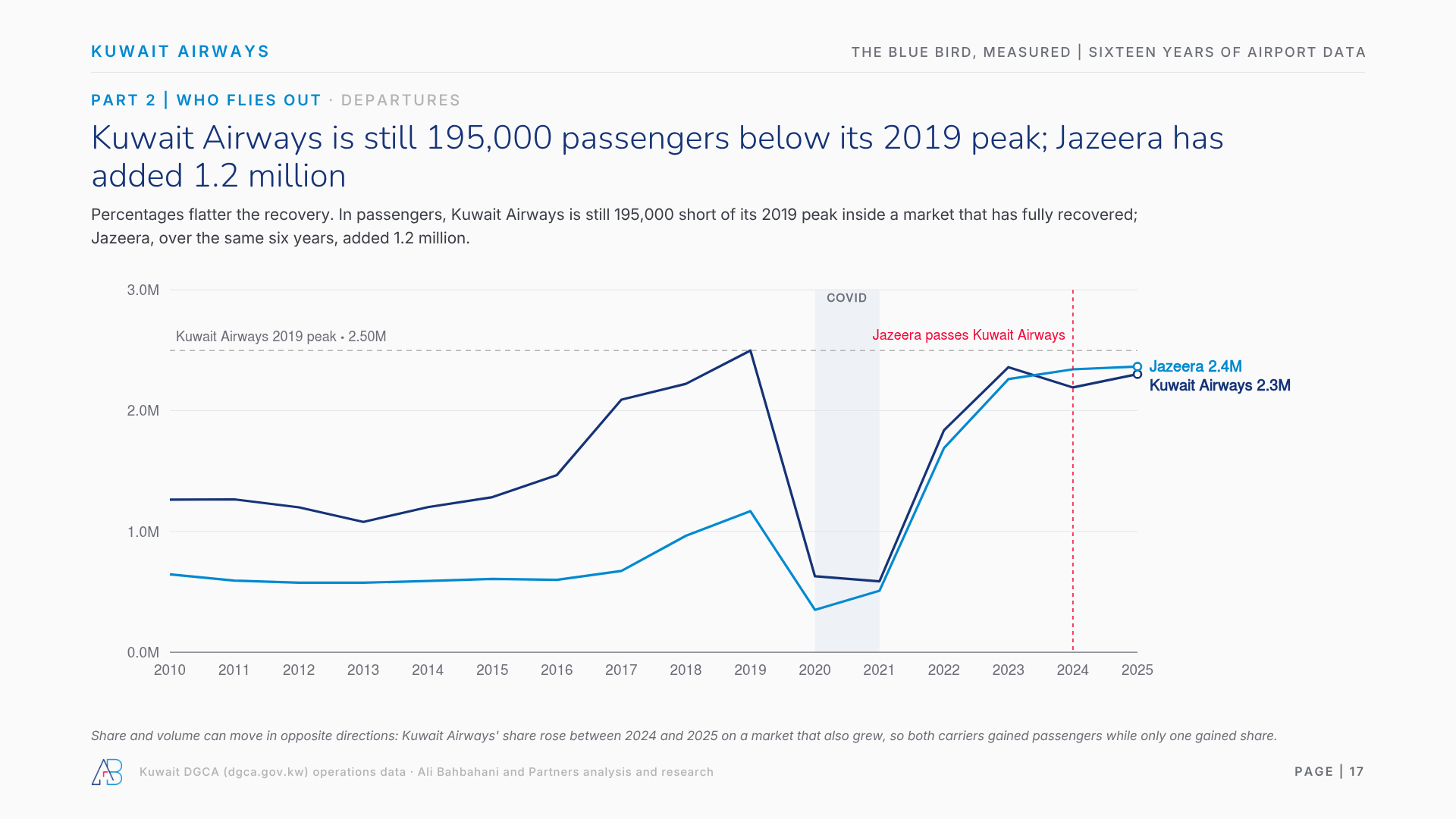
Kuwait Airways has already recovered one collapse in this period, from a trough of 23.1% in 2013, the re-fleeting years, back to 29.6% in 2025. What it has not recovered is its own history: 2025 still sits below 2010’s 31.2% and 2019’s 32.3%. In passengers rather than percentages, the airline is 195,000 short of its 2019 peak of 2.50 million departing passengers inside a market that fully recovered, while Jazeera added 1.2 million over the same six years. Share and volume can move in opposite directions: between 2024 and 2025 both carriers gained passengers while only one gained share, because the market grew underneath them.
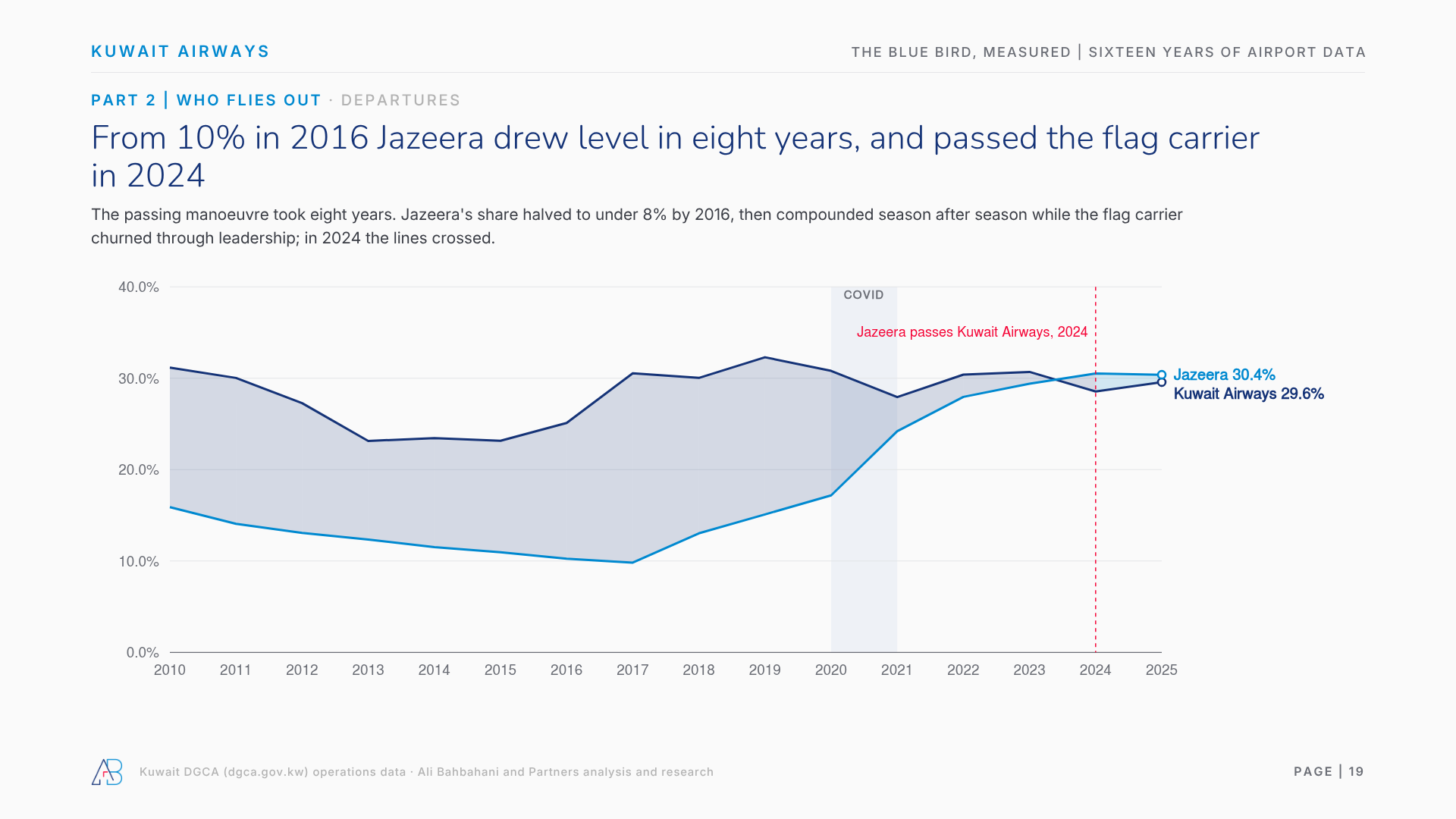
Jazeera’s climb was patient. Its share of departures sat near 10% as late as 2016, then compounded season after season while the flag carrier churned through leadership; in 2024 the lines crossed, and 2025 closed at 30.4% against Kuwait Airways’ 29.6%. The passing manoeuvre took eight years.
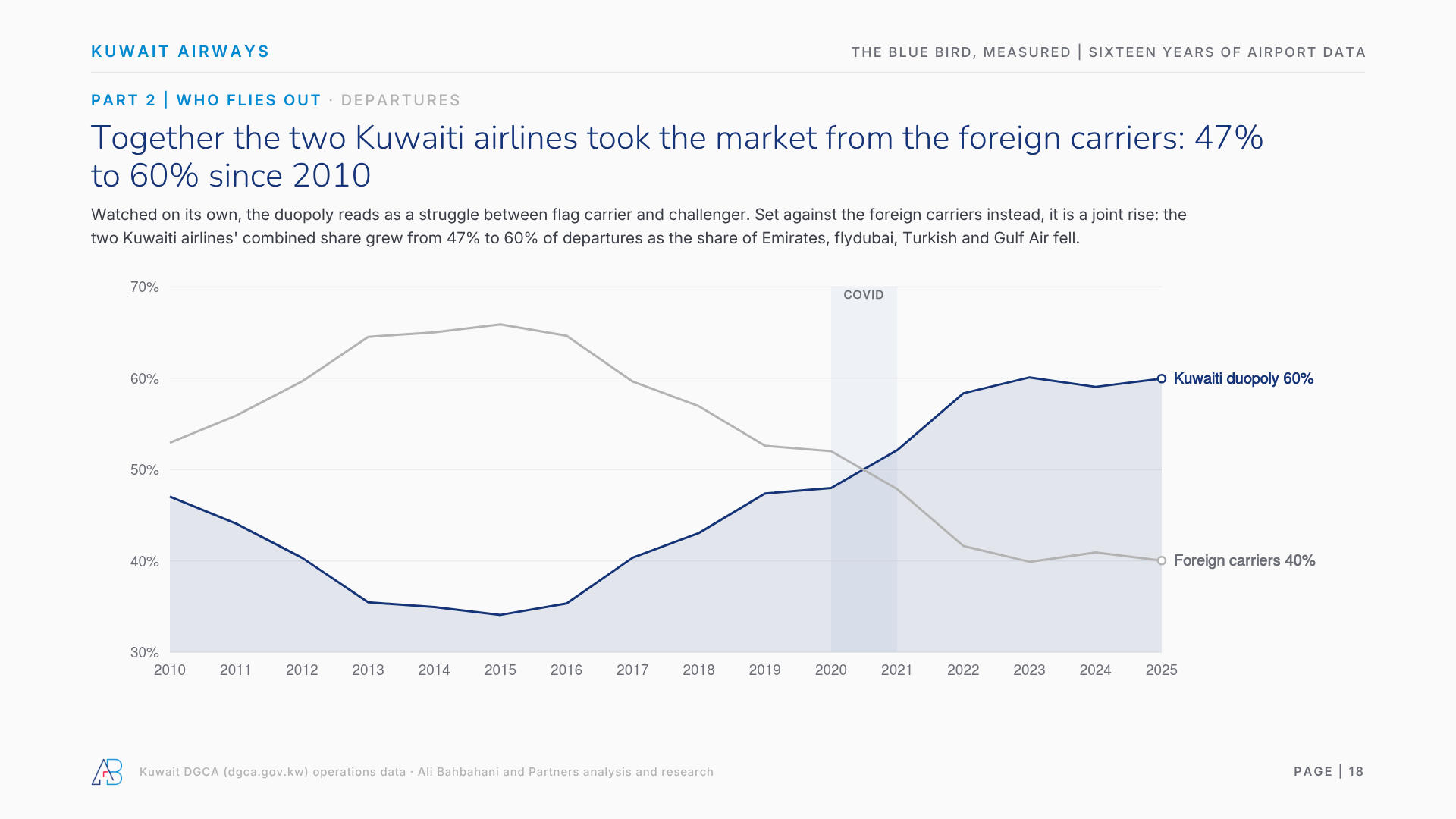
Watched on its own, the duopoly reads as a struggle between flag carrier and challenger. Set against the foreign carriers, it is a joint rise: the two Kuwaiti airlines’ combined share grew from 47% of departures in 2010 to 60% in 2025, and the foreign share fell from 53% to 40% as Emirates, flydubai, Turkish and Gulf Air all gave ground. Whatever the two airlines took from each other, together they took the market from everyone else.
None of this came out of a weakening rival. Jazeera recorded its best year on record, KD 21.8 million of net income, in the same year it ceded share back, per its Boursa Kuwait filings; its only deep loss in sixteen years came in 2020, and the 2014 loss was one-off fleet-transaction accounting with positive earnings per share underneath. The board’s recommended KD 18.3 million distribution out of 2025 profits was deferred with shareholder approval during the closure, and on 13 May 2026 the board approved an 83-fils interim dividend in its place. The equity market moved earlier than the operations data: rebased to December 2019, Jazeera’s share price peaked at 207 in July 2023, halved to 103 by December 2024, the very year it passed Kuwait Airways on passengers, then re-rated 67% through 2025 to stand at 170 against the Boursa All-Share at 141. The price series alone cannot say why; the operations story is context, not cause. Kuwait Airways publishes no comparable results, so the financial scoreboard is necessarily one-sided.


Route by route: where Kuwait Airways actually stands
Scale does not equal strength. Across the sixteen largest city markets, London is the only one where Kuwait Airways carries more than half the passengers, 95.1%, and even that competitor is gone: British Airways flew its last Kuwait departure in March 2025, leaving the route to the flag carrier. I had written about BA’s customer problem before it left; the exit surprised nobody who flew the route. The full ladder is worth writing out: Mumbai 40.7%, Istanbul 40.6%, Amman 35.8%, Jeddah 34.0%, Cairo 28.9%, Hyderabad 28.0%, Beirut 24.6%, Dubai 23.4%, Riyadh 22.5%, Kathmandu 22.5%, Madinah 15.1%, Bahrain 14.5%, Doha 11.0%, Colombo 2.8%, and Abu Dhabi at zero, unserved since 2021. On every Gulf shuttle the flag carrier trails its own 2025 network average of 29.6%.

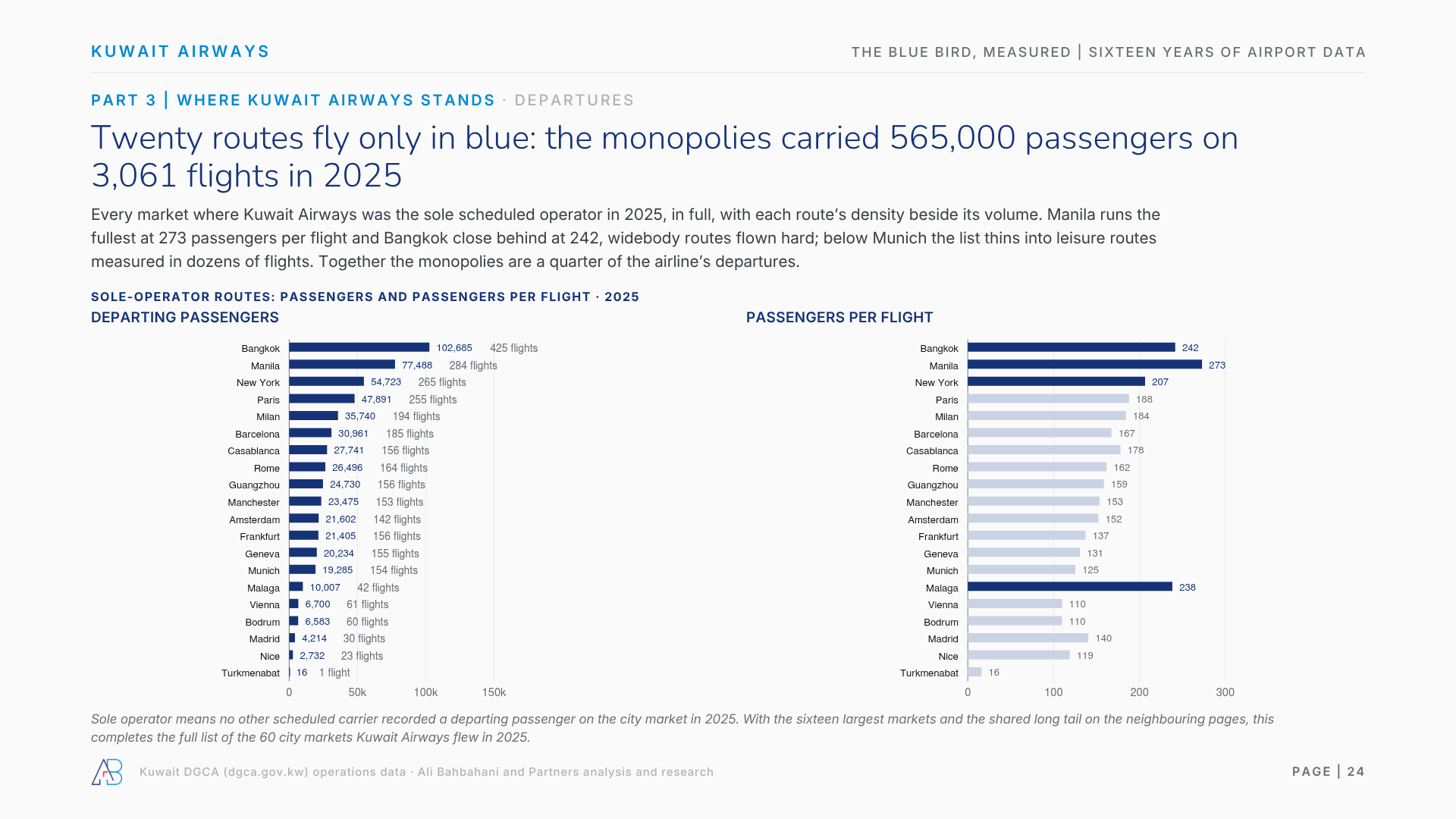
Twenty routes fly only in blue. The monopolies carried 565,000 passengers on 3,061 flights in 2025, a quarter of the airline’s departures. Bangkok leads at 102,685 passengers on 425 flights, then Manila at 77,488 running the fullest in the network at 273 passengers per flight, New York at 54,723, Paris at 47,891, Milan at 35,740, Barcelona at 30,961, and Casablanca, Rome, Guangzhou, Manchester, Amsterdam, Frankfurt, Geneva and Munich behind them; below Munich the list thins into leisure routes measured in dozens of flights, though Malaga’s 42 flights ran at 238 passengers each. In the twenty-five contested markets beyond the big sixteen, Dhaka is the largest at 84,724 departing passengers and a 41% share, Delhi follows at 67,846 and 46%, Kochi at 57,201 and 34%, and six quiet majorities surface where the bigger rivals barely contest: Dammam at 77%, Antalya at 69%, Thiruvananthapuram at 64%, Islamabad at 62%, Lahore at 51% and Bengaluru at 50%.

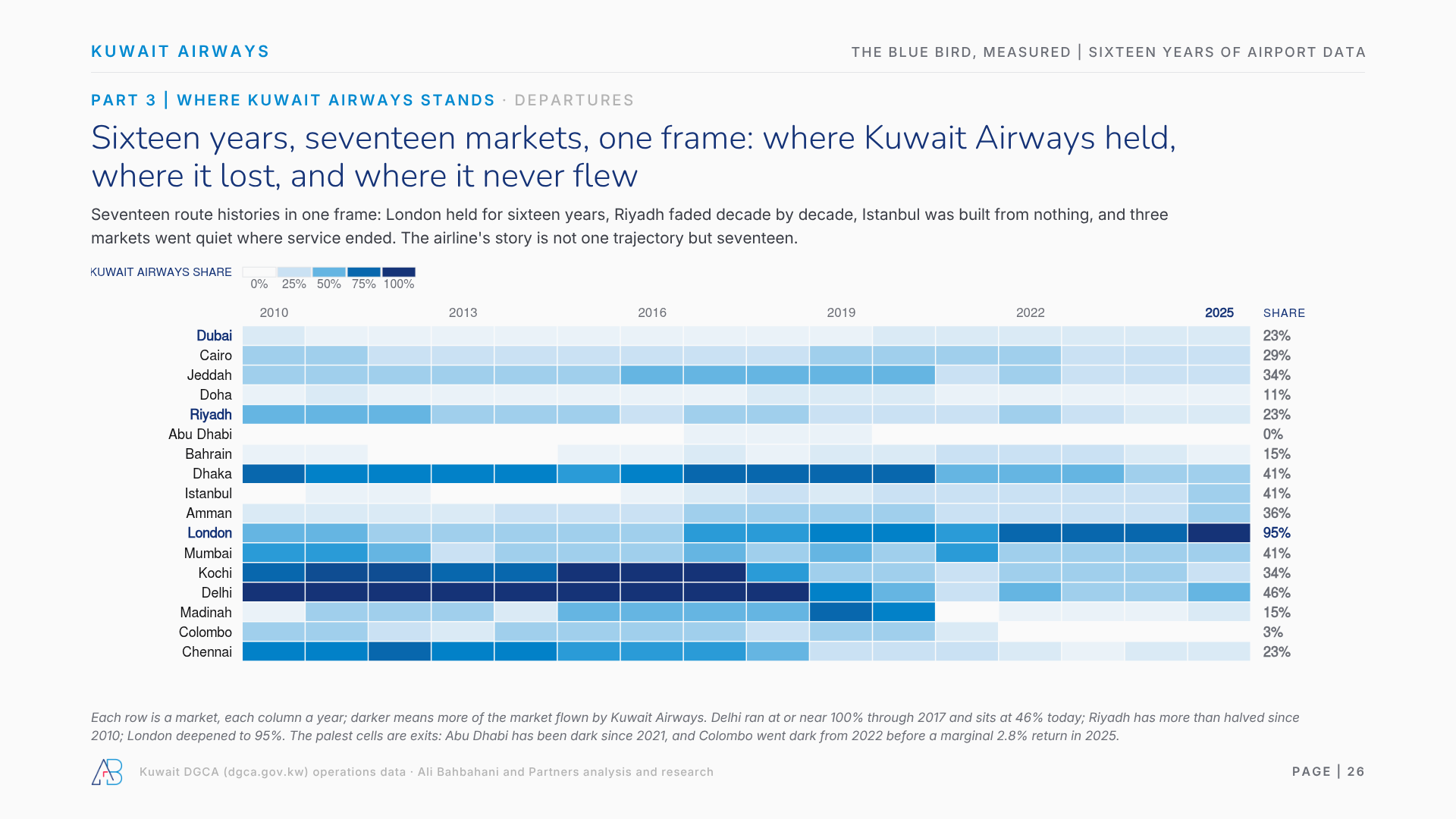
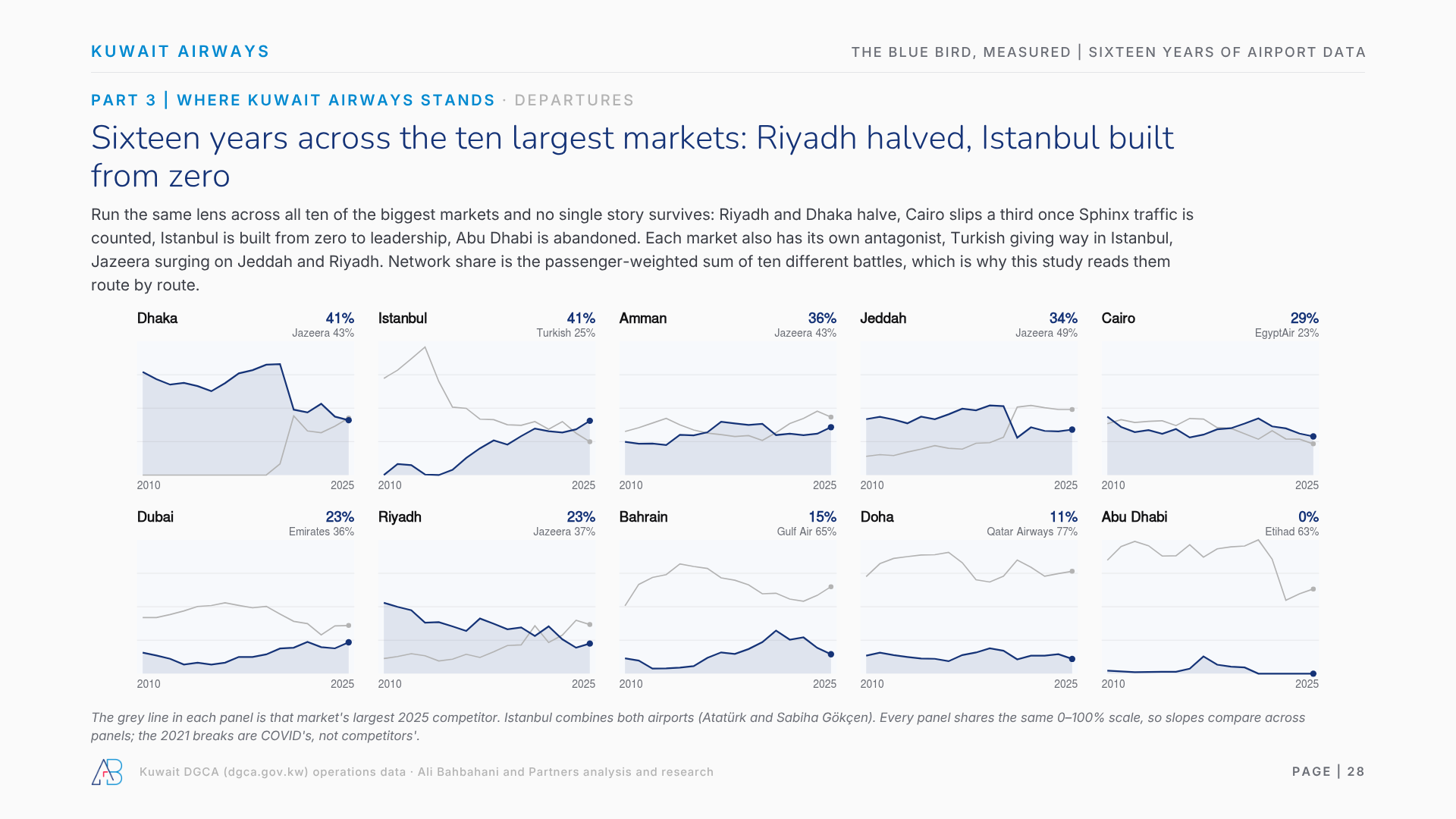
The two Saudi trunk routes show what fragmentation looks like. Riyadh and Jeddah fell to several competitors at once: Jazeera now leads both at 37% and 49%, flynas grew from 2% to 16% on Riyadh, even Saudia gave ground, and the 53% Kuwait Airways once held in Riyadh simply had too many claimants; it holds 23% there today and 34% on Jeddah. Run the same lens across all ten of the biggest markets and no single story survives: Riyadh and Dhaka halve, Cairo slips a third once Sphinx traffic is counted, Istanbul is built from zero to leadership, Abu Dhabi is abandoned, and each market has its own antagonist, Turkish giving way in Istanbul, Jazeera surging on the Saudi routes. Network share is the passenger-weighted sum of ten different battles, which is why this study reads them route by route.

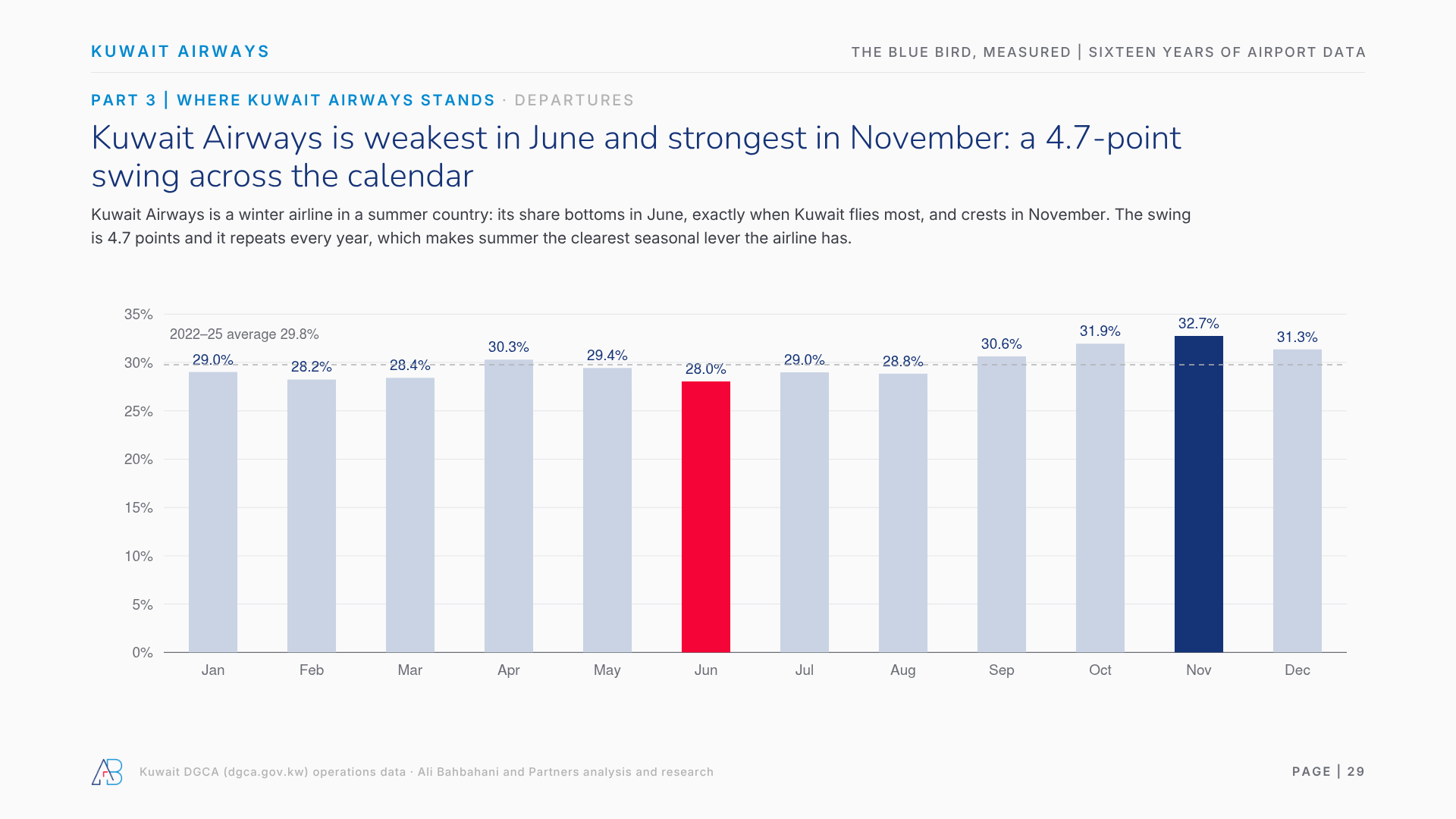
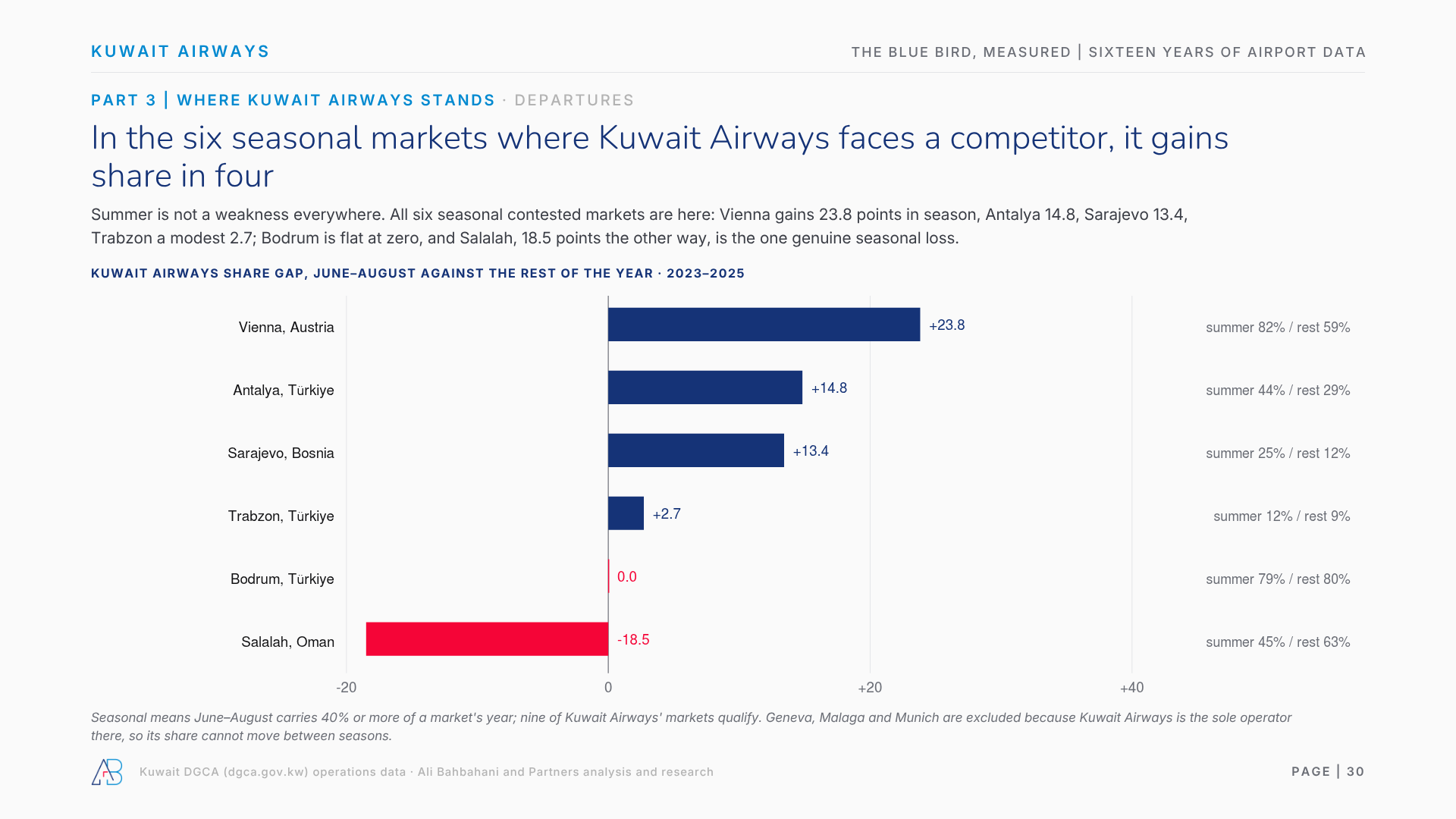
Kuwait Airways is a winter airline in a summer country. Its share bottoms at 28.0% in June, exactly when Kuwait flies most, and crests at 32.7% in November, a 4.7-point swing that repeats every year against a 2022 to 2025 average of 29.8%. Summer is not a weakness everywhere: in the six seasonal markets where it faces a competitor, it gains share in four, Vienna by 23.8 points in season, Antalya by 14.8, Sarajevo by 13.4, with Salalah the one genuine seasonal loss at 18.5 points the other way.
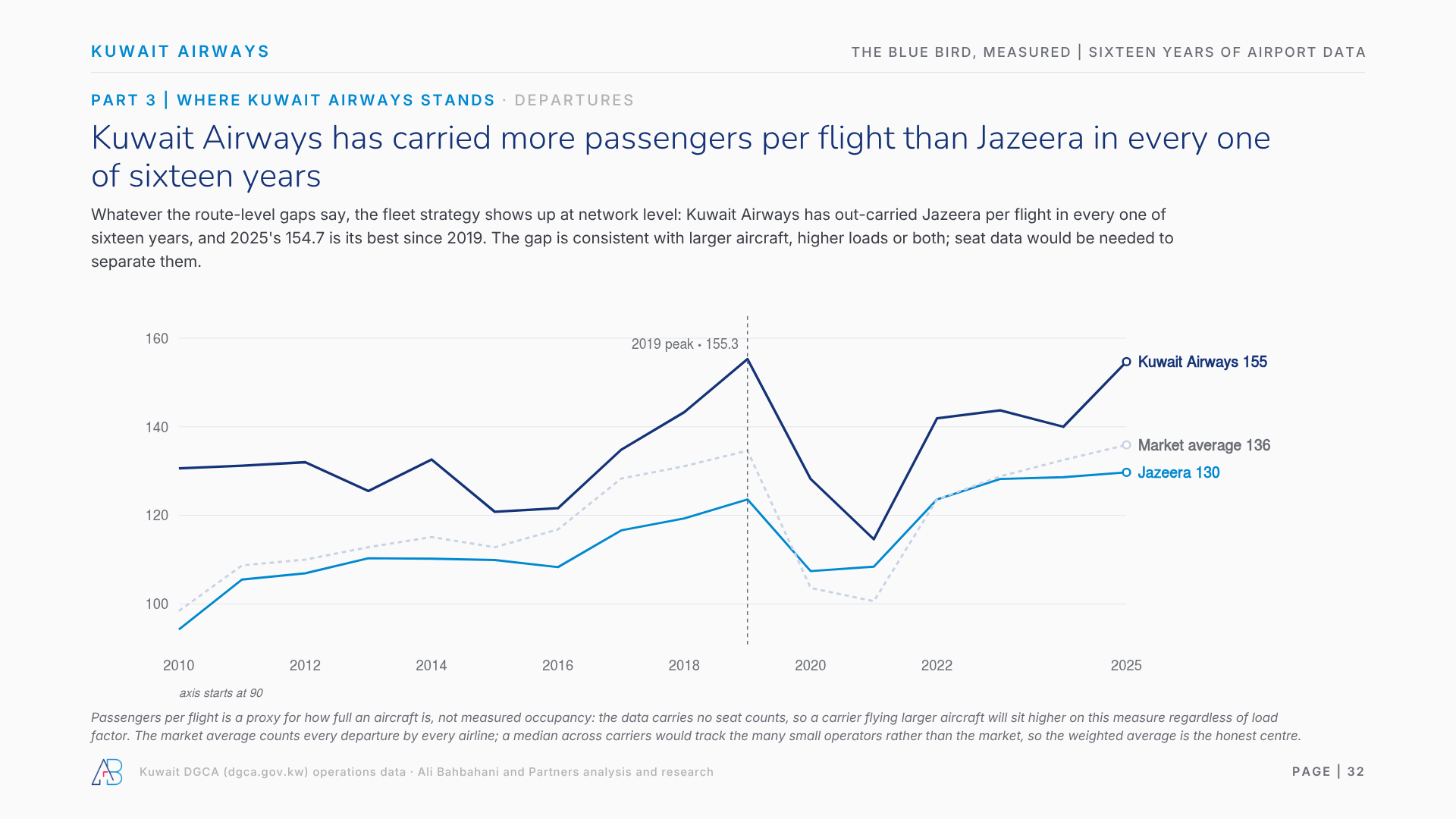
On density the picture is uncomfortable and precise. Kuwait Airways carries fewer passengers per departure on 23 of the 32 contested routes where a comparison exists, and the gap is widest exactly where the traffic is thickest: 89 per departure against IndiGo’s 164 on Hyderabad, 61 behind Qatar Airways on Doha, 43 behind Emirates on Dubai. Its own leads sit at the network’s edges: 250 per departure on London against British Airways’ 127 before the exit, 63 ahead of Jazeera on Jeddah, 58 ahead of Nile Air on Cairo. Jazeera sets the benchmark on fifteen of these routes and IndiGo on six. Yet at network level the fleet strategy shows up unambiguously: Kuwait Airways has out-carried Jazeera per flight in every one of sixteen years, 155 against 130 in 2025 with the market average at 136, the signature of a widebody fleet, consistent with larger aircraft, higher loads or both.

The weekly picture is mostly flat, and the exceptions are sharp. Kuwait flies 8% more over the Thursday to Saturday weekend, but only thirteen markets lean five points or more either way. Where it leans, it leans hard: in Lahore Kuwait Airways carries 74% of Thursday to Saturday passengers but 42% of the working week’s, a 32.5-point tilt, with Thiruvananthapuram close behind at 31.2 points; Bengaluru and Frankfurt lean fifteen points the other way. A tilt mostly reflects scheduling rather than passengers switching airline by day, which is exactly why it is a lever: where a carrier concentrates its weekly flights is a choice.

Ten chief executives in sixteen years
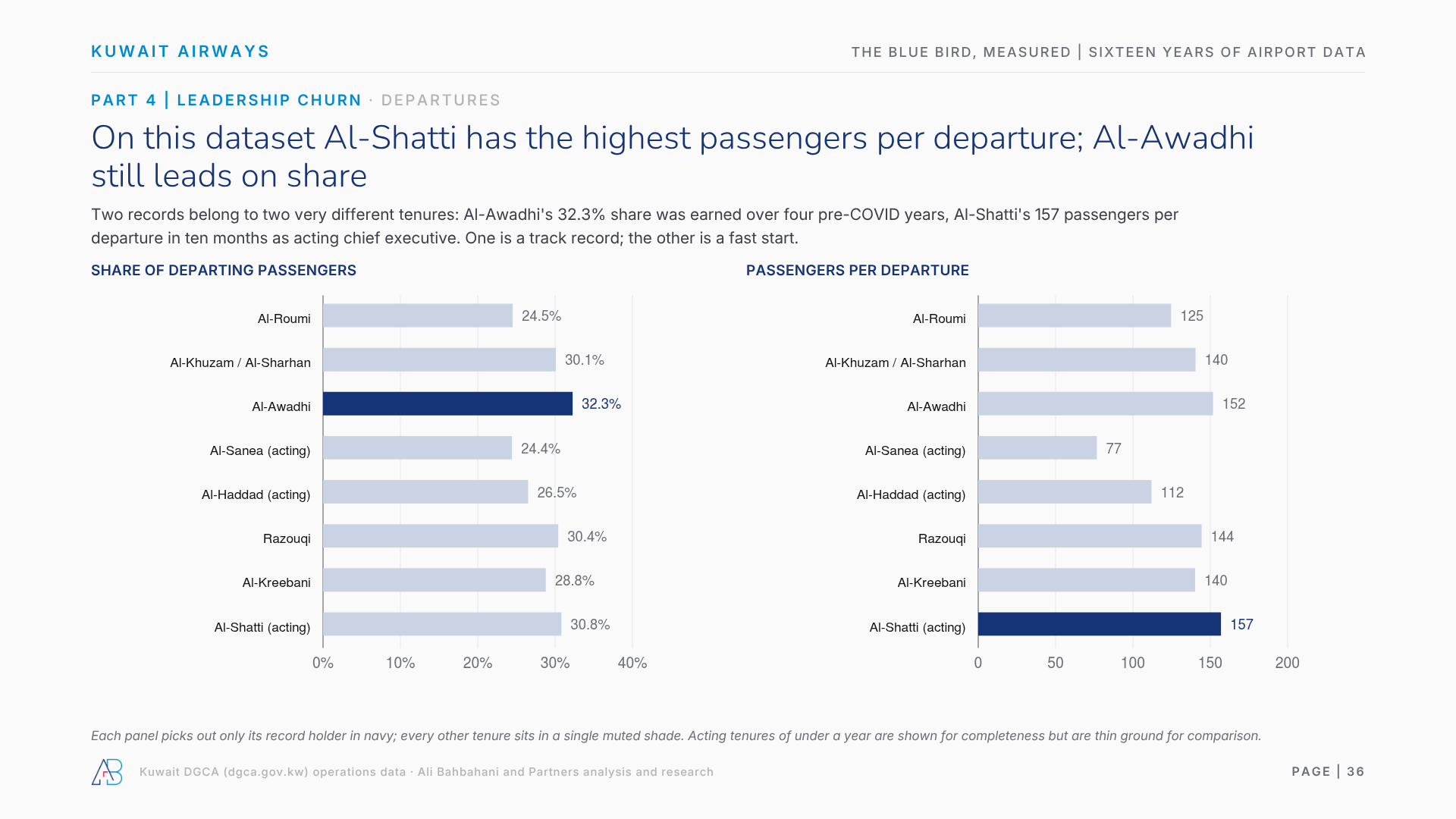
No airline changes its chief executive every eighteen months by design. Ten leaders in sixteen years, four of them acting, is the operating environment every strategy above had to survive. The roster reads: Al-Falah from 2008 to December 2013 at a 27.7% era average, Al-Roumi from January 2014 to April 2017 at 24.5%, Al-Khuzam and then Al-Sharhan through October 2018 at 30.1%, Al-Awadhi from November 2018 to September 2020 at 32.3%, the acting tenures of Al-Sanea and Al-Haddad through the COVID trough, Razouqi from November 2021 to September 2023 at 30.4%, Al-Kreebani from September 2023 to April 2025 at 28.8%, and Al-Shatti, acting, from May 2025 at 30.8%. Era averages inherit market conditions, so they measure periods, not merit; on passengers per departure the range runs from Al-Sanea’s 77, the artefact of flying near-empty COVID services, to Al-Shatti’s 157. Al-Awadhi’s 32.3% remains the share record, earned over four pre-COVID years; Al-Shatti’s 157 is a fast start over ten months. One is a track record, the other is not yet, and the data cannot say which the second becomes.

2025: the turn
The aircraft that carried the 2025 run were ordered by executives long gone. The fleet grew from 17 aircraft, where it sat from 2010 through 2013, to 32 by 2025; the 25-jet Airbus order of 2014 and the first 777-300ER of 2016 arrived under Al-Roumi, and Kuwait Airways was the global launch operator of the A330-800neo: Airbus’ first-ever delivery of the type went to Kuwait on 29 October 2020, and the type’s first revenue flight anywhere was Kuwait to Dubai on 20 November 2020. The first A330-900neo followed in 2024, and the A321neo that opened the 2025 wave arrived on 14 May 2025, first of nine, the airline’s first flat-bed narrowbody, carrying its first passengers, again to Dubai, within a week. Fleet is the slowest lever in aviation, which is why it is context for the result rather than its cause.

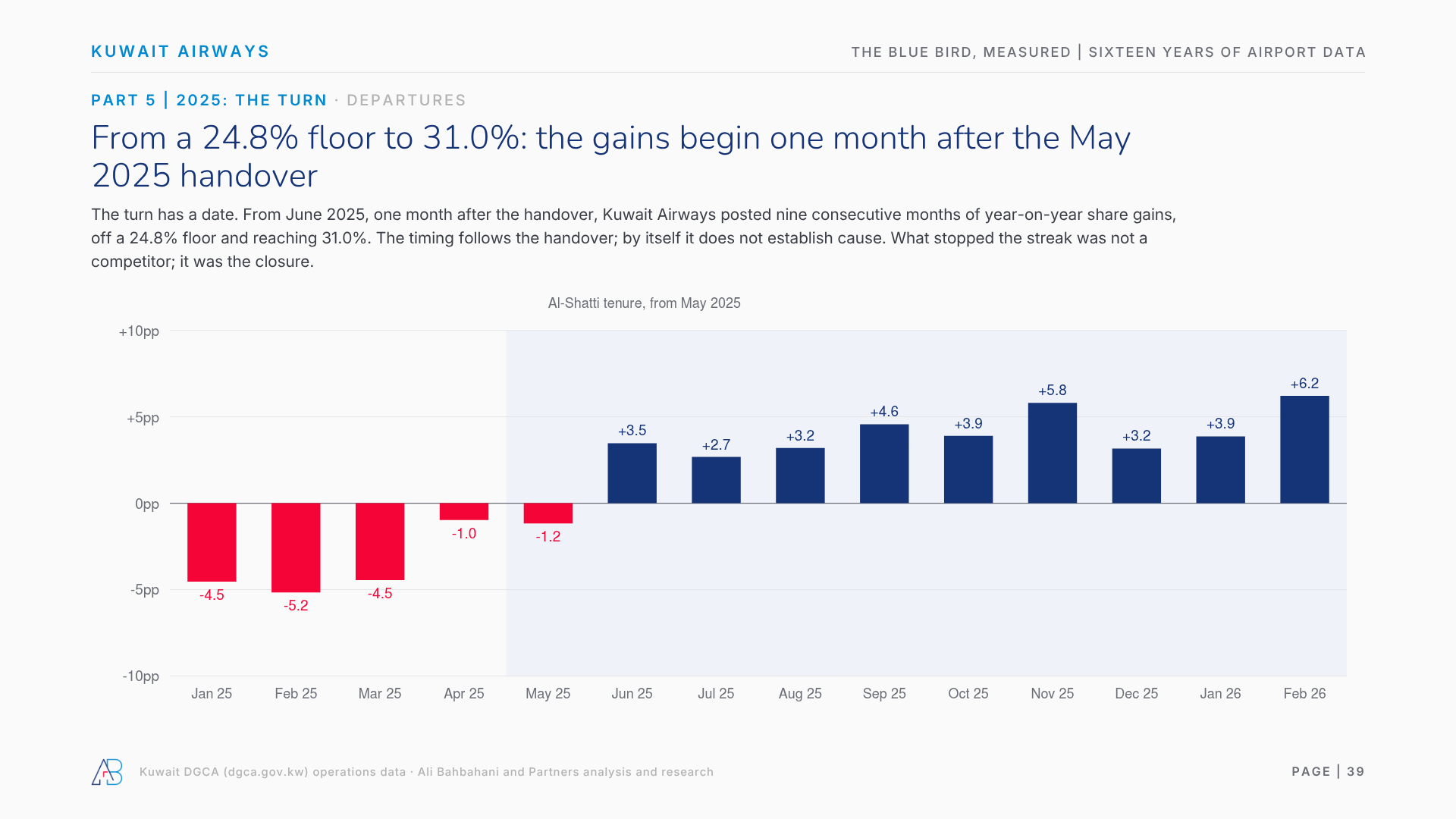
The turn has a date, and the monthly sequence deserves to be written out because early 2025 was not a good year. January ran 4.5 points below the prior year, February 5.2 below, March 4.5 below. From June, one month after the handover to Al-Shatti, the sign flips and holds for nine consecutive months: +3.5, +2.7, +3.2, +4.6 in September, +3.9, +5.8 in November, +3.2 in December, then +3.9 in January 2026 and +6.2 in February, the streak’s strongest month and its last. The share ran from a 24.8% floor to 31.0%. The timing follows the handover; by itself it does not establish cause. What stopped the streak was not a competitor.
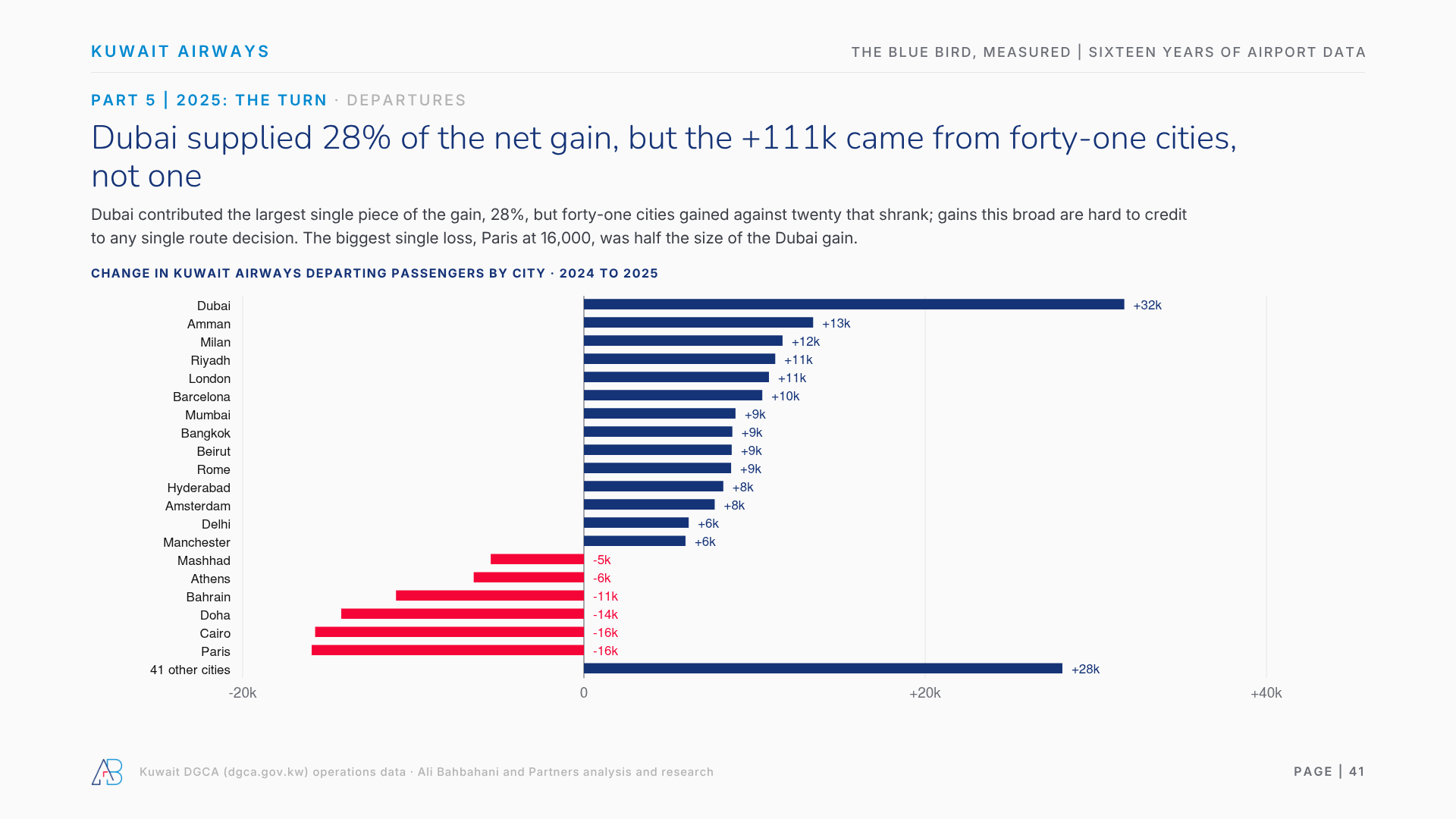
The gain decomposes cleanly. Kuwait Airways carried 2,301,516 departing passengers in 2025 against 2,190,277 in 2024, a net gain of 111,000: flying fuller added 217,000 passengers as throughput rose from 140.0 to 154.7 per departure, while flying less, 14,882 departures against 15,640, gave 106,000 back. That is a productivity gain rather than an expansion, and it is the signature of the whole 2025 story. Dubai supplied the largest single piece at 28%, plus 32,000 passengers, with Amman adding 13,000, Milan 12,000, Riyadh and London 11,000 each and Barcelona 10,000; against them Paris and Cairo each gave up 16,000, Doha 14,000 and Bahrain 11,000. Forty-one cities gained against twenty that shrank, and gains this broad are hard to credit to any single route decision.

Eight weeks into 2026 the race was too close to call: 30.6% of departures each, 219 passengers apart, against 25.8% and 31.9% a year earlier. Then the airport closed.

The airspace closure: 56 days of zero
The run did not wind down; it was severed. February 2026 was running at 151 departures a day, the eve flew 148, the final morning 62, then 56 consecutive days of zero passengers. Kuwait was the last GCC state to restore operations, more than a fortnight after Bahrain reopened on 8 April. Through the closure both Kuwaiti carriers kept flying, operating repatriation and scheduled services out of Dammam and Al Qaisumah in Saudi Arabia, and Kuwait Airways continued to move freight through Kuwait itself. The wider economic shock has its own article; the March data note covers what the Central Bank numbers absorbed.
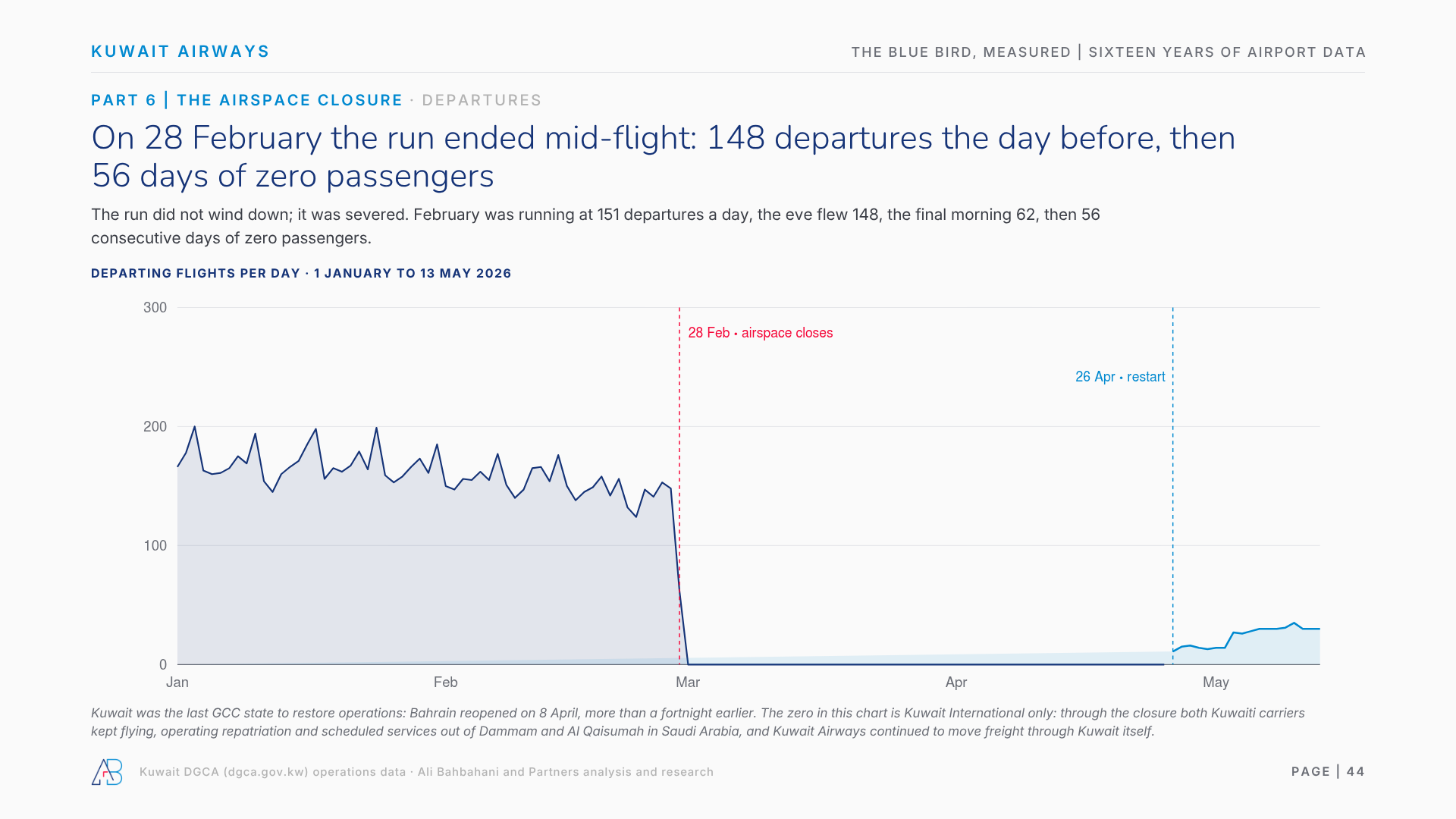
The restart, from 26 April to the study’s 13 May cutoff, was a two-airline affair, and it rewarded density. Jazeera flew 246 departures carrying 39,096 passengers; Kuwait Airways flew 170 carrying 35,765. Flying 69% of Jazeera’s departures, it carried 91% of its passenger volume. No foreign carrier had returned by the cutoff.

Network outcomes: what sixteen years of competition did to the map
The 2025 network at true scale: three regions carry 88% of it, the Gulf, Levant and Turkey at 47%, South Asia at 21%, Europe at 20%, with the remainder scattered from New York to Manila. Sixty city markets in all, drawn as great circles from a single hub.

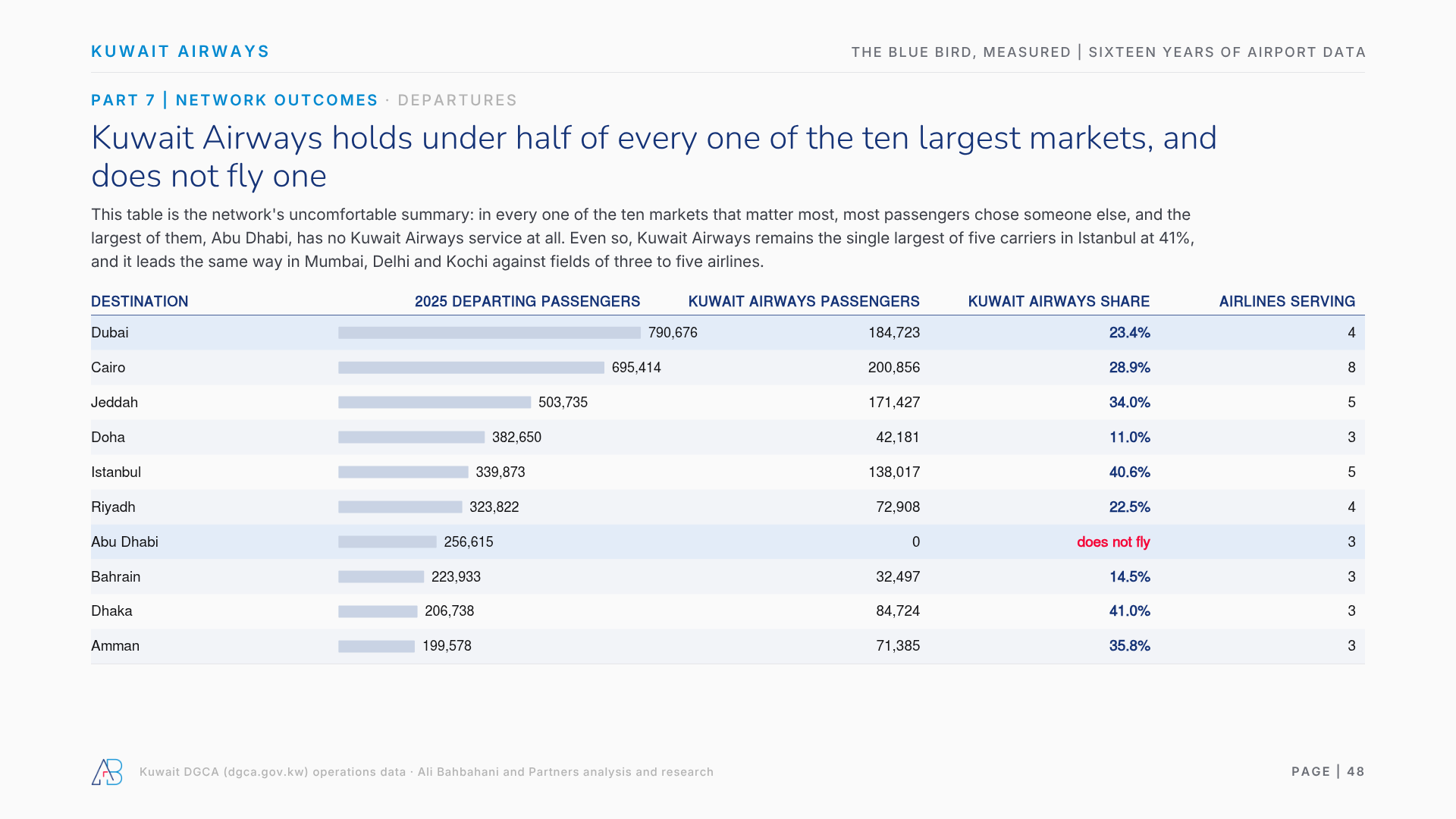
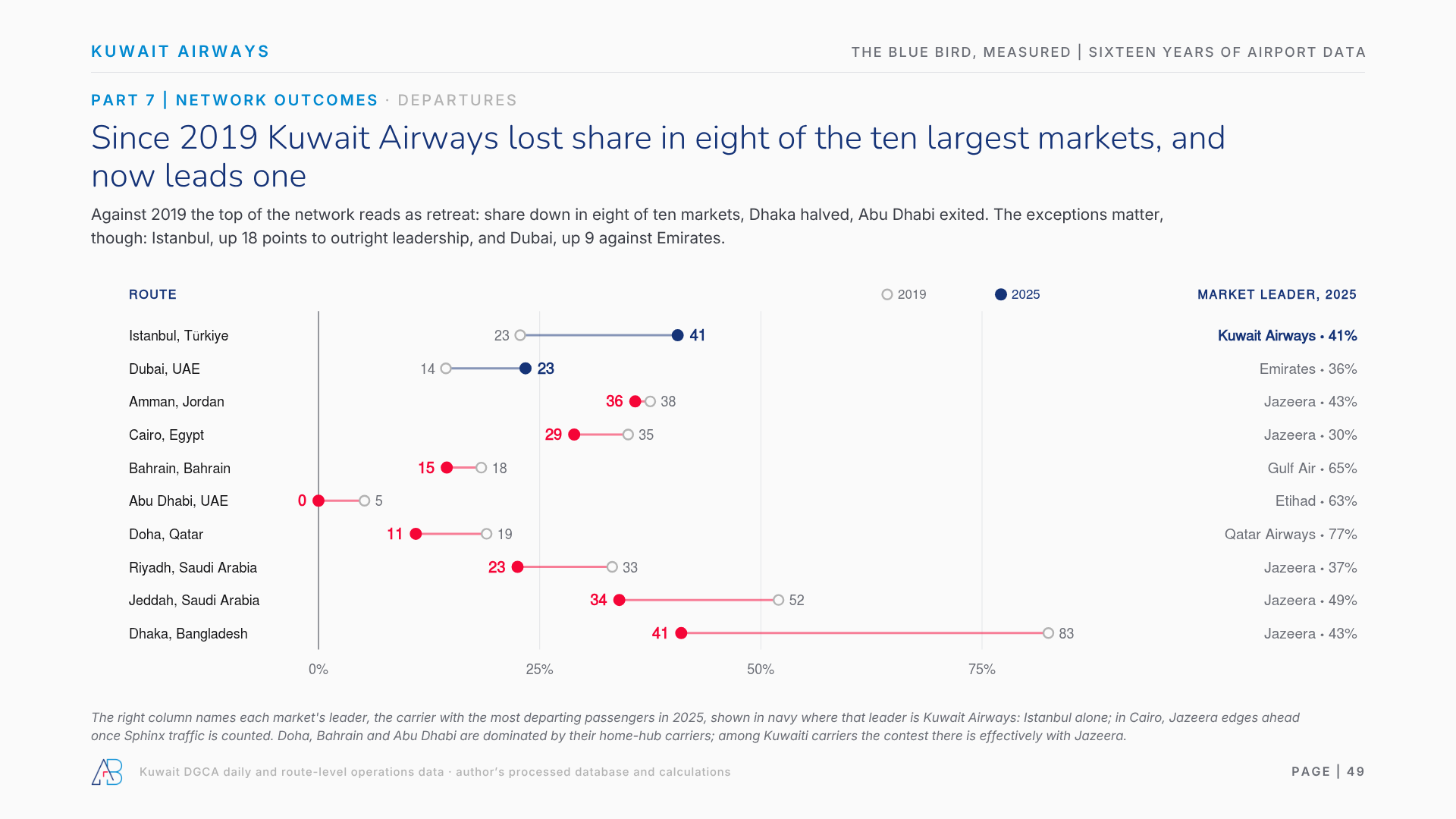
The uncomfortable summary sits in one table: in every one of the ten markets that matter most, most passengers chose someone else. Dubai is the largest at 790,676 departing passengers in 2025, of which Kuwait Airways carried 184,723; Cairo follows at 695,414 across eight competing airlines, then Jeddah at 503,735, Doha at 382,650, Istanbul at 339,873 and Riyadh at 323,822. Abu Dhabi, at 256,615, has no Kuwait Airways service at all; Etihad holds 63% of it, and having flown and reviewed Etihad myself, I would not call that share unearned. Istanbul is the one market of the ten the flag carrier leads outright, at 41% against five airlines; in Cairo, Jazeera edges ahead once Sphinx traffic is counted; Doha and Bahrain belong to their home-hub carriers at 77% and 65%. Against 2019 the top of the network reads as retreat, share down in eight of ten markets and Dhaka halved from 83% to 41%, but the exceptions matter: Istanbul, up 18 points to leadership, and Dubai, up 9 against Emirates.
Distance is the network’s real organising principle: the further a market is from Kuwait, the stronger Kuwait Airways stands in it. Band by band its share climbs from 20% under 1,000 km to 29% out to 2,500 km, 49% out to 5,000, and 100% of recorded nonstop traffic beyond, from Bangkok and Guangzhou to New York. A long-haul airline in a short-haul market. The caveat belongs next to the number: beyond 5,000 km the hub carriers compete with one stop, which point-to-point data cannot see.

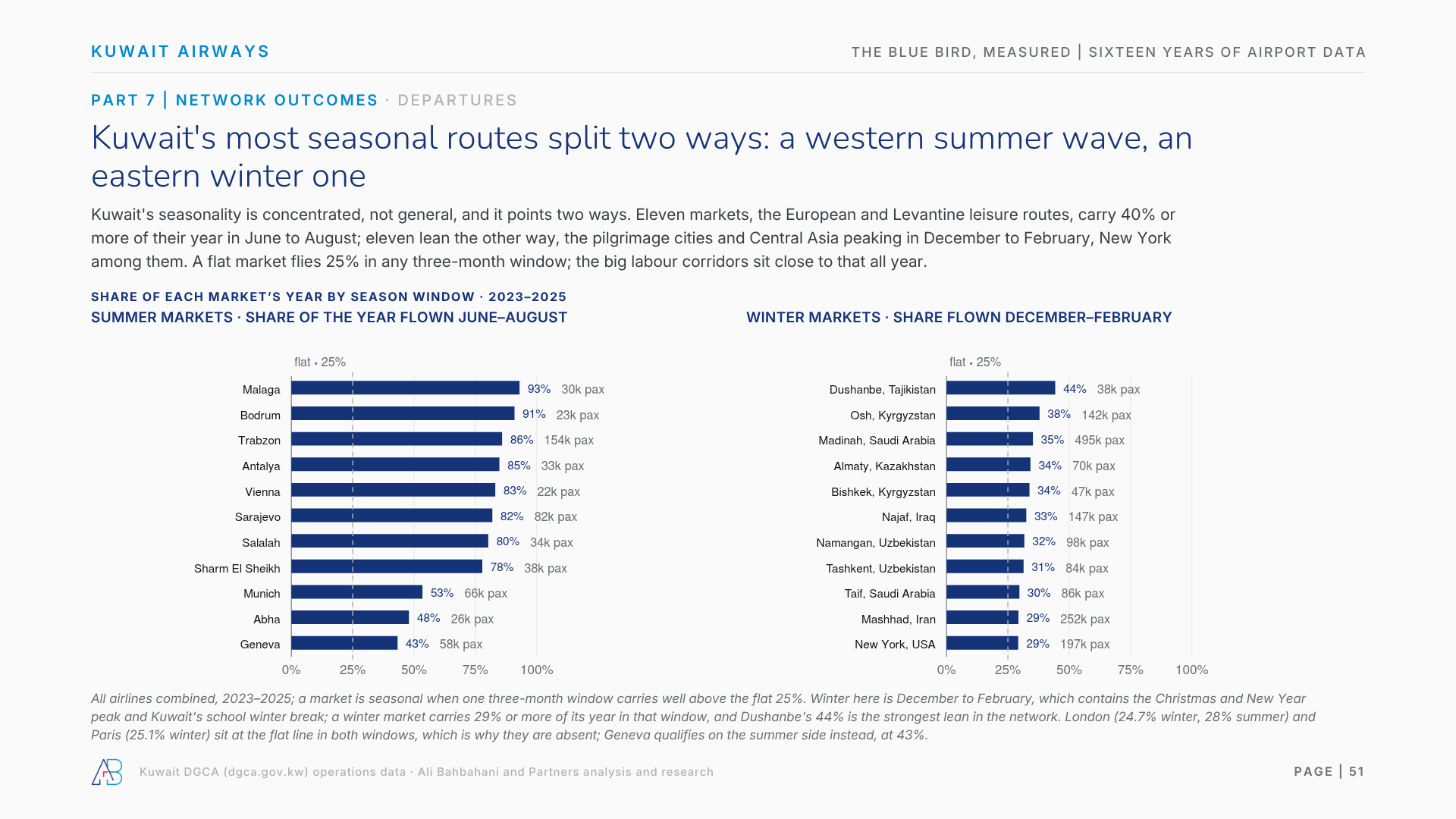
The map also carries its seasons and its scars. Kuwait’s most seasonal routes split two ways: a western summer wave, Malaga at 93% of its year flown in June to August, Bodrum at 91%, Trabzon at 86% on a substantial 154,000 passengers, Antalya, Vienna and Sarajevo behind them; and an eastern winter one, Dushanbe at 44% of its year in December to February, Osh, Almaty and Bishkek with it, alongside Madinah, whose 35% winter lean comes on 495,000 passengers, the largest seasonal market in the network, and New York at 29%. Six times in fifteen years an airline built a route from nothing and the market usually grew around it: Pegasus into Istanbul in 2014, plus 64,000 for the market in the entry year, flynas into Riyadh the same year, Bahrain Air in 2012, Onur Air in 2019. Cairo is the exception twice over, shrinking in the entry year both times, by 39,000 when Jazeera entered in 2011 and by 15,000 when Air Arabia Egypt arrived in 2025; entry and growth coincide here, and the data cannot say which caused which. And six routes collapsed outright: Dammam from a 94,000 peak in 2022 to 26,000, Frankfurt from 82,000 under Lufthansa in 2018 to 21,000, Washington dead entirely with United’s exit from a 60,000 peak, Namangan, Kannur and Jakarta, which was 100% Kuwait Airways at its 2011 peak and is now gone. None of the six has found an airline willing to try again at scale.


The rhythm: when Kuwait flies
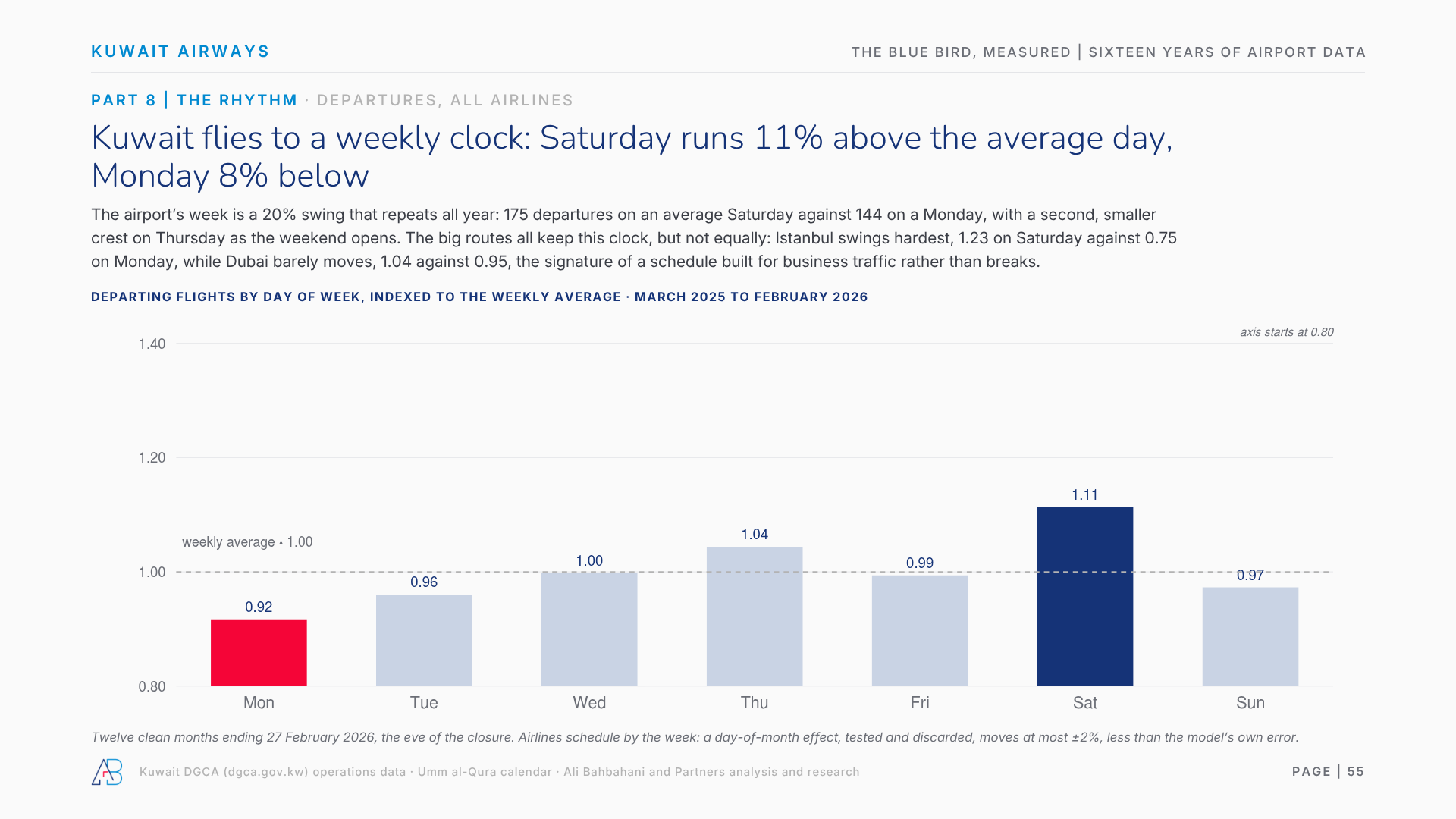
When Kuwait flies is the most predictable thing about it. The airport runs to a weekly clock: 175 departures on an average Saturday against 144 on a Monday, an 11% crest and an 8% trough around the weekly mean, with a second smaller crest on Thursday as the weekend opens. The big routes keep this clock unequally: Istanbul swings hardest, 1.23 on Saturday against 0.75 on Monday, while Dubai barely moves, 1.04 against 0.95, the signature of a schedule built for business traffic rather than breaks.
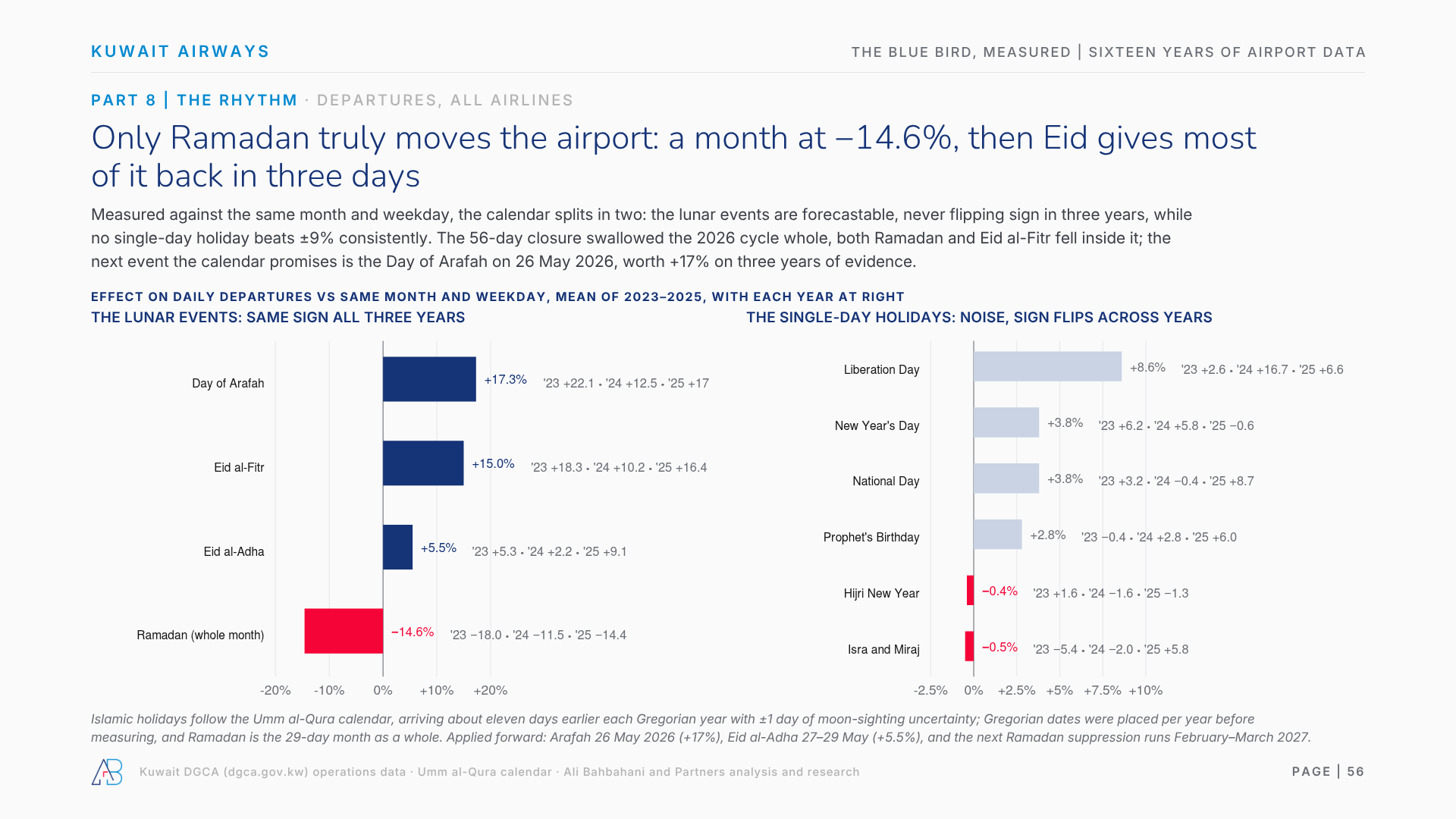
Only Ramadan truly moves the calendar: a month at minus 14.6% against the same month and weekday, and then Eid al-Fitr gives most of it back at plus 15.0% across three days. The lunar events never flipped sign in three years of measurement, Eid al-Adha at plus 5.5% and the Day of Arafah at plus 17.3%, while no single-day state holiday beats plus or minus 9% consistently; Liberation Day averages plus 8.6% but swings year to year. The calendar applies forward: Arafah landed on 26 May 2026 worth plus 17% on three years of evidence, and the next Ramadan suppression runs February to March 2027.
Put the pieces together and the flying year has kept the same shape for three years running: a March to May trough, an August peak at 1.12 to 1.18 times the year’s average, and a within-month spread of 3 to 10%. Predicting each 2025 month from the 2023 to 2024 index alone misses by 2.9% on average, and the misses are structured: June is worst at 7.1% because the Hajj drifts eleven days a year, March and April wander because Ramadan does. A working forecast of this airport is level times month times weekday times the lunar calendar; everything else measured is smaller than the model’s own error.

Cargo: the duopoly that is not one
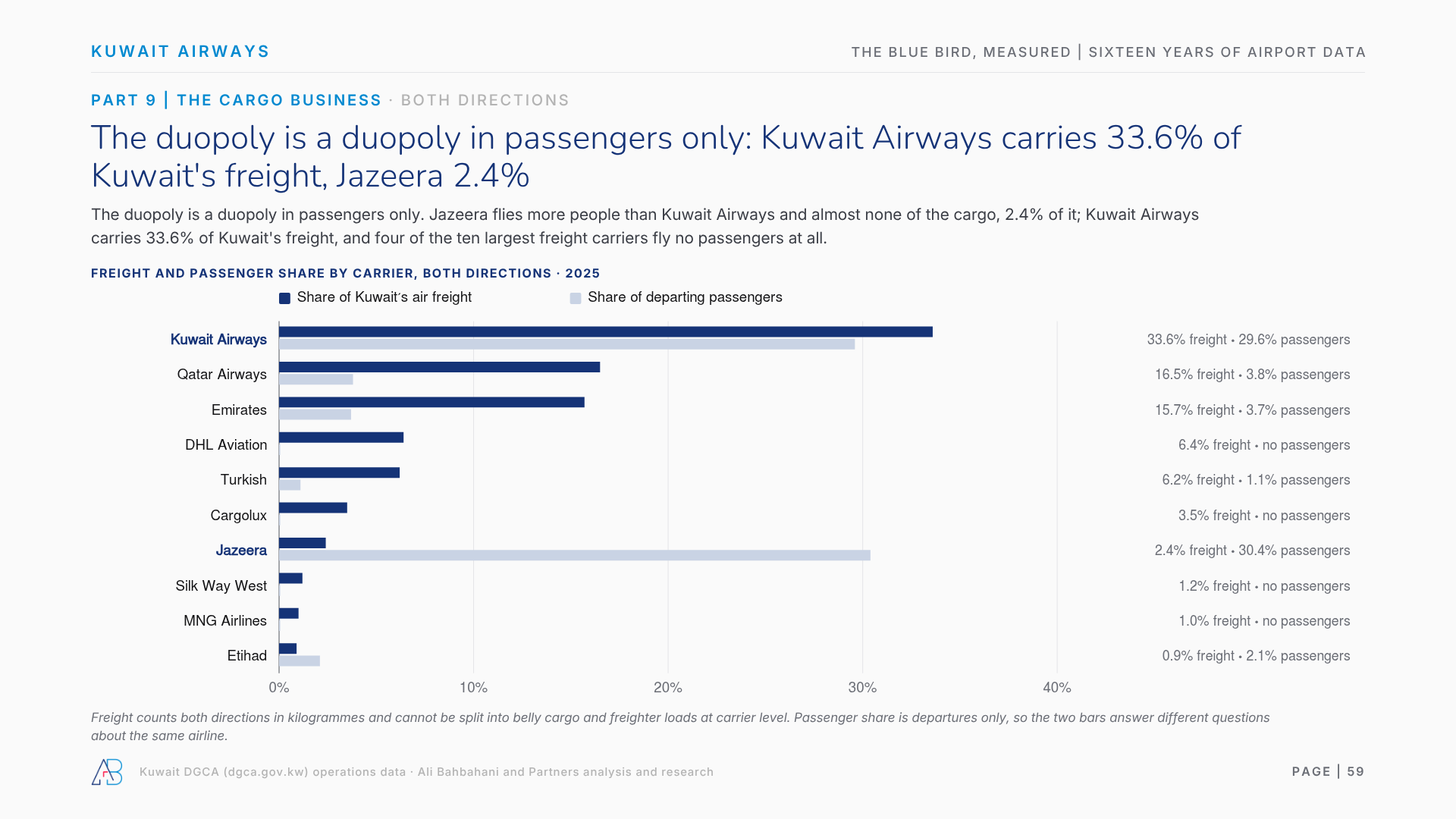
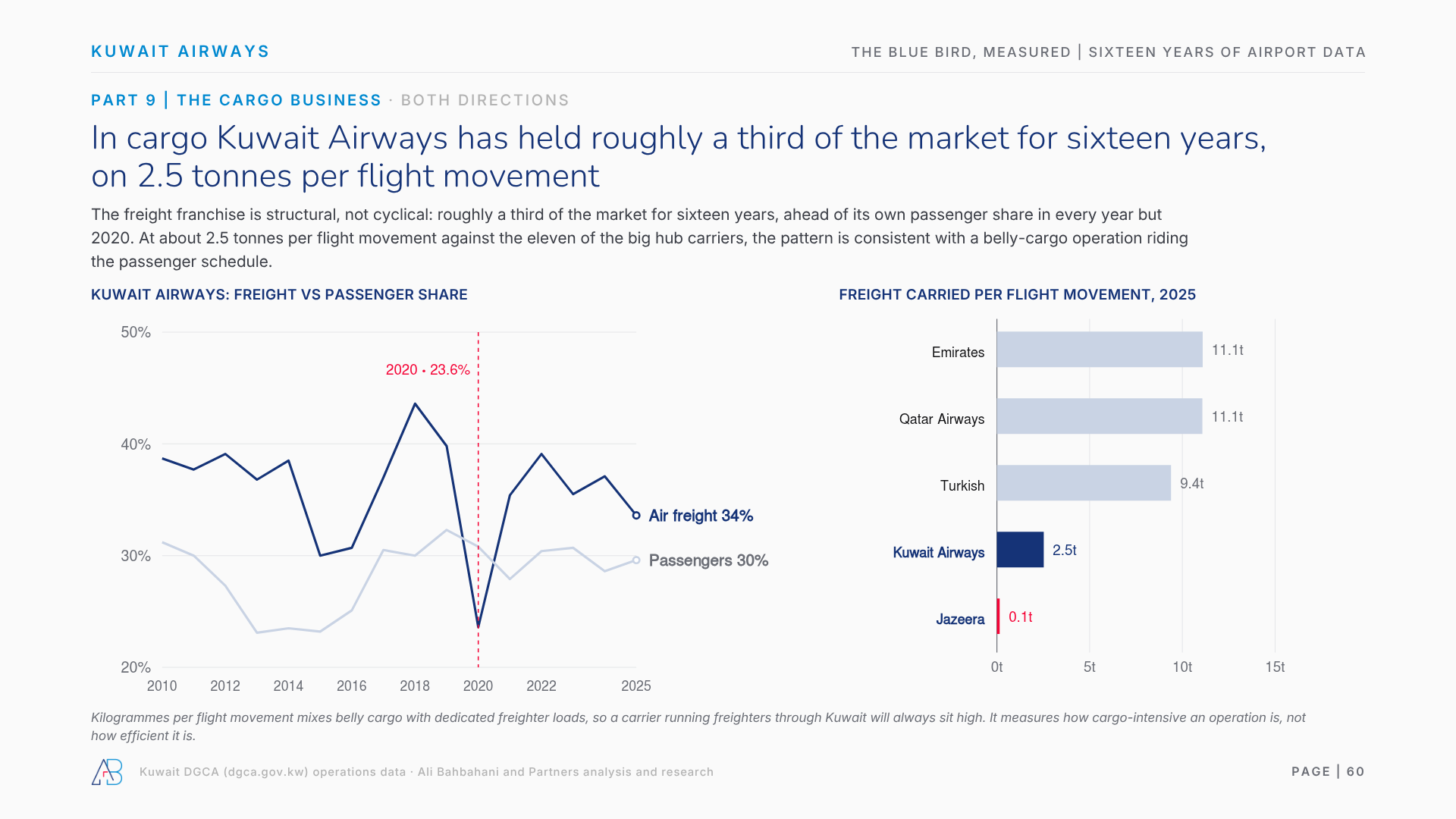
The duopoly is a duopoly in passengers only. Jazeera flies more people than Kuwait Airways and almost none of the cargo, 2.4% of it; Kuwait Airways carries 33.6% of Kuwait’s air freight and has held roughly a third of the market for sixteen years, ahead of its own passenger share in every year but 2020. Behind it, Qatar Airways carries 16.5% of Kuwait’s freight and Emirates 15.7%, then DHL Aviation at 6.4%, Turkish at 6.2% and Cargolux at 3.5%; four of the ten largest freight carriers fly no passengers at all. Intensity separates the models: Emirates and Qatar Airways move 11.1 tonnes per flight movement through Kuwait and Turkish 9.4, against Kuwait Airways’ 2.5 and Jazeera’s 0.1, the pattern of a belly-cargo operation riding the passenger schedule. The closure proved the franchise: with zero passengers for 56 days, 628 airline-flown tonnes still moved, 96% of them on Kuwait Airways.
The two directions: what arrivals reveal that departures cannot
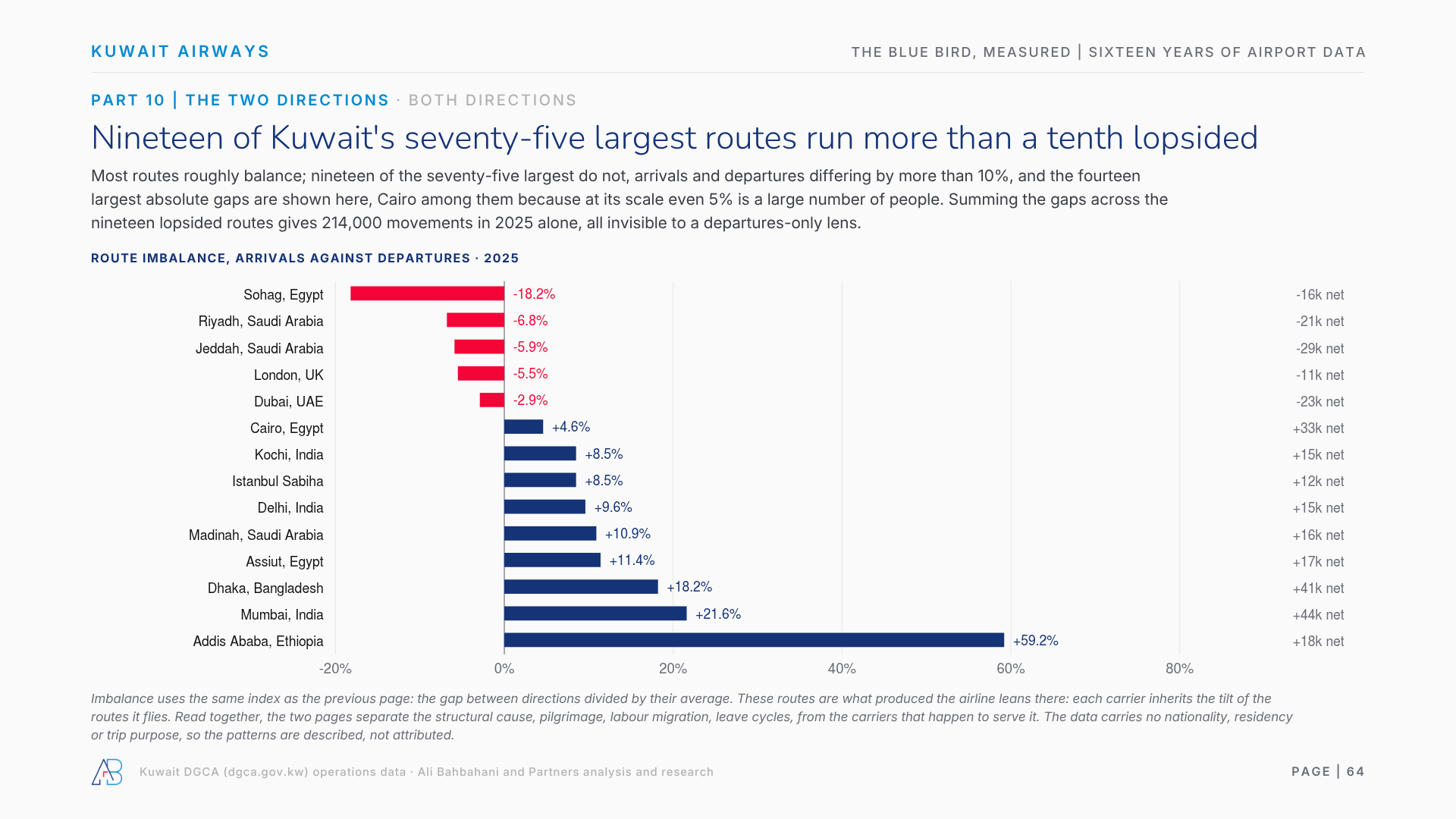
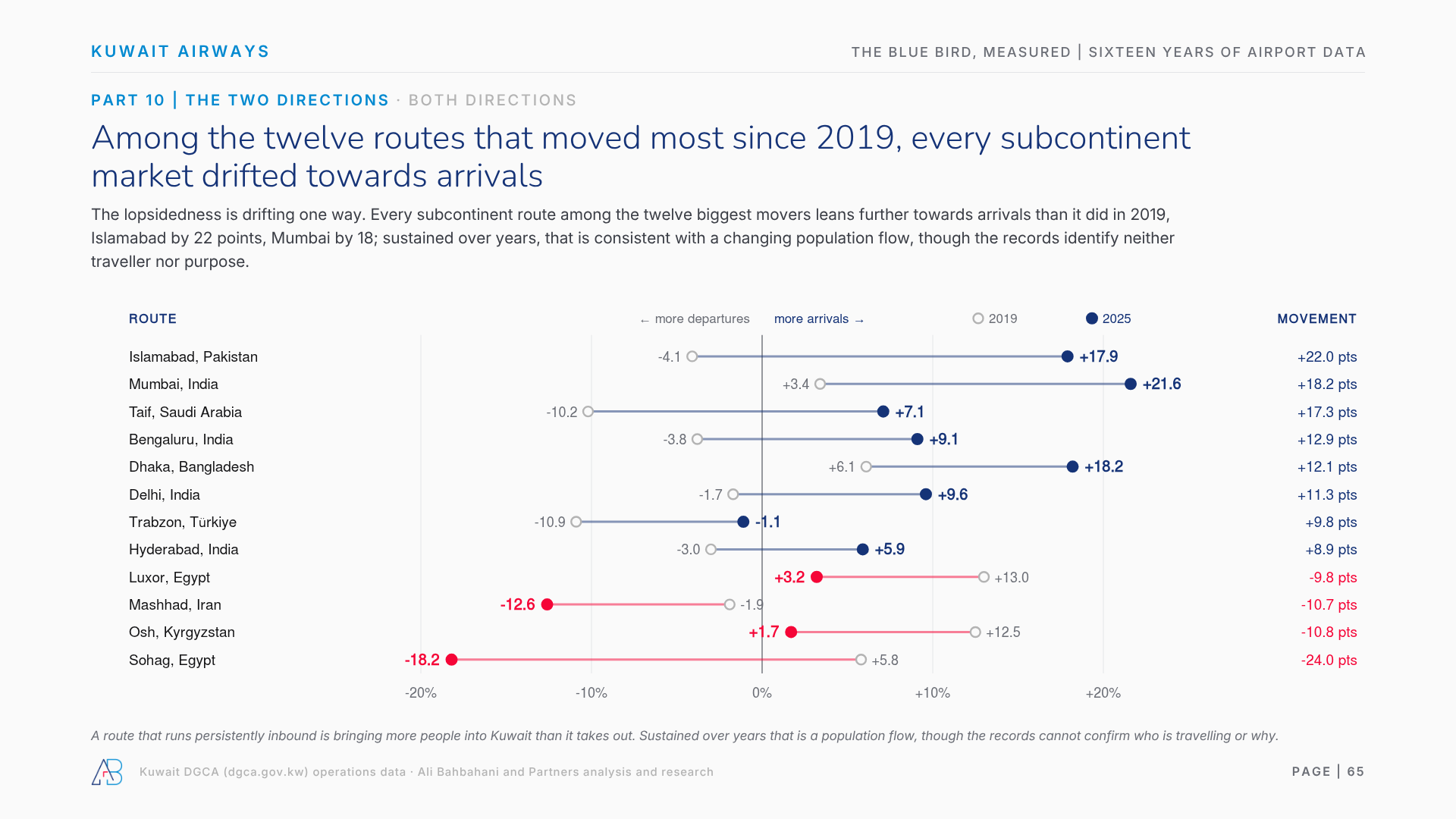
At carrier level the two directions stop agreeing. Saudia flies 23,000 more passengers out of Kuwait each year than it brings back, 162,000 out against 139,000 in, a 15.5% outbound lean consistent with one-way pilgrimage traffic; flydubai leans out by 9.7% and Emirates by 4.4%. The inbound-leaning carriers all serve the subcontinent: IndiGo at plus 4.0% on 276,000 out and 287,000 in, and Kuwait Airways itself at plus 3.9% on 2.30 million out and 2.39 million in. Nineteen of Kuwait’s seventy-five largest routes run more than a tenth lopsided, 214,000 movements in 2025 invisible to a departures-only lens: Addis Ababa runs 59.2% towards arrivals, Mumbai 21.6% for 44,000 net movements, Dhaka 18.2% for 41,000, Cairo only 4.6% but 33,000 people at its scale, while Sohag leans 18.2% the other way. Every subcontinent route among the twelve biggest movers since 2019 drifted towards arrivals, Islamabad by 22 points, Mumbai by 18; sustained over years, that is consistent with a changing population flow, though the records identify neither traveller nor purpose.

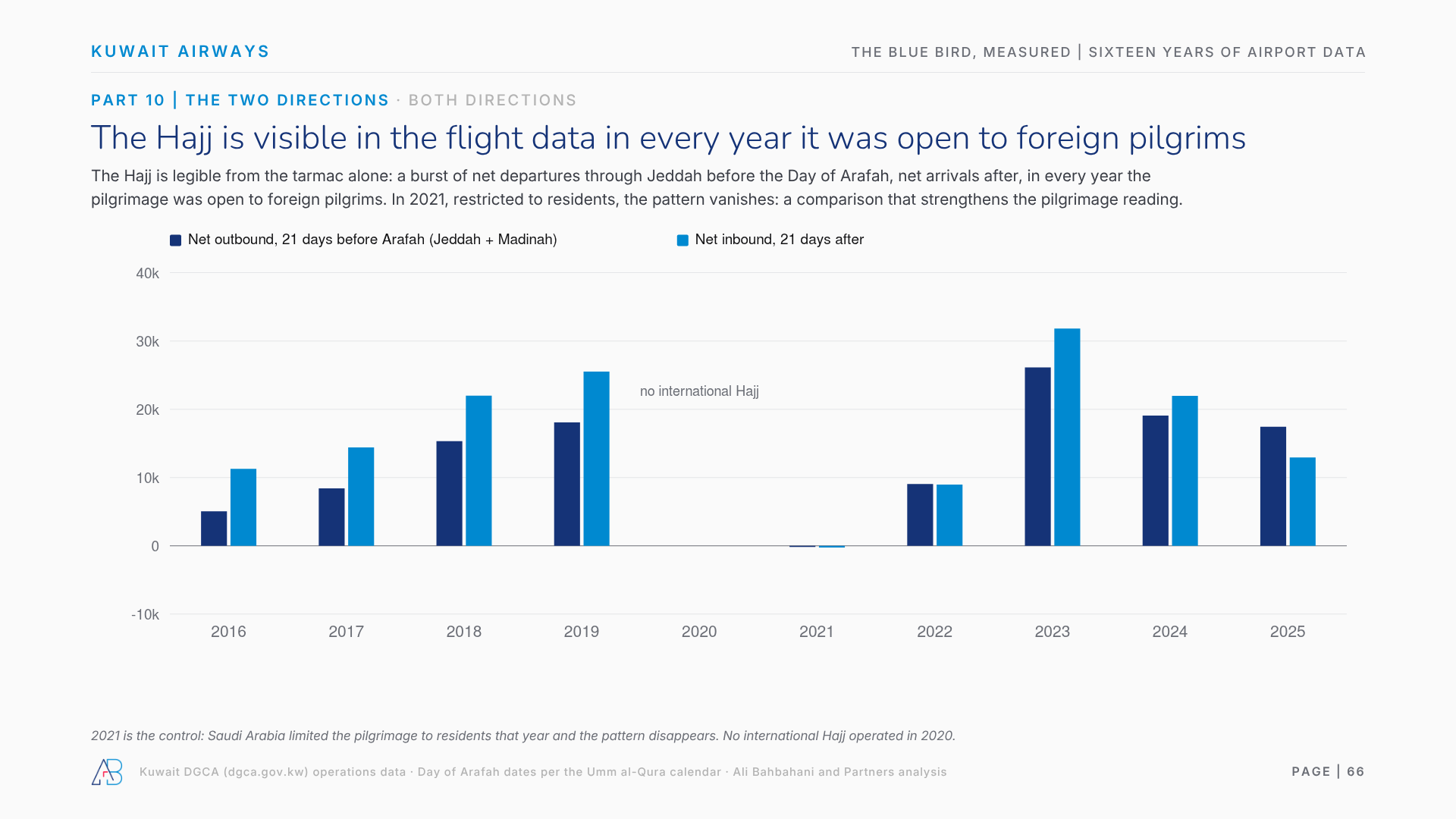
The Hajj is legible from the tarmac alone: a burst of net departures through Jeddah before the Day of Arafah and net arrivals after, in every year the pilgrimage was open to foreign pilgrims. Averaged across all fourteen open years, the peak outbound day runs 4,177 net departures three days before Arafah and the peak return 4,700 four days after, with Jeddah carrying three quarters of the movement out: two tight windows, not two months. In 2021, when Saudi Arabia restricted the pilgrimage to residents, the pattern vanishes, which is the control that strengthens the reading. The subcontinent corridor breathes on its own annual cycle, emptying out in June at 28% net departures and refilling in September at 51% net arrivals, consistent with a summer leave cycle.


Where next, and the three numbers that decide the restart
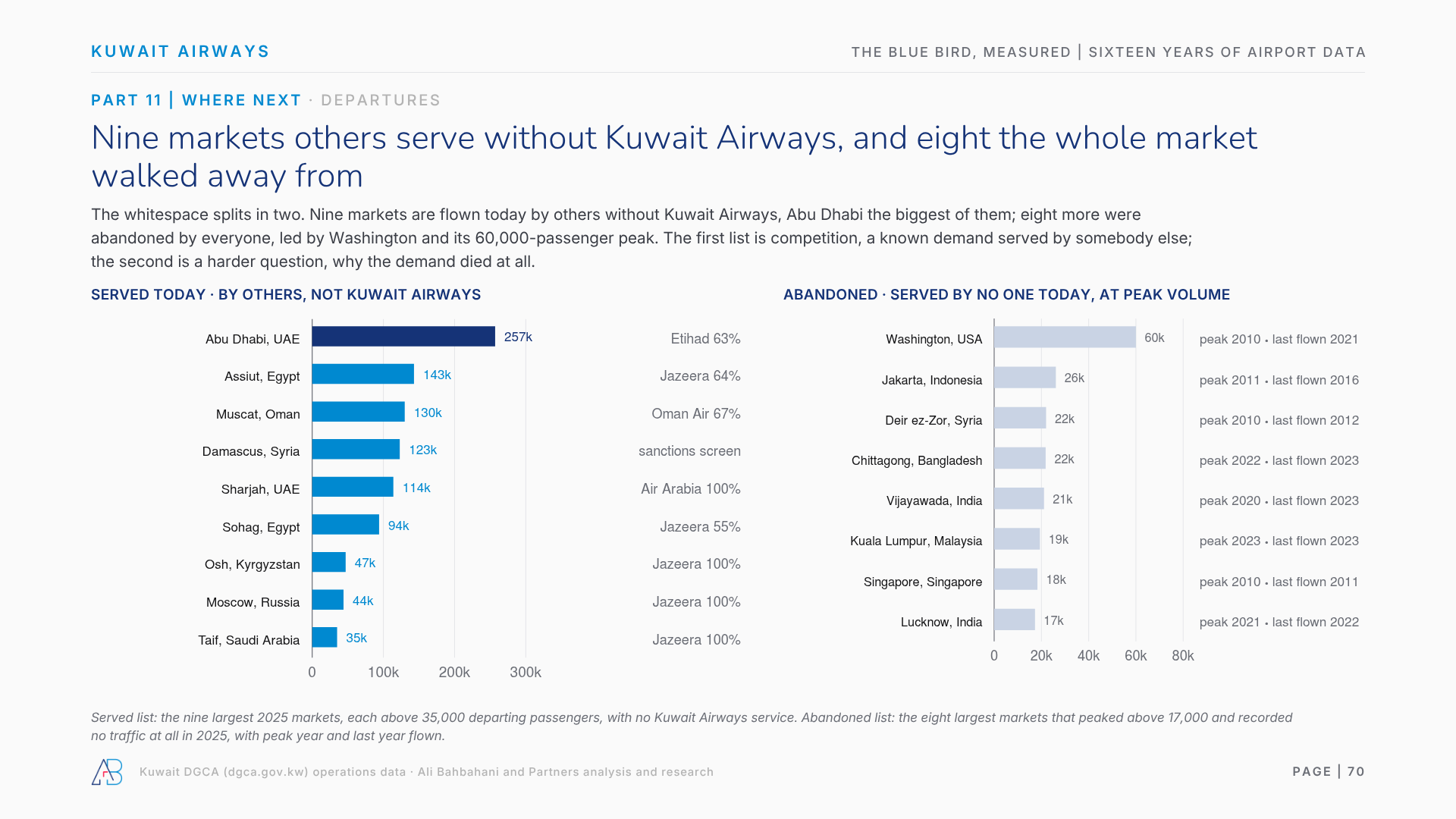
The whitespace splits in two. Nine markets are flown today by others without Kuwait Airways: Abu Dhabi the biggest at 257,000 departing passengers with Etihad holding 63%, Assiut at 143,000 where Jazeera holds 64%, Muscat at 130,000 under Oman Air, Damascus at 123,000 behind a sanctions screen, Sharjah at 114,000 flown entirely by Air Arabia, then Sohag, Osh, Moscow and Taif. These are known demand served by somebody else, the first candidates for a route-economics screen. Eight more were abandoned by everyone: Washington’s 60,000-passenger peak under United, last flown in 2021; Jakarta, 100% Kuwait Airways at its 2011 peak, last flown in 2016; Deir ez-Zor, Chittagong, Vijayawada, Kuala Lumpur, Singapore and Lucknow. Those pose the harder question of why the demand died at all. Since 2019 the network still grew, from 51 city markets to 60.
Three numbers will say who won the restart. The 30.6% dead heat on the eve of the closure: whoever breaks it owns the market’s direction. The 154.7 passengers per departure: Kuwait Airways’ best since 2019 and the engine of its gain, and the question is whether it survives a full schedule. And 33.6% against 2.4%: the cargo shares, the one franchise Jazeera does not contest and the one that kept flying through the closure.

Kuwait airport data and airlines data: quick answers
How many passengers does Kuwait International Airport handle?
Kuwait International moved 15.7 million passengers in 2025, its busiest year on record: 7.78 million departures and slightly more arrivals, with net arrivals in each of the last four years. Across the full window of this study, 2010 to 13 May 2026, the airport recorded 181.8 million passenger movements.
What is the largest airline in Kuwait?
Counting both arriving and departing passengers in 2025, Jazeera Airways was the largest airline at Kuwait International with 4.77 million passenger movements, 30.32% of the airport, against Kuwait Airways’ 4.70 million at 29.86%. No foreign carrier reached 4%. Counting departures only, the basis on which passengers choose an airline, the two were level at 30.6% each in the first eight weeks of 2026.
What is Kuwait Airways’ market share?
Kuwait Airways carried 29.6% of departing passengers from Kuwait in 2025, against 32.3% in 2019 and 31.2% in 2010. Inside 2025 the monthly figure climbed from a 24.8% floor to 31.0% across nine consecutive months of year-on-year gains, a streak the airspace closure interrupted.
How many aircraft does Kuwait Airways operate?
Around 32 aircraft in 2025, up from 17 in 2010, based on corporate disclosures and manufacturer delivery records; the counts are estimates rather than audited registers. The airline was the world’s launch operator of the Airbus A330-800neo in October 2020 and took the first of nine A321neos, its first flat-bed narrowbody, in May 2025.
Why was Kuwait’s airspace closed in 2026?
Kuwait closed its airspace on 28 February 2026 after Kuwait International was struck during the regional conflict, and commercial passenger operations stopped for 56 days; the restart began on 26 April 2026, later than any other GCC state. This study measures the operational record; the economic side is covered in our March 2026 data note.
Which routes does Kuwait Airways fly with no competition?
Twenty city markets had no other scheduled carrier in 2025, led by Bangkok at 102,685 departing passengers, then Manila, New York, Paris and Milan. Together the monopoly routes carried 565,000 passengers on 3,061 flights, about a quarter of the airline’s departures.
Where does this Kuwait airlines data come from?
From the daily and route-level operations data of Kuwait’s Directorate General of Civil Aviation, with Boursa Kuwait filings and prices, Central Bank of Kuwait and Central Statistical Bureau context, and PACI population records, analysed by Ali Bahbahani and Partners. The dataset runs from 2010 to 13 May 2026 and excludes transit passengers.
At Ali Bahbahani and Partners we have worked on both sides of this industry: we redesigned the end-to-end customer experience for the flag carrier itself, documented in Elevating the Art of Travel, and we rebuilt the mobile booking journey for a GCC airline, with the revenue results in this case study. If your business depends on reading Kuwait’s aviation market, or competing in it, the underlying route-level database behind this study is the place to start a conversation.
Method note: the study counts point-to-point traffic at Kuwait International, transit excluded. Parts of the analysis count departures only, the basis on which a passenger chooses an airline; airport totals, cargo and directional analysis count both directions and say so. Passengers per departure is a density proxy, not measured occupancy. Sources: Kuwait DGCA (dgca.gov.kw) daily and route-level operations data, Boursa Kuwait filings and prices, Central Bank of Kuwait, Kuwait CSB, PACI and the Umm al-Qura calendar, with Ali Bahbahani and Partners analysis and research throughout. Data through 13 May 2026.