Kuwait Travel & Tourism 2025: Trends & Growth
.avif)
.webp)
Every year Skift publishes its Megatrends report and every year I read it looking for Kuwait. Every year Kuwait is not in it. That is not a complaint, it is a diagnosis. Kuwait is not in the report because Kuwait is not yet a destination that the people who write about global tourism feel compelled to write about. We are a transit country, a business-travel stop, and an easy weekend for our GCC neighbours. That is the current ceiling and it is well below where it should be.
The 2025 Megatrends list runs to seventeen shifts in how people travel, where they spend, and what they expect. I have read through them twice and asked myself the same question each time: which of these does Kuwait actually have a credible answer to in the next three years, and which are we pretending to take seriously while quietly doing nothing? The answers are uncomfortable in places. That is the point of writing them down.
.avif)
A note on method. I am not going to rehearse every trend in the Skift report. I am going to run through them at pace, take a position on each one as it relates to Kuwait specifically, and move on. If you want the full Skift read-out, they publish it for free. What I am doing here is the part nobody else will do — arguing with it from inside Kuwait, with the names of the places and the people who would actually have to make the decisions.

1. Pet-Friendly Travel Is Not Coming to Kuwait Anytime Soon
Globally, pets are now travellers. Hotels in Europe and North America compete on dog menus, pet concierges, and in-room bedding for a labrador. Skift is correct that this is a structural shift, not a fad — about 60% of American households now own a pet and a growing share of them refuse to leave the animal behind.
In Kuwait, this trend is a rounding error. The cultural relationship with dogs in particular is not the same as in the West, and the idea of a dog on a hotel sofa in Salmiya is not going to land with most Kuwaiti guests. I am not arguing that we should pretend this trend does not exist. I am arguing that chasing it is a mistake. The property that devotes a floor to pet-friendly rooms in Kuwait is optimising for a customer who is not in the market.
What Kuwait could actually do is thoughtful accommodation for the GCC expat market, where pet ownership is closer to Western norms. That is a specific, quiet, well-priced offering — not a reinvention of the brand.

2. Wellness Done Seriously, or Not at All
The global wellness conversation has moved on from the spa menu. Skift is tracking properties that do psychedelic retreats in Jamaica, week-long breath-work programmes in Costa Rica, and diagnostic-grade longevity clinics in Switzerland. That end of the market is not a Kuwaiti conversation. It is also not where the Kuwaiti opportunity is.
Our opportunity is the authentic one. Kuwait sits on top of a regional tradition of hammam, herbal medicine, and rituals around rest that have been practised here for longer than any Western wellness brand has existed. A Kuwaiti hotel that builds a serious wellness programme around those traditions — properly researched, properly designed, properly priced — would have a story that no spa in Dubai can copy because no spa in Dubai has the cultural claim to it.
Most of our hotels do the opposite. They install a generic spa menu, print it in English and Arabic, and hope nobody notices it is the same menu that is on sale in every other city in the region. That is the part I would argue with.

3. Big Events Work — If You Build on Them
Khaleeji Zain 26 proved Kuwait can host an international event and pull it off. The tournament moved 400,000 spectators, generated 61 million KD, and delivered a media reach of 16 million viewers across the GCC. Those are not small numbers. I wrote about the tournament in January and then again in the post-tournament analysis once the full data had landed.
Here is where I want to be direct. Skift treats big events as a structural trend — host a mega-event, convert visitors into return travellers, build a long-run tourism moat. The first half of that sentence, Kuwait can do. The second half, Kuwait did not do. Visitors came, spent, and left. Almost nothing was built on top of them in the months that followed. That is not a Skift problem, that is a Kuwait follow-through problem. The trend is real. Our exploitation of it has not been.

4. The Influencer Economy, and Why Kuwait Has One Real Asset
Globally, travel creators have moved from photographing destinations to selling them. They book hotels through affiliate links, they run private tour groups, and in some cases they are the reason a city shows up on a 25-year-old's shortlist. Skift treats this as the dominant acquisition channel for under-35 leisure travel, and they are right.

The Kuwait Angle: @hello965 Is the Template
Kuwait has one world-class travel creator in this space — @hello965 — and the reason to mention her by name is that she does what tourism boards in the region spend millions trying to do, and she does it from a phone. Her trip diaries convert in a way that billboards never will, and the Kuwaiti tourism sector has been collectively slow to figure out what to do with her and the handful of others in her orbit.
The playbook is not complicated. Partner with local creators seriously. Give them creative freedom. Pay them what they are worth. Measure bookings, not likes. Most of the Kuwaiti brands who have tried this have either micromanaged the content into uselessness or underpaid the creator and then been surprised when the post felt obligatory. Both of these failures are solvable in an afternoon.

5. Unbundling Is How Hotels Quietly Become Airlines
Skift is right that hotels worldwide are unbundling services — early check-in as a paid upgrade, breakfast as an add-on, a room-type selector that charges for the view. Some of this is legitimate revenue management. Most of it is a race to the bottom that turns a hotel stay into a transaction and the guest into a resentful accountant.
I am going to take a position on this one. Kuwaiti hotels should not adopt the unbundling playbook. It is cheap, it is obvious to the guest, and it breaks the one thing our industry has going for it — the expectation that hospitality in this part of the world is generous by default. The hotel that charges 10 KD for a two-hour early check-in is saving money that it will lose on the next booking, and the hotel that hides the breakfast charge in a third booking step is teaching its guests to distrust it.
If you need more revenue per guest, the answer is not to nickel-and-dime the base experience. It is to create genuinely better options at the top of the stack that a real customer would pay for. That is a harder conversation than adding a 10 KD line item. It is also the only version of the conversation that actually builds the brand.

6. Discovery Has Moved. Booking Has Not.
This is the most misunderstood trend in the Skift list. Yes, TikTok and Instagram and ChatGPT are where younger travellers now find destinations. Yes, Google's share of pure destination discovery is falling. Yes, AI-generated travel planning is becoming real enough to matter.
But the actual booking still happens on Google, Booking.com, Expedia, and the hotel's own site. The funnel has split — discovery on one set of platforms, conversion on another. Kuwaiti tourism businesses that panic and pour budget into TikTok-only campaigns are solving half the problem. The other half is making sure that when a traveller who saw your property on TikTok opens Google thirty seconds later, your site loads, your booking flow works, and your pricing is defensible.
Most Kuwaiti hotels fail the second half. The TikTok part is discussed in marketing meetings. The broken checkout flow is not.

7. Kuwait Does Not Have an Over-Tourism Problem
Skift spends a good portion of the report on policy responses to over-tourism — Amsterdam capping cruise ships, Barcelona raising daily tourist taxes, Venice charging for day trippers. None of this is a Kuwait problem and I would argue it is not a useful frame for our conversation. We have the opposite problem. Too few visitors, not too many. A visitor cap in Kuwait in 2025 would be tourism malpractice.
What we do need is the policy side of the tourism equation to function at all. Visa-on-arrival that is faster than it currently is. Signage in Kuwait International Airport that does not make a first-time visitor anxious. A coherent national tourism brand that does not look like it was designed in the mid-2010s. A cultural calendar that is published in English more than three weeks in advance. These are boring, expensive, and the kind of thing that every other GCC tourism ministry has figured out. Ours has not.

8. First Class Is Back. Kuwait Airways Should Notice.
The global premium-cabin numbers are clear. First class, which most of the industry declared dead in the 2010s, is back. The highest-spending travellers want privacy, space, and service that is measurably different from business — and they will pay for it. Airlines that got rid of first class are quietly re-adding it.
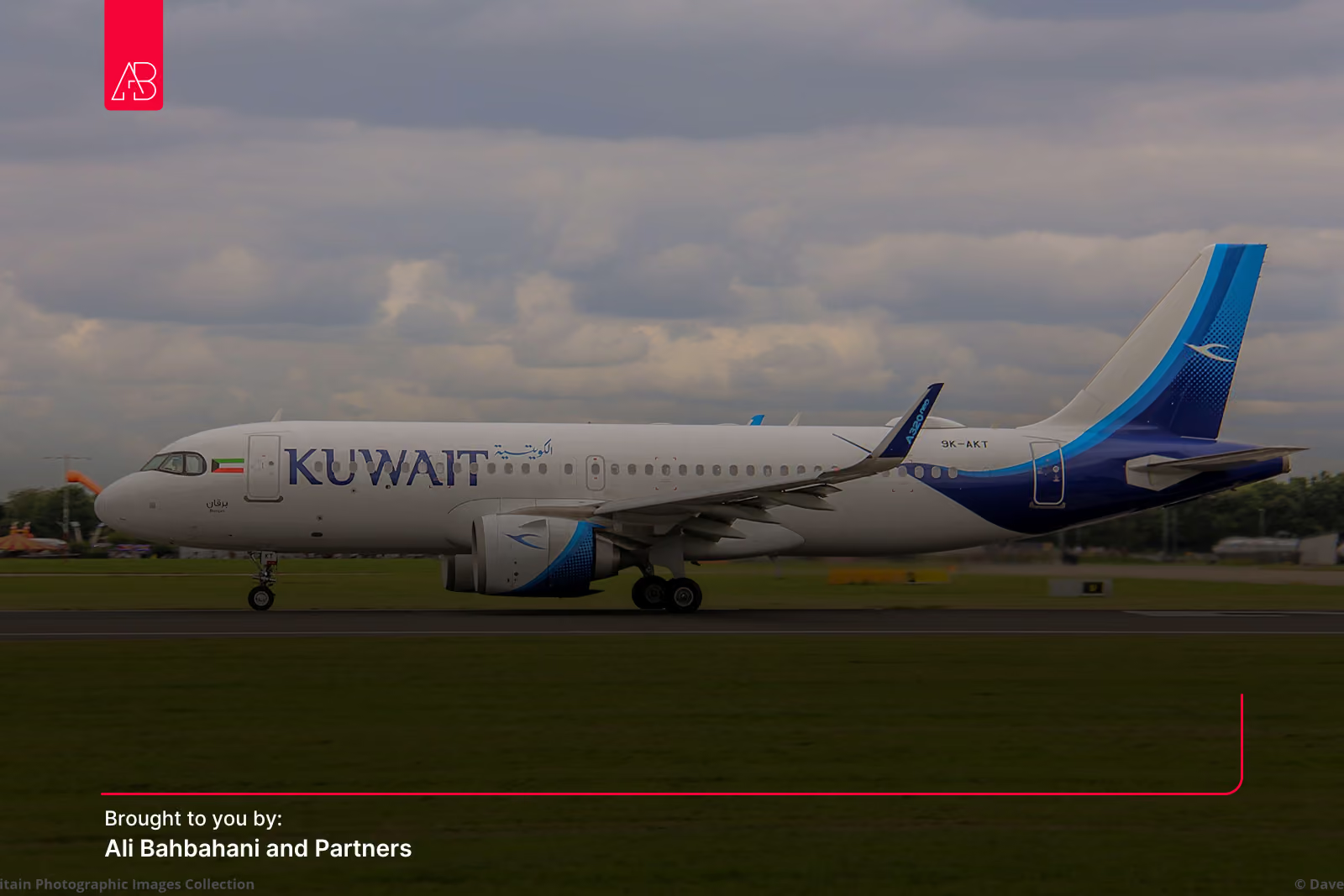
Gulf carriers should be the natural leaders here, and some of them are. Emirates still has the most recognisable first-class product in commercial aviation. Qatar Airways' Qsuite blurred the line between business and first so effectively that it made the whole category interesting again. Kuwait Airways, which could and should be part of this conversation, is not.
I have flown every Gulf carrier's premium product and I have written about the drop in British Airways' long-haul first. The truth is that Kuwait Airways does not need to out-spend Emirates. It needs to pick one thing — service, privacy, catering — and do it at a world-class level. The current product is competent and forgettable. Competent and forgettable is fine for a regional carrier. It is not fine for the national flag of a country that wants to be a tourism destination.

9. The Summer Exodus Is Permanent. Kuwait Hotels Should Stop Pretending Otherwise.
Every Kuwaiti family I know leaves Kuwait in July and August. They have been doing this for decades. The only thing that has changed is that the global climate is making the summer hotter, longer, and less tolerable, which means the exodus will grow, not shrink. Skift frames this as "travellers chasing cooler climates" and for Kuwait it is not a trend — it is a structural fact about how this country's hospitality economy works.
What our hotels should do with this is the interesting question. Every Kuwaiti hotel I talk to treats July and August as a dead zone, lays off temporary staff, and waits for September. That is a choice, and it is the wrong one. The right one is to build the summer around the people who cannot leave — the expat residents, the GCC visitors on short trips, the residents of other Gulf countries who want a long weekend in an air-conditioned city. Kuwait in July can be quietly excellent for the traveller who was never going to be in the desert anyway. Most of our properties have not written that story, let alone sold it.

10. Travel Insurance Is Becoming Real. Most of Kuwait's Travellers Do Not Know It.
Skift is right that travel insurance is moving from post-event compensation to active support — concierge-grade rebooking when flights cancel, medical evacuation that actually works, real-time rebooking assistance. This is a quiet revolution in the category. It is also almost invisible in Kuwait, where travel insurance is still bought as a line item on the same page as the flight and treated as a formality nobody reads.
There is a real opportunity for a Kuwaiti insurance provider or a tourism ministry to make the new generation of travel protection a selling point for inbound visitors. "Come to Kuwait and if anything goes wrong we will actually help you fix it" is a genuinely strong positioning statement and it costs almost nothing to build on top of products that already exist internationally. Nobody is doing it here yet.

11. Kuwait's Quiet Diplomacy Is a Tourism Asset Nobody Is Using
The global trend Skift names here is that geopolitics is now a travel variable. Visa reciprocity, trade tensions, and political shifts reshape where people can and cannot go on short notice. For most of the Gulf, this is a complication. For Kuwait, it could be an advantage we have not bothered to claim.
Kuwait has one of the most diplomatically stable foreign-policy postures in the region. We rarely get drawn into regional disputes. Our relationships across the Arab world, Europe, and Asia are deliberately boring, which in diplomatic terms is a compliment. A traveller who is weighing up Kuwait against an alternative and thinking about stability should rationally pick us. But nobody is making that argument out loud. Our tourism messaging says nothing about it, and the people who would notice — the traveller who cares about not being caught in a regional incident — are not being told to consider Kuwait at all.

12. Quiet Luxury Is the Kuwait Story, If We Would Tell It
The global move toward quiet luxury — craft over logo, experience over display, the room that does not need to announce itself — is a fit for Kuwait that is almost too on the nose. Our domestic culture of hospitality is already quiet. The majlis tradition is restrained. The best Kuwaiti food is served in ways that do not call attention to themselves. We have the raw materials for a quiet-luxury hospitality brand that the rest of the region does not.
Instead, our new hotel developments keep defaulting to the Dubai playbook — gold accents, oversized lobbies, LED screens at the entrance. That is not what the quiet-luxury traveller is looking for. The property that leans into restraint, into authentic Kuwaiti craft, into service that does not perform itself, will win that customer by default because there is no competition for them in the GCC. This is the single clearest opportunity on the Skift list and the one I am most disappointed is not being taken up.

13. Experiential Travel, and What Kuwait Already Has
Skift tracks a global move toward playful, immersive, experience-led travel — the traveller who wants to do something, not just see something. The GCC answer to this has largely been theme parks, manufactured at scale in Dubai and now Saudi. That is one answer. It is not the only one.
Kuwait has museums and cultural spaces that could, with better programming, be genuine experiential venues. The Sheikh Abdullah Al Salem Cultural Centre is underused. Failaka Island, properly developed, could be a unique cultural-heritage experience that no other GCC country can replicate because nobody else has a 4,000-year archaeological site. The Tareq Rajab Museum is a world-class private collection that almost no visitor to Kuwait has heard of. The raw ingredients are here. What is missing is the ambition and the operations.

14. Loyalty Is Becoming Access, Not Discounts
Points-based loyalty is being replaced globally by access-based loyalty. The elite guest does not want a free night, they want a table at the restaurant that does not have availability. They want the private tour. They want the upgrade that money cannot buy. Marriott, Hyatt, and Four Seasons have all been quietly restructuring their loyalty benefits in this direction.
Kuwaiti hotels are mostly running loyalty programmes that were designed in the 2000s. The opportunity, specifically for a property like the Four Seasons Kuwait or the Grand Hyatt Kuwait, is to translate their global loyalty currency into access to things that only they can offer — private after-hours at the Tareq Rajab, a dinner at a chef's home, a tour of the Kuwait Towers that includes the structural-engineering story nobody has told before. None of this is expensive to deliver. All of it is memorable in a way a free breakfast is not.

15. AI in Travel: Overhyped Globally, Under-used in Kuwait
The global AI-in-travel conversation is running ahead of the useful applications. Most of what is marketed as "AI for travel" is a chatbot with a veneer, and most of those are worse than the website they replaced. I am not going to pretend the technology will transform Kuwaiti tourism in the next 12 months.
What I will say is that Kuwait has a specific AI-shaped gap that is solvable now. An Arabic-language tourism chatbot — not a generic translation of an English one, but a product that actually understands Kuwaiti dialect, local place names, and the specific ways a Saudi or Emirati visitor would ask a question — would be genuinely useful and technically not hard to build. I have yet to see one that works well. The Kuwait Ministry of Information could build it in a quarter. They have not.

16. The GCC Is Moving. Kuwait's Position Is Not.
This is the part of the Skift report that should make every Kuwaiti tourism official uncomfortable. Saudi Arabia has Vision 2030, which is funding cultural and tourism infrastructure at a scale that has no regional precedent. The UAE has added gaming to its tourism mix and is quietly building the infrastructure to host Gulf-region casinos within the decade. Qatar is consolidating the post-World Cup tourism brand it built in 2022. Bahrain runs the F1 and has been building a cultural calendar around it.
Kuwait's public position on all of this is silence. There is no equivalent Kuwait Vision. There is no announced tourism megaproject. There is no calendar of events that the region knows about by name. The word I keep coming back to is "measured" — and measured can be a strategy, if it is deliberate. If Kuwait's position is that it will build a quieter, more culturally authentic, less bombastic tourism offering than its neighbours, that is a defensible choice and I would back it. But it has to be said out loud. Right now it is not being said at all, which means the region reads our silence as absence rather than choice.

17. Purpose-Driven Hospitality, and the One Thing Kuwait Already Has
The last trend on the Skift list is the one that annoys me the most because the global version of it is mostly marketing. "Purpose-driven hospitality" in Europe and North America has become a sustainability PR exercise in most places — the towel that encourages you to reuse it, the paper straw, the glass water bottle in the room. The traveller notices and is unimpressed.
The Kuwaiti version could be the real one. Generosity is not a marketing angle in Kuwait, it is how hospitality has been practised here for generations. The Kuwaiti hotel that made its guest relationship about that tradition — not performed generosity, but the real kind that shows up in the small decisions — would have a story that no consultant could manufacture because it would be the truth. I have argued this with clients for a decade. The ones that have listened have done well. The ones that have not are still wondering why their guest feedback reads the same as every other hotel in the region.
The Uncomfortable Summary
Seventeen trends, three that Kuwait has a real and near-term opportunity to claim (quiet luxury, the summer-in-Kuwait story, purpose-driven hospitality in its authentic form), six that we could engage with seriously if anyone decided to (big events follow-through, influencer economy, first-class aviation, cooler-climate positioning for GCC visitors, loyalty-as-access, Arabic-language travel AI), three that are largely irrelevant to us right now (pet-friendly travel, psychedelic wellness, over-tourism policy), and the rest of which we are quietly ignoring while our neighbours are not.
Kuwait's tourism story for 2025 is not going to be written by Skift. It is going to be written by whichever Kuwaiti operators, ministries, and entrepreneurs decide that the current ceiling is not acceptable and act on it. I have been working on that argument from inside the industry for long enough to have opinions on who those people are and where the work is actually happening. If you are one of them, the conversation is worth having.
At Ali Bahbahani & Partners I work with hospitality operators, destinations, and brands in Kuwait and across the GCC on exactly this gap — the distance between the trend report and the operational decision. If any of the seventeen above is a conversation you are trying to have inside your organisation and you want a second perspective, reach out. If you want my earlier work on the travel customer journey or the Kuwait economic diversification story, they are on this site.