Ahla Leila, Ahla Nas: The Summer Anthem Nobody Cashed
.webp)
Somewhere on a beach in Greece last August, a few thousand people who do not speak a word of Arabic threw their hands up and shouted: ahla leila, ahla nas. The best night, the best people. They didn't know what it meant. They didn't need to. The track behind it was "Ma Tnsani (Yalla Habibi)" by the South African producer Vanco, with vocals by AYA, a Kuwaiti sister duo. It entered Billboard Arabia's Hot 100 at number four and passed forty million streams. It earned BBC Radio 1 rotation, a Tiësto remix on Warner Records and support from Black Coffee and Pete Tong, and finished as the most Shazamed track in Ibiza all summer.
Countries spend decades and serious budgets trying to make one fragment of their culture travel like that. Kuwait got it for free. So what does a country do with a gift like that, and why didn't we do any of it?
The part that was ours
The credit needs to be precise, in both directions, or the pride is worthless.
Start with what is not ours. The phrase belongs to every Arab. Ahla leila, ahla nas is what a Beiruti wedding singer says, what a Cairo MC says, what your uncle says when the gathering is good. Kuwait does not own those words. Claiming them would invite the correction it deserves, starting with Lebanon, the song's most engaged search audience.
What is ours is narrower and, to my mind, more impressive: the voices, and the moment of creation. Vanco told DJ Mag the session was unplanned. His manager rerouted him to London, a detour on his way to a gig in Beirut, to meet a Kuwaiti duo he had never worked with. They spent 45 minutes on a track they threw away. Then he played a loop and asked the sisters, in his words, "Can you do something in your language?" One started singing habibi yalla habibi. The other, riffing on her line, added ahla leila, ahla nas. The hook the world spent a summer chanting was invented in seconds by two Kuwaiti sisters improvising in their own dialect.
The sisters have since spoken on record once, to Rolling Stone MENA, and their choices say as much as their words. They keep their identities private by design, going simply by A and Y. They paid for their first studio session themselves, before any producer knew their names. And when the magazine's writer described grabbing her friends in an Ibiza bar because the song was in her own language, their answer was: "That's the point, wallah." Hold those two facts together. The spark was self-financed, and the point, by the artists' own account, was hearing our language on the world's dancefloors. No Kuwaiti institution funded the first part or collected the second.
And here is the detail that should have made it impossible for us to miss. The first crowd ever to hear the track was not in Europe. Vanco tested it at his New Year's Eve set at Ushuaïa Dubai, before it was even released. The Gulf heard it first, a ninety-minute flight from Kuwait City. By the time global interest peaked in August, the signal had been audible next door for more than half a year.
That instinct has a lineage. Kuwait was the Gulf's cultural engine for two generations. The region quoted our theatre, scheduled its evenings around our drama, grew up on our music. Nobody who knows that history needs convincing that Kuwaitis are creative. What this song proved is something more specific: Kuwaiti delivery of a pan-Arab feeling, raw and untranslated, still sells to people who have never heard of us. A crowd in Mykonos is the most honest focus group on earth, and it voted for our sisters all summer.
The window, measured
Virality has a shape. Regular readers know the method from how Kuwait absorbed a war in March: take out the adjectives, put in the series. I pulled the worldwide search data for the phrase. Interest surfaces in late June 2025, climbs through July, peaks in mid August, and by early October has fallen to a third of its peak. Call it ninety days in which the world was actively curious about something carried by Kuwaiti voices, when anything stamped with the moment would have travelled at a fraction of its normal cost.
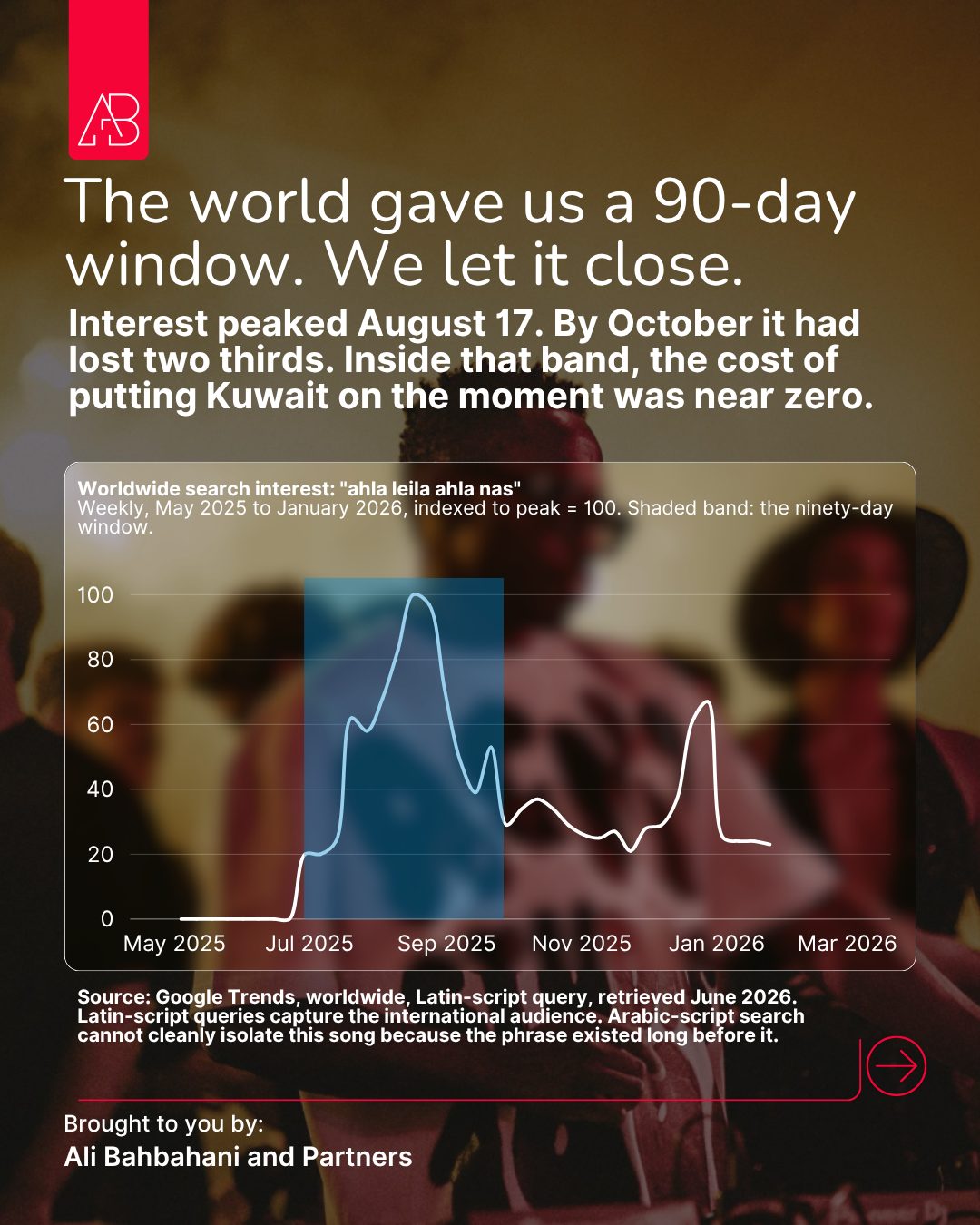
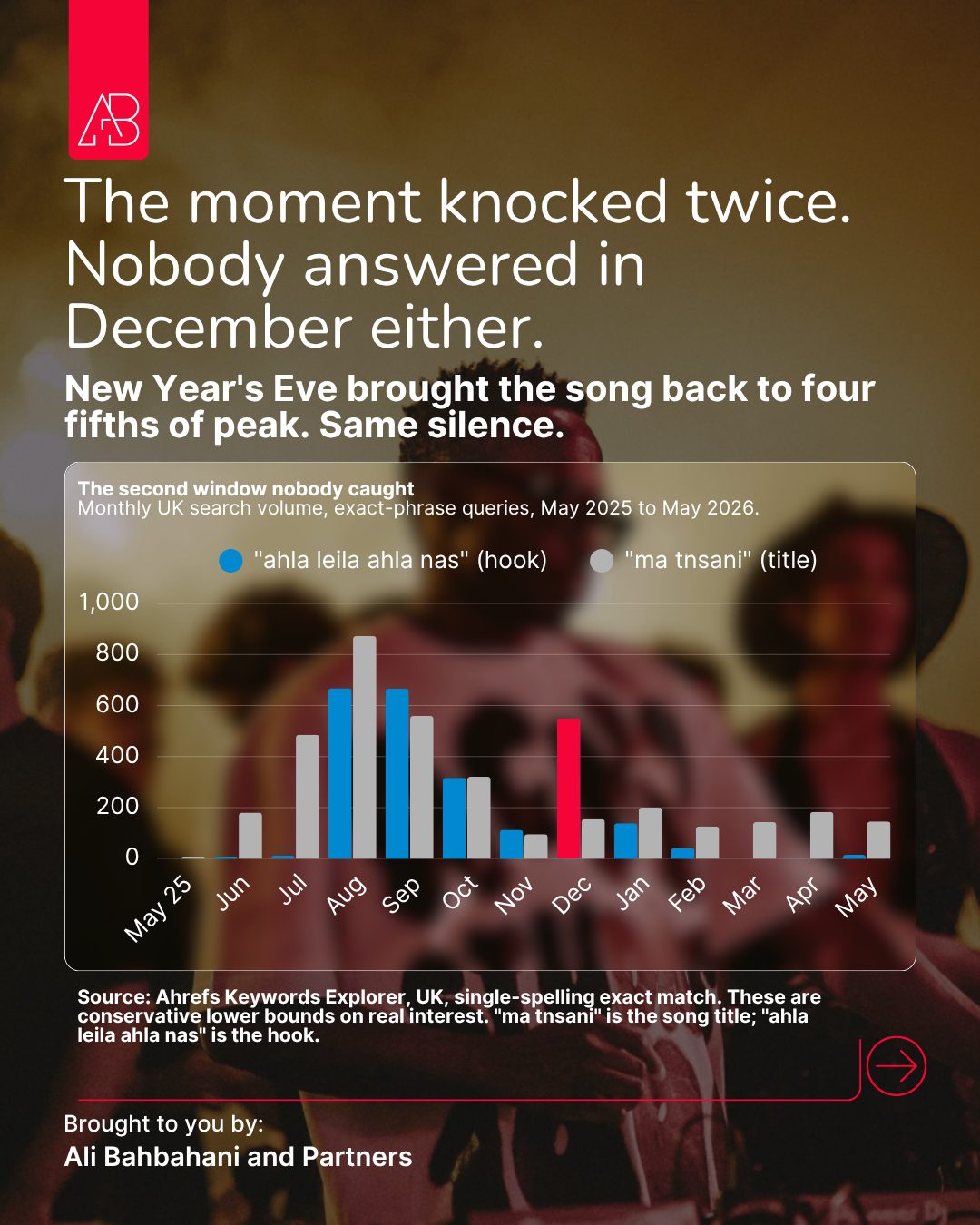
Absolute numbers tell the same story, with a sting in the tail. Take the UK, one market, one spelling, ignoring the dozens of misheard variants the meme produced. Searches for the hook went from zero in May to about 670 a month at the peak. By November they had collapsed to 113. Then December: 549. New Year's Eve sets around the world reached for the song one more time, and the moment came back at four fifths of its original strength. Nobody collected the second time either. By March 2026 the term flatlines to zero. Windows close.
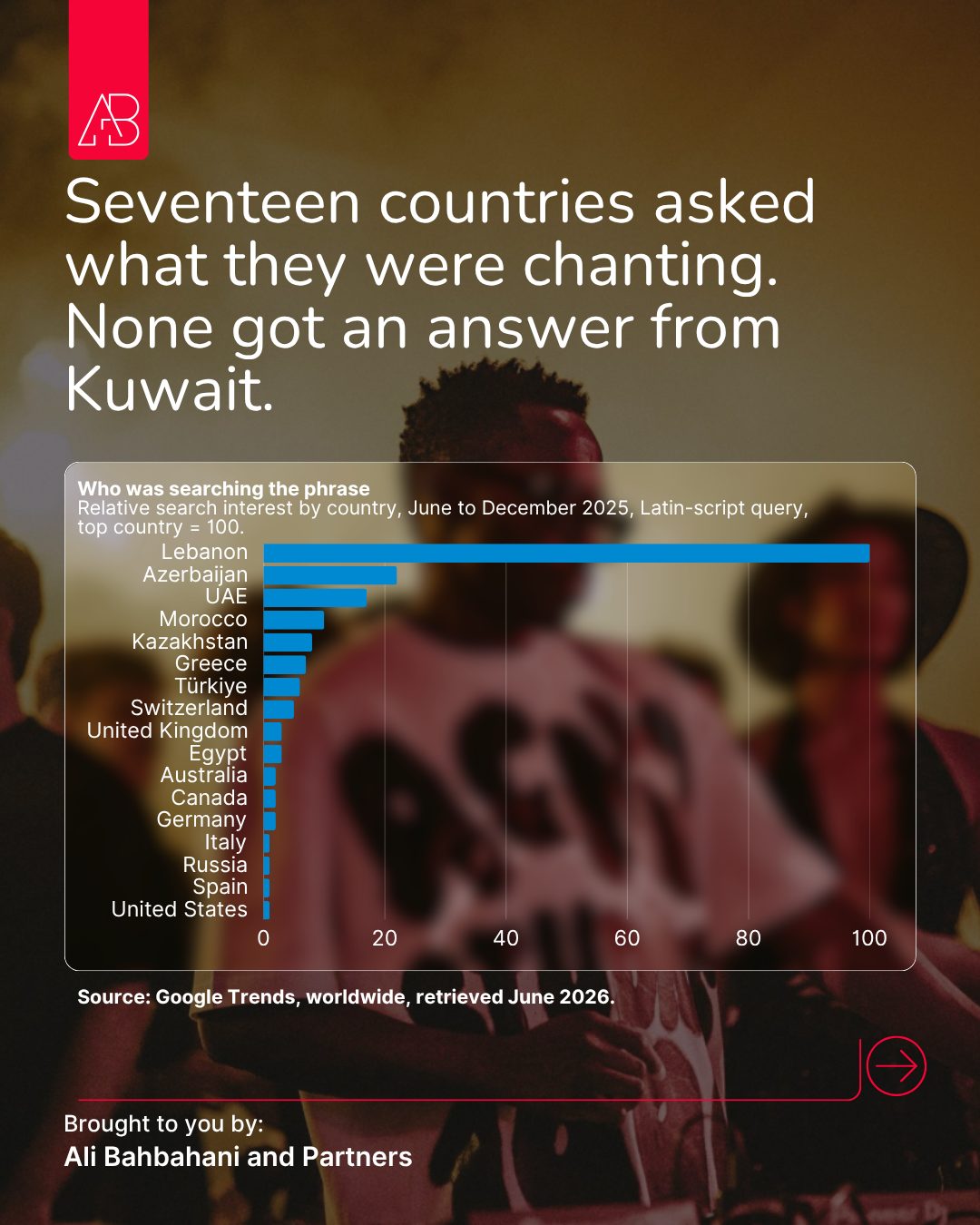
The audience was global in a way the data makes concrete. Latin-script searches for the phrase came from seventeen countries, led by Lebanon, then Azerbaijan, the UAE, Morocco, Kazakhstan, Greece, Türkiye and Switzerland. A sentence sung by Kuwaitis, queried in Latin letters, from Lebanon to Kazakhstan.
Three songs, three governments
Ours is not the first small place handed a global summer. Put the three famous cases on one chart, each song's worldwide search interest aligned to its peak week, and you can read each government's reflexes straight off the decay rate.
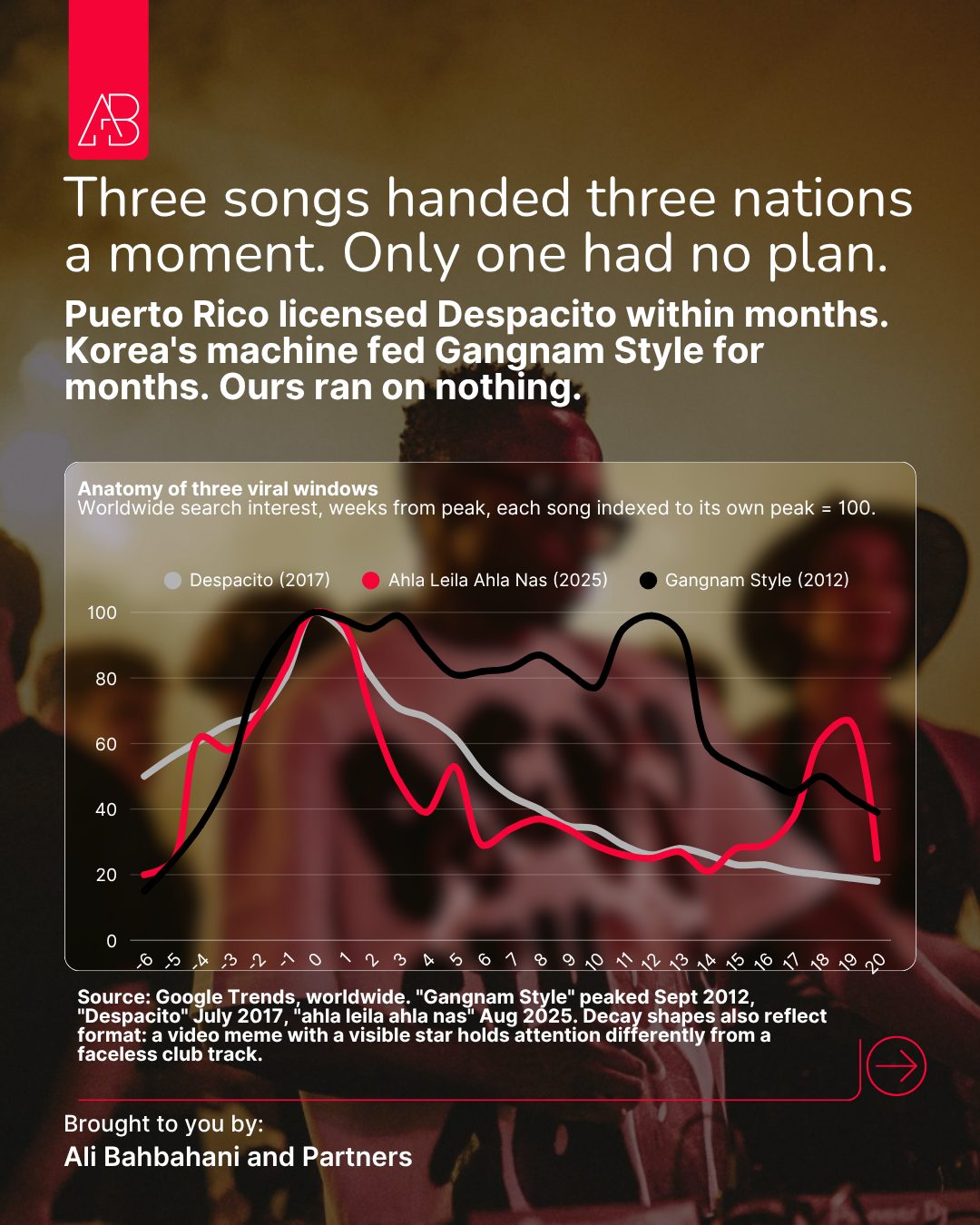
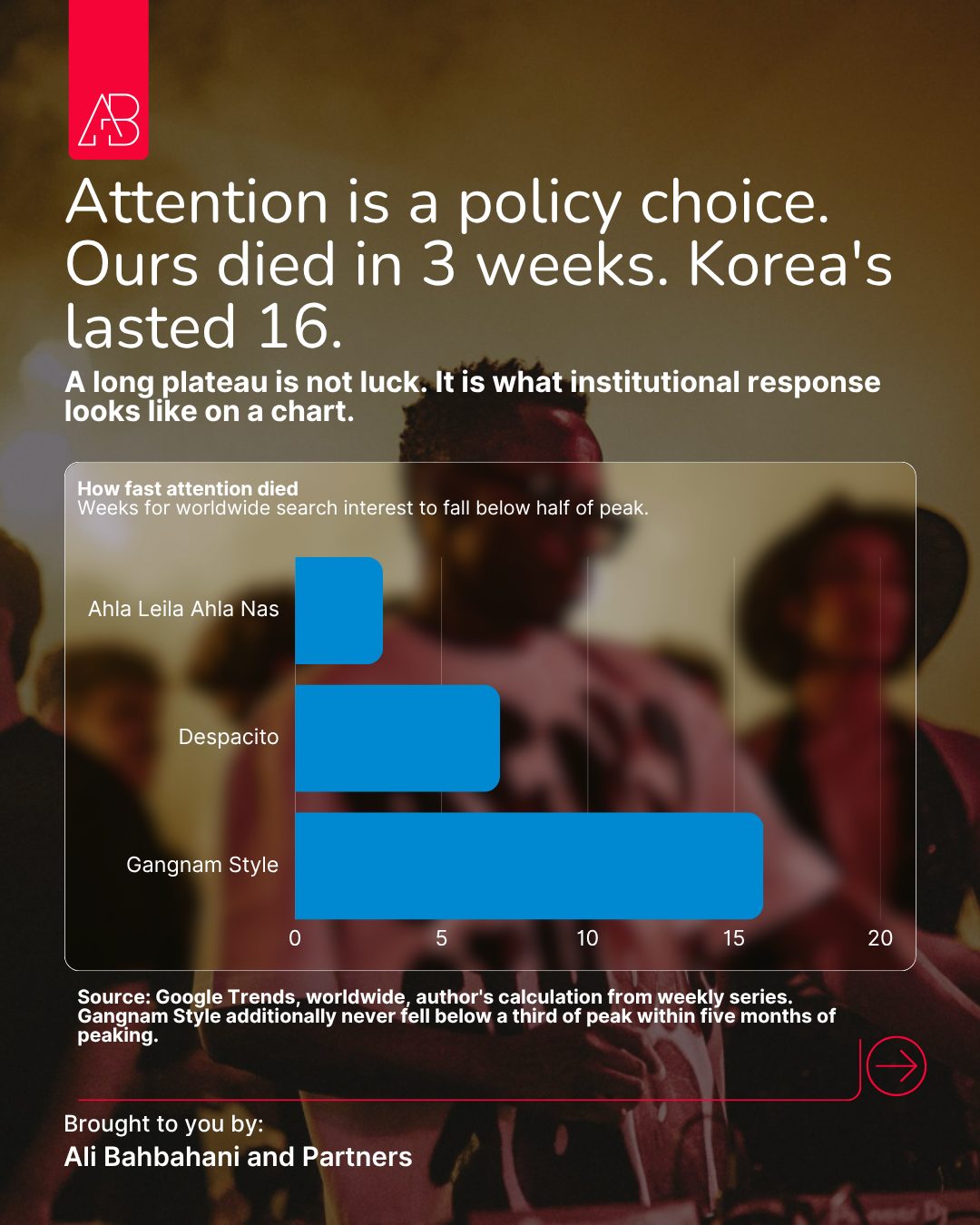
3 weeks: Ahla Leila Ahla Nas fell below half of peak interest. Nobody fed the fire. 7 weeks: Despacito, after Puerto Rico licensed the song for about $700,000 from inside a bankruptcy. 16 weeks: Gangnam Style, which never fell below a third of peak in five months. Korea's machine kept feeding it.
Puerto Rico, 2017. You may remember the claim that "Despacito" lifted the island's tourism by 45 per cent. The Washington Post took it apart: the figure was recycled from a booking site's "search interest" data, and actual hotel occupancy showed no such jump. I cite the debunking on purpose, because the real lesson survives it. Two months before the song peaked, Puerto Rico had entered the largest bankruptcy-type proceeding in American history, unable to pay roughly $70 billion in debt, with its budgets under a federal oversight board and its schools closing. That August, in the middle of the crisis, its Tourism Company paid Luis Fonsi roughly $700,000 to license the song and his image for a global campaign, and took criticism at home for spending it. They paid anyway, because the cost of moving was trivial next to the cost of letting the moment expire. A government that could not pay its bondholders refused to miss its window. Kuwait, with no debt crisis and one of the largest sovereign funds on earth, missed both of its own.
South Korea, 2012. "Gangnam Style" arrived in a year the Korean economy was struggling, and the state treated it as an economic event rather than an entertainment story. The finance minister publicly cited Psy as the model of creativity the country needed. Gangnam's district authorities moved to build a music-themed tourist attraction. The year closed with record tourism revenue of $13.1 billion over eleven months and more than ten million visitors for the first time, and analysts credited a meaningful share of that to one song. Korea could move that fast because it had been building the machinery since 1998: funds, agencies, export offices. Its curve stayed high for months because that machine kept feeding it, with television bookings, state promotion and tourism projects. The plateau is logistics.
Different countries, different decades, the same reflex. When the world starts singing about you, a desk somewhere already has the mandate, the budget and the authority to answer. Our curve fell fastest of the three because no such desk exists here.
Why we didn't move
Not laziness, and not a lack of pride. Kuwaitis flooded social media celebrating the song. The gap is structural. I searched news coverage and official channels in Arabic and English, through June 2026, for any coordinated Kuwaiti response: a campaign, a licensed activation, an official event, anything. I found nothing. If something existed and I missed it, I will publish the correction gladly, because it would be the cheapest correction of my life.
The rebuttal writes itself, so let me answer it now. Kuwait does have a cultural institution. The National Council for Culture, Arts and Letters runs the Qurain festival, the theatre and music festivals, the book fair, archaeological missions and heritage restoration, and by its own description its work is cultural development. That work matters. But the mandate is custodial. It preserves and programs; it is not built to spot a commercial signal on a Tuesday and write a licensing cheque by Friday. Vision 2035 lists nine pillars, and a creative economy is not one of them. It is the same gap I described in Kuwait's digital transformation: the capability exists in pieces, and nobody holds the connective mandate.
Nor are we incapable of seizing a national moment. When the Gulf Cup came home, the country mobilized, and the tourism comeback was real; I documented it then and measured its longer-term impact after. But Khaleeji Zain had years of lead time and an organizing committee. The song was an unplanned signal that needed a fourteen-day reflex. Kuwait can mobilize for what it schedules. It has no muscle yet for what surprises it.
So when the moment landed there was no desk whose job was to catch it. No music export office. No body with a commercial mandate, a standing budget and a sign-off chain shorter than a summer. Think about what was feasible in July: a tourism campaign licensing the hook, a homecoming concert staged as a national event, a fund signing AYA and two more acts in the same month, airlines and brands cleared to activate around the phrase. Every one of those needed an institution that could say yes in days. We have institutions that say yes in quarters.
Virality cannot be engineered. Readiness can. Nobody creates these moments. The failure was having no dock standing when the ship arrived. Twice.
And here is what should sting. Smallness is supposed to be our advantage. Korea has fifty million people and its reflex still took fifteen years to build. Kuwait is small enough that the entire decision chain, minister, fund, broadcaster, flag carrier and two banks, fits around one majlis table. A small country with a viral moment should be the fastest mover on earth. We were the slowest, because no one owned the move. This is friction in its purest national form: not a missing capability, a missing owner.
The dock
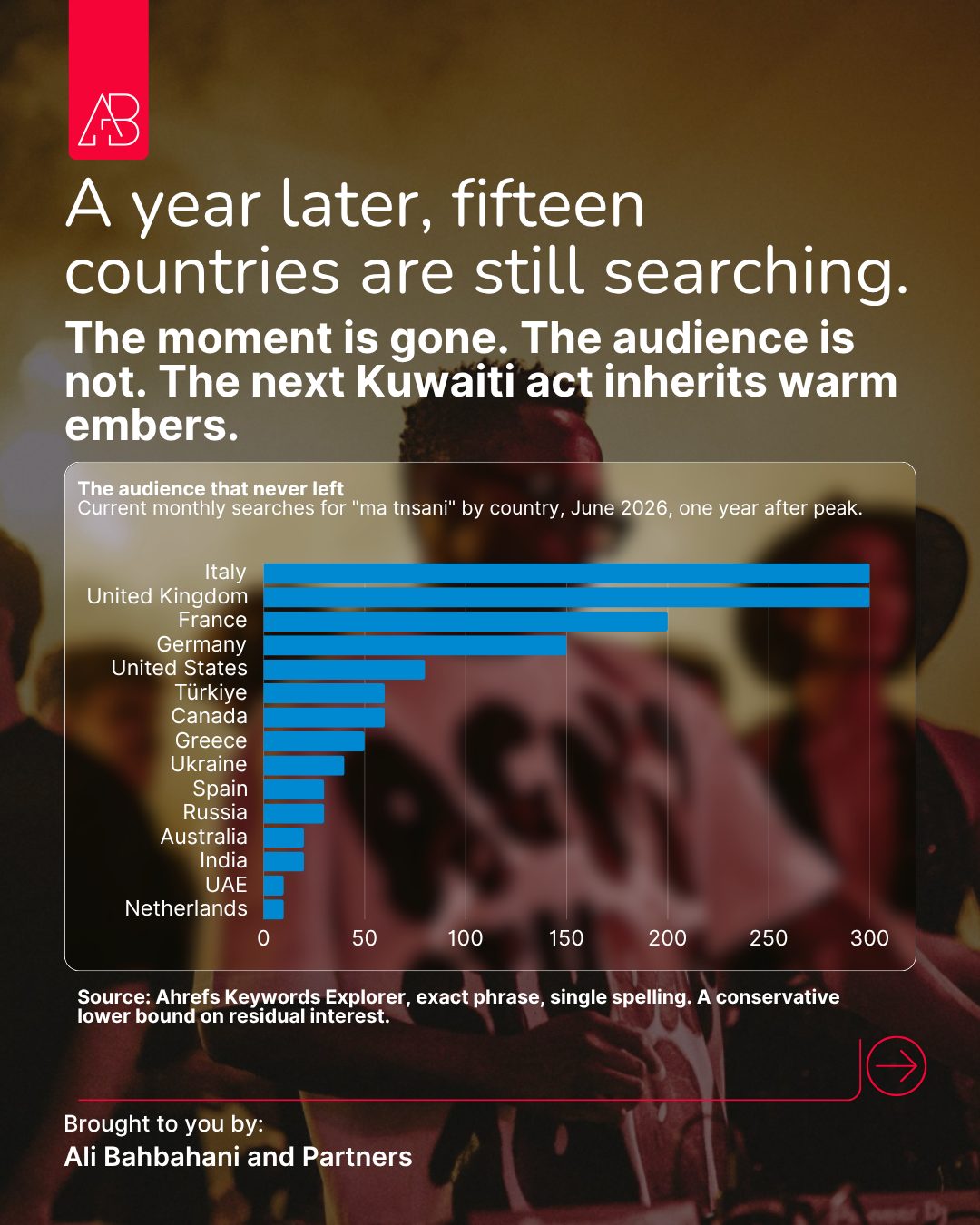
One more number before the proposal, because it changes the tense of this article. The song still gets searched. A full year after the peak, the title alone pulls around 1,400 searches a month across fifteen markets, led by Italy and the UK, counting one spelling and ignoring every variant. The moment is gone. The audience is not. The embers are still warm for whoever shows up with the next Kuwaiti act.
I am not proposing a ministry. Ministries are where ninety-day windows go to die. I am proposing the smallest thing that would have changed last summer: a Cultural Opportunity Desk. Five people inside an existing body, a pre-approved activation budget, and one mandate. When Kuwaiti culture trends anywhere in the world, respond within fourteen days, with pre-cleared authority to license, fund and partner without fresh approvals. Licensing is already one of Kuwait's most underused commercial instruments, and it is the cheapest lever on this list. Put rough numbers on it: five salaries and a standing activation fund come to somewhere around KD 250,000 a year. For context, Puerto Rico paid about KD 215,000, at today's rate, to license one song. The entire Desk, running all year, costs about one Despacito. Measure it on a single number: days from peak to first activation. Korea's was measured in weeks. Puerto Rico's in months. Ours, last summer, was infinite. The December rebound proves the moment knocked twice.
The phrase is the closing argument. It belongs to all Arabs. The voices that carried it around the world were ours. For one summer the world declared, in words our sisters made up on the spot, that the best night happens with the best people. The best night was ours. Next time, we show up to it.
The thinking behind this article is the work we do. Ali Bahbahani and Partners helps brands and institutions across the GCC build the reflex this piece argues for: reading the commercial signal early, positioning to own it, and moving while the window is open. That work lives in our Brand Strategy & Positioning and Strategic Growth Initiatives practices. If your organization has a moment coming, or missed one, talk to us.
Data notes: worldwide search-interest series and country breakdown from Google Trends (Latin-script query "ahla leila ahla nas"), retrieved June 2026; values are indexed, not absolute. UK monthly volumes from Ahrefs Keywords Explorer (exact phrase, single spelling, a lower bound). Comparison curves from Google Trends worldwide ("despacito", "gangnam style"), aligned by peak week; decay shapes reflect format differences as well as institutional response. Chart position per Billboard Arabia; stream count and remix details per industry press (40M+ streams; Tiësto remix via Warner Records). Session account and quoted line per Vanco's interview with DJ Mag; the sisters' quoted words, anonymity and self-funding per Rolling Stone MENA; Ushuaïa Dubai premiere and DJ support per Mixmag and release coverage. NCCAL mandate per nccal.gov.kw; Vision 2035 pillars per newkuwait.gov.kw. The "no coordinated response" finding reflects searches of news coverage and official channels in Arabic and English through June 2026; corrections welcome. Unit costing is the author's rough estimate; the Puerto Rico comparison uses the reported $700,000 license fee converted at roughly 0.31 KD/USD. Despacito licensing figure as reported by industry press; the 45% tourism claim is disputed (Washington Post, 2017). Korea 2012 tourism figures per WTTC/HSBC as reported by CNBC.