The Missing Piece in Kuwait's Digital Transformation
.webp)
Why Kuwait's digital government will keep underperforming until someone owns the experience
Open three Kuwaiti government websites right now. The Ministry of Interior. The Public Authority for Civil Information. Kuwait Municipality. Look for the same thing on each: a button to apply, a form to submit, a way to switch languages.
Does it feel like one government? Or does it feel like you're learning a new system every time?
That inconsistency isn't a minor annoyance. It's a structural failure. And we keep paying for it, ministry by ministry, vendor by vendor, year after year.
Without a shared design system, every new government service starts weaker than the last, no matter how good the vendor is.
After two decades working across customer experience, digital platforms, and large organizations, one pattern keeps repeating: systems don't produce coherence by accident. They produce coherence when someone is accountable for it.
The Real Problem: No One Owns the Citizen Experience
A national design system is not a theme or a style guide. It's shared infrastructure: buttons, forms, navigation patterns, accessibility rules, and code packages that every government team can reuse. When it exists, teams stop reinventing the same components. Citizens stop re-learning how government works every time they switch ministries.
But here's the uncomfortable truth: Kuwait's digital fragmentation isn't a technical gap. It's a governance failure.
Each ministry owns its website, vendor relationships, budget, and approval processes. CITRA coordinates, but who owns "the Kuwaiti government experience" end-to-end?
When everyone owns it, no one owns it.
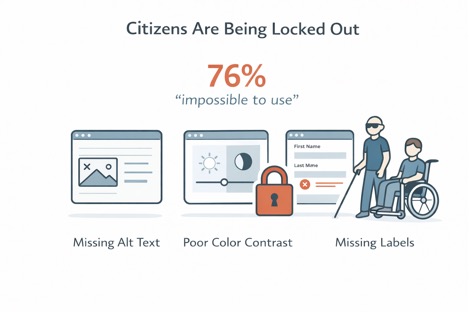
Citizens Are Being Locked Out
This isn't about design preferences. A peer-reviewed study evaluated 17 of the most commonly used e-government services in Kuwait against WCAG 2.0 Level A—the minimum accessibility standard. The findings: 76% were rated "impossible to use" for people with disabilities.
The most common failures? Missing alternative text for images. Missing labels on form fields. Basic requirements that a design system would address by default.
More recent research in 2024 found persistent violations: inadequate color contrast, missing alt text. The researchers noted that "the absence of crucial accessibility features hinders access for people with disabilities."
Governments don't feel fragmented because they are complex. They feel fragmented because no one is accountable for coherence.

The Sahel Paradox: Proof That Kuwait Can Do This
The Sahel app launched in September 2021 with 123 services. By September 2025: 111 million transactions, 2.9 million users, more than 460 services from 40+ government entities.
Sahel proves the model. It also exposes the inconsistency.
Same government. Same citizens. Two radically different experiences—unified on mobile, fragmented on web.
This isn't an accident. A 2015 standards document from CAIT explicitly noted that while integration is standardized, "the presentation layer is handled by each agency." The user experience is fragmented by design.
If we can unify services in a mobile app, why can't we unify patterns on the web?
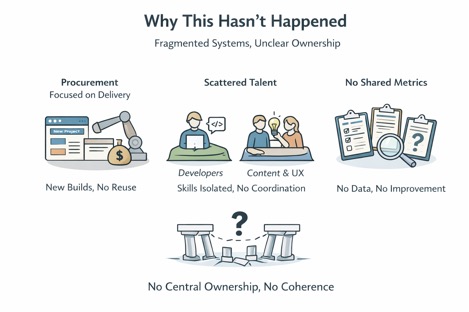
Why This Hasn't Happened
The blockers aren't about money. Compared to back-end modernization, a design system is one of the cheapest high-use investments a government can make.
The blockers are structural, and they're how systems naturally behave when ownership is unclear:
Procurement rewards delivery, not reuse. Vendors get paid to build new things. Reusing a shared component library is good for citizens and budgets, but invisible in a project plan unless explicitly required.
Talent gets scattered. One ministry has strong engineers but no UX capability. Another has content people but no design engineering. Without a central system, these skills never concentrate.
No shared measurement culture. If teams aren't measuring task completion rates, form abandonment, and accessibility scores, the pain stays anecdotal.
Systems like this don't emerge without a single owner. That's not a failure of execution. That's physics.
What Others Have Built
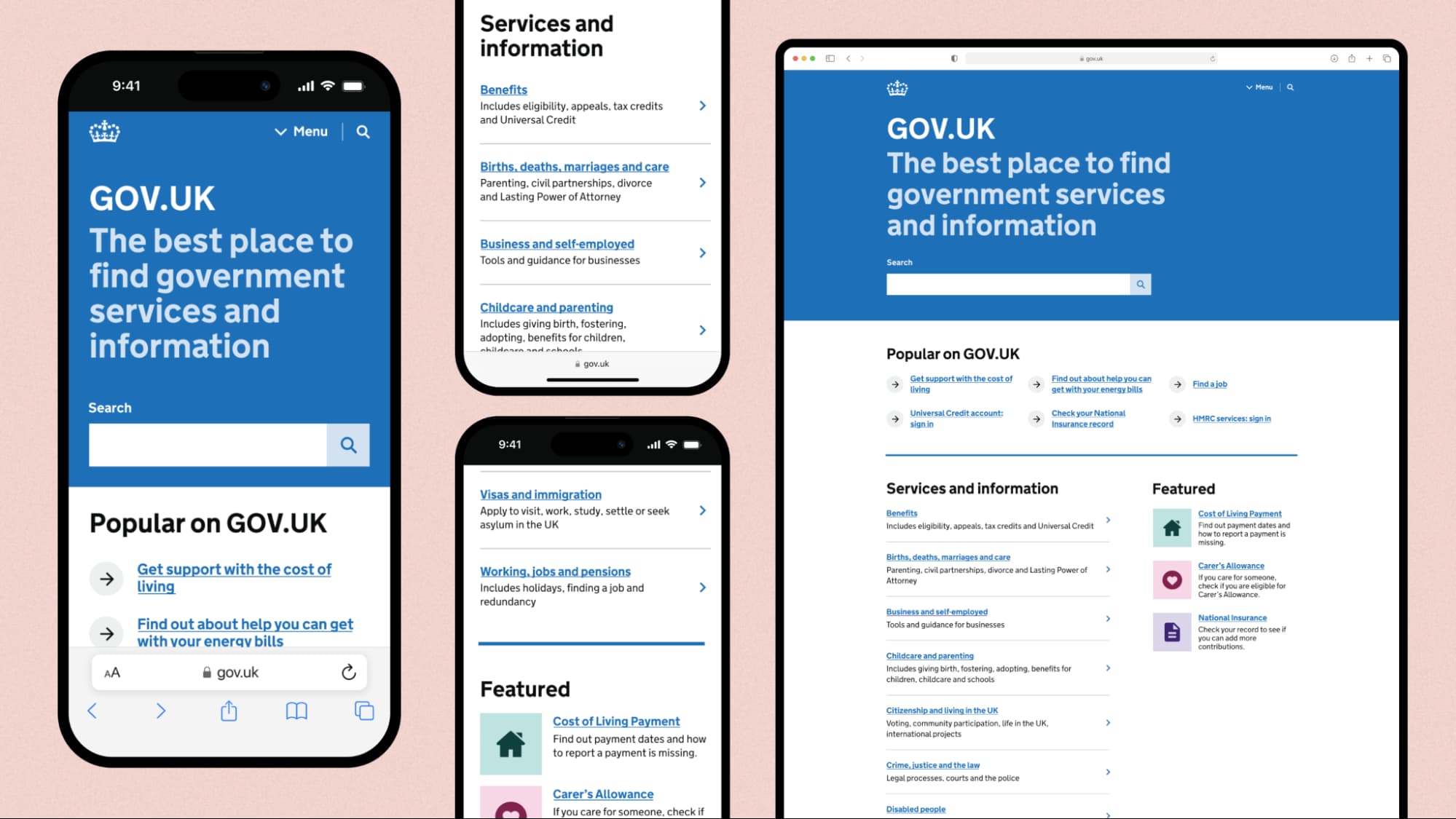
The UK replaced 1,882 separate government websites with GOV.UK in 2012. During COVID-19, they built a critical service in four days, because the components already existed. That's the real value: speed when it matters most.
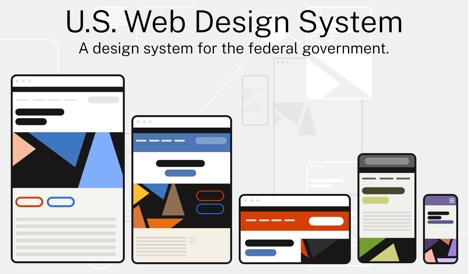
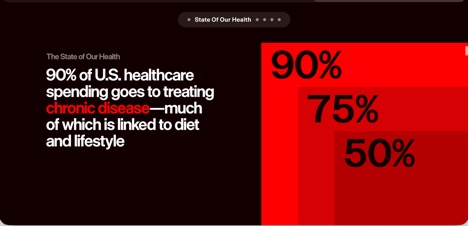
The US Web Design System saves agencies an estimated $100,000 per project. In August 2025, a White House Executive Order established a Chief Design Officer and National Design Studio. The new realfood website, the official Dietary Guidelines site, was designed and engineered by this studio.
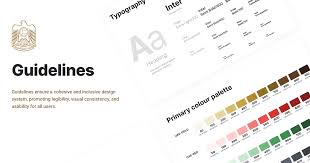
The UAE, right next door, published a comprehensive Design Language System that meets WCAG 2.2 and is open-sourced on GitHub. Their stated goal: "position the UAE as a pioneer in digital services."
These aren't experiments. They're infrastructure. And Kuwait hasn't built its version.
What Kuwait Can Do in 90 Days
This doesn't require a five-year roadmap. Start like a product team.
Create a minimum viable system. Bilingual design tokens (Arabic/English, RTL/LTR). Typography. A standard header and footer. Form components with validation. A service page template. An accessibility baseline. Don't solve everything, solve the most common things well.
Ship it as real code, not a PDF. Copy-paste HTML templates. An npm package. Ready-to-use components. Adoption is always the hardest part. Convenience wins.
Make it mandatory through procurement. "Any new public-facing service must use Kuwait Government Design System components, unless an exemption is documented and approved." Procurement is where behavior changes.
Pilot on three high-demand services. Civil ID renewals. Municipality permits. Traffic services. Measure the change. Publish the results.
The Question That Matters
If Kuwait is serious about digital government, a national design system is one of the clearest next moves. Not because it looks modern, but because it reduces duplication, raises accessibility, speeds delivery, and makes government feel like one government.
The UAE has built one. Singapore has built one. The UK has built one. The US just made it a White House priority.
Kuwait has Sahel, with 111 million transactions, proving that a unified government works. We have the capability. We have the appetite.
If no one owns the government experience end-to-end, why would we expect it to ever feel coherent?
So the real question becomes: who will sponsor it?
If you're working on government digital services in Kuwait, whether at CITRA, a ministry, or as a vendor, I'd be interested in hearing your perspective.