Kuwait Watch Market Size: KD 164m to KD 192m
.webp)
We went looking for the size of Kuwait's watch market and could not find one. Not a stale figure, not a rough estimate buried in a trade report. Nothing. The Central Statistical Bureau publishes what the country imports. It does not publish what the market is worth, and no research house sizes Kuwait on its own rather than folding it into a Gulf total.
The Kuwait watch market is worth KD 164m to KD 192m at retail in 2025, or roughly USD 535m to USD 626m. That is an illustrative scenario built from two counted numbers and one assumed margin, not a measurement.
- KD 101.8m of watches crossed the Kuwaiti border in 2025, 2.7 times the 2010 figure
- 68% of that import value is Swiss, up from 51% in 2015
- 72 luxury-tier doors exist in the country, and three addresses hold 61.1% of them
- 6,213 realised auction lots worth KD 44.85m are the only public price record in Kuwait
- 59.7% of Kuwaiti resale value went to Rolex in the first half of 2026, against 40.9% worldwide
So we built the number. It took fifteen years of Kuwaiti customs returns, twenty-five years of Swiss export data, Kuwait's own filings to the United Nations, and 6,213 realised auction lots pulled lot by lot from a weekly Kuwaiti sale. What follows is the answer, the whole arithmetic behind it, and the four things it still cannot see. A market size nobody can check is worth very little.
Data current to 29 July 2026. Import series through 2025, auction record 2021 to 2026, retail structure read August 2026.
What is in this study
- How big is the Kuwait watch market?
- The industry Kuwait buys from
- Kuwaiti watch imports, 2010 to 2025
- How Kuwait compares with other markets
- Who sells luxury watches in Kuwait
- What Kuwaiti watches actually resell for
- What the secondary market is worth
- What this study does not measure
- The gap worth acting on
- Common questions, answered with the numbers
- Sources and method
How big is the Kuwait watch market?
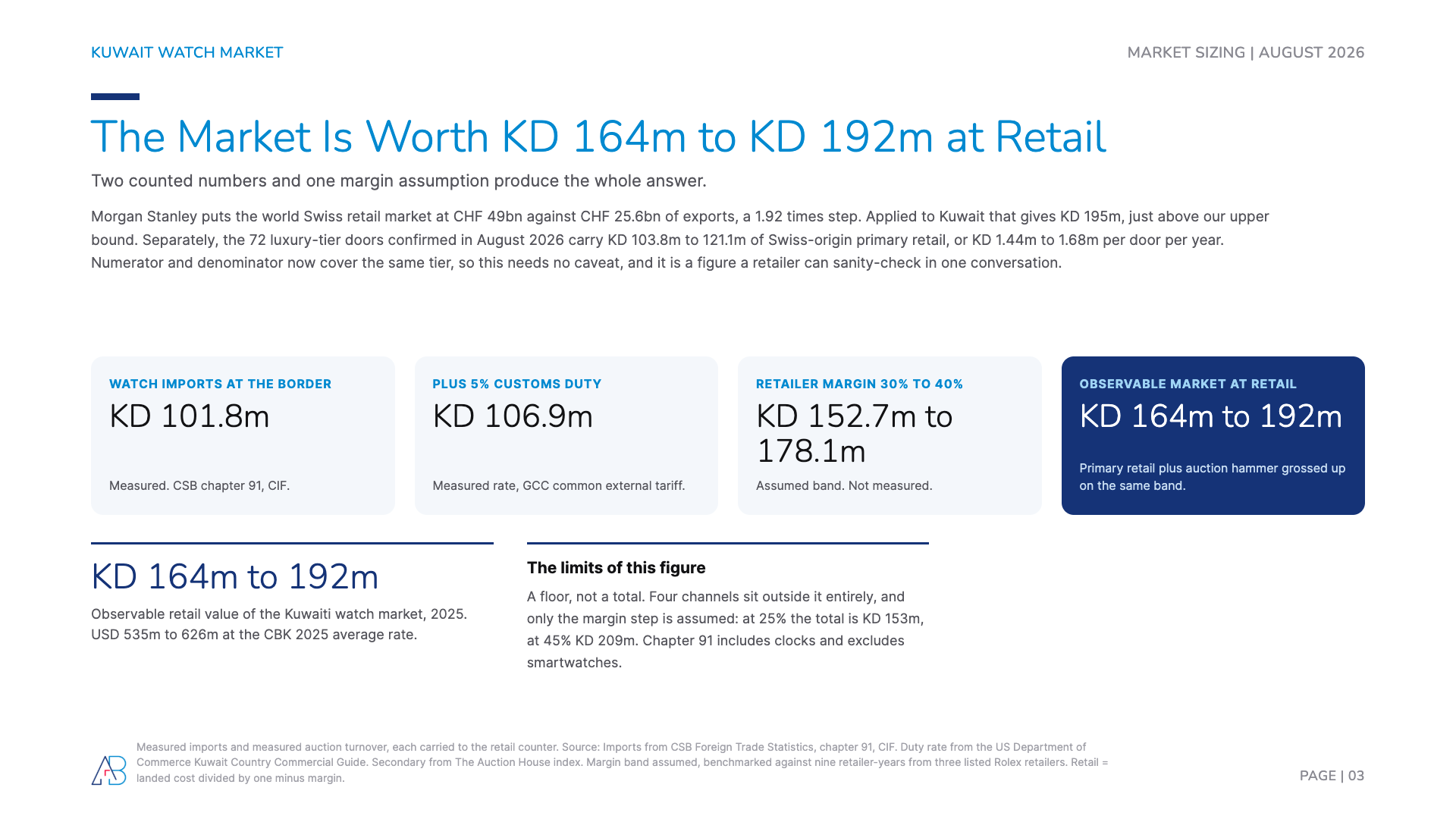
KD 164 million to KD 192 million at retail in 2025, or roughly USD 535m to USD 626m. That is an illustrative scenario, not a measurement, and the distinction matters enough that I put it in the sentence rather than the footnote. Two of the three inputs are counted. One is assumed.
Kuwait watch market size 2025: the four-step arithmetic
- Watch imports at the border: KD 101.8m. Measured. CSB chapter 91, CIF, including re-exports and the 4% of the chapter that is not wristwatches
- Plus 5% customs duty: KD 106.9m. Measured rate. GCC common external tariff
- Retailer margin of 30% to 40%: KD 152.7m to KD 178.1m. Assumed band, benchmarked against nine retailer-years. Not measured
- Plus secondary retail equivalent: KD 164m to KD 192m. Primary retail plus auction hammer grossed up on the same band. Scenario
Only the third step is an assumption, and it is the one I worked hardest to pin down. Three listed pure-play luxury watch retailers publish a merchandise gross margin: Watches of Switzerland Group at 36.3% and 36.6% in its last two years, The Hour Glass between 29.2% and 33.6% across five, and Emperor Watch and Jewellery at 28.3% and 30.9%. All three are official Rolex retailers, which matters, because Rolex dealers run tighter margins than the multi-brand average. Nine retailer-years, every one inside 28% to 37%. The band above is well supported at the bottom and generous at the top. No listed retailer has reported a 40% merchandise margin in the last five years.
The margin step is also where the range moves most. At a 25% margin the total is KD 153m. At 45% it is KD 209m. Anyone quoting a single point estimate for this market is quoting an assumption they have not stated.
Two independent sanity checks land close. Morgan Stanley puts the world Swiss retail market at CHF 49bn against CHF 25.6bn of exports, a 1.92 times step from export value to retail counter. Applied to Kuwait that gives KD 195m, just above the upper bound here. Separately, the 72 luxury-tier doors confirmed in August 2026 carry KD 103.8m to KD 121.1m of Swiss-origin primary retail between them, which is KD 1.44m to KD 1.68m per door per year. Numerator and denominator cover the same tier, so that one needs no caveat, and it is a figure any retailer in Kuwait can sanity-check in a single conversation.
The industry Kuwait buys from sells half as many watches as it did in 2000
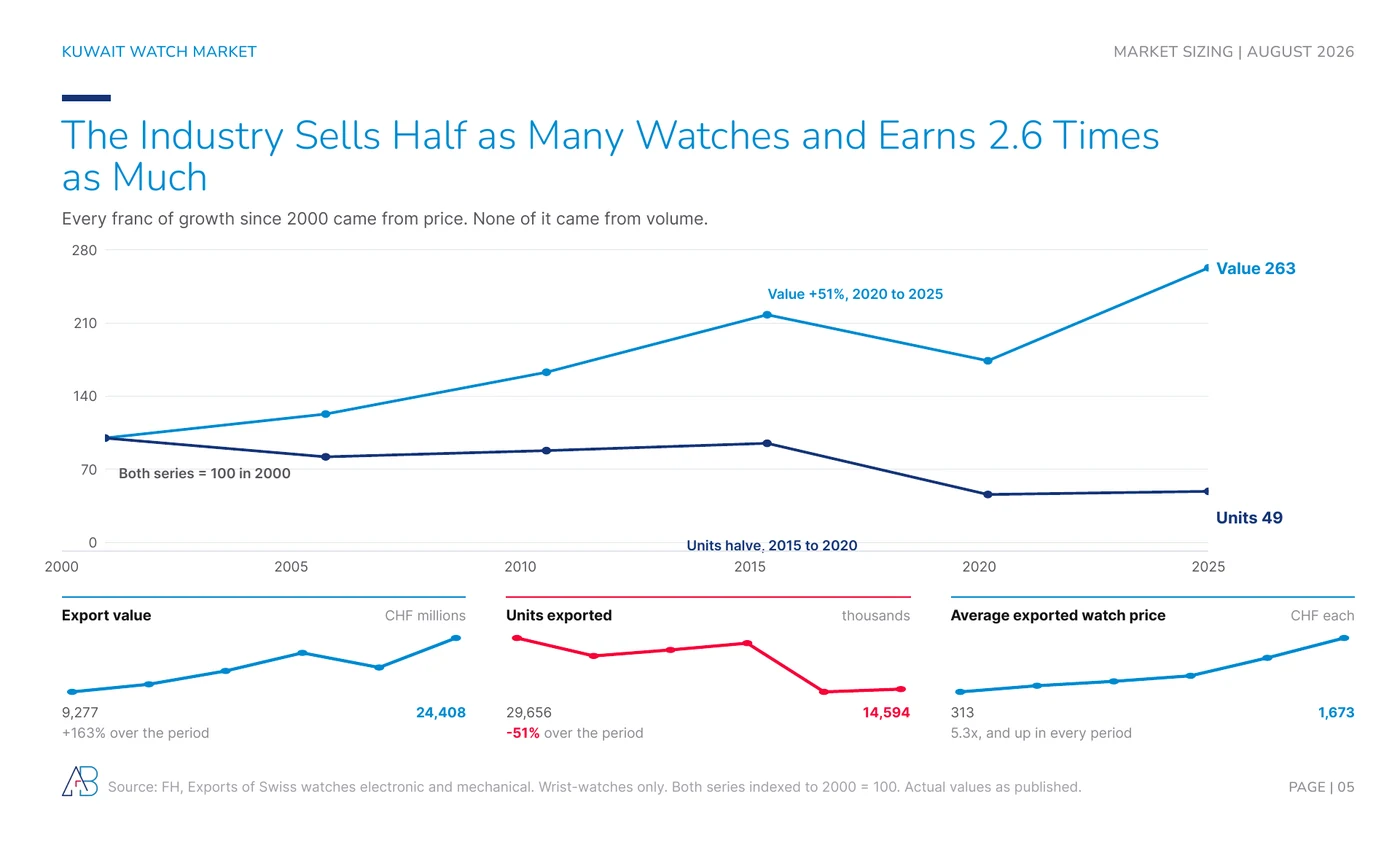
Start with the supply side, because it explains almost everything downstream. Swiss watch export value went from CHF 9,277m in 2000 to CHF 24,408m in 2025, up 163%. Over the same twenty-five years units fell from 29.7 million to 14.6 million, down 51%. The average exported watch went from CHF 313 to CHF 1,673, a 5.3 times rise, and it rose in every sub-period.
Every franc of growth since 2000 came from price. None of it came from volume. That is not a slogan, it is what the two series do when you index them to the same base: value reaches 263 and units reach 49.
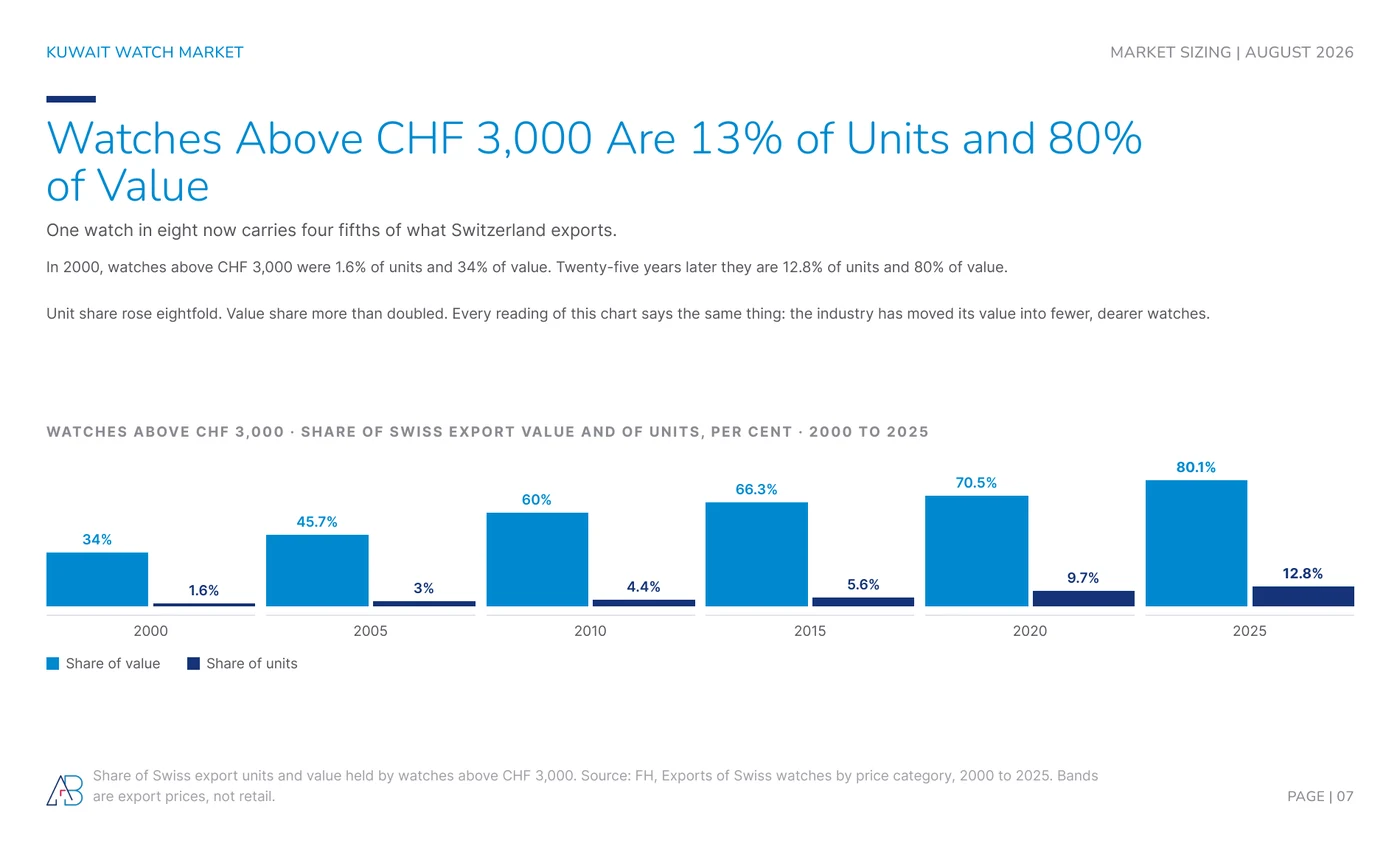
The mechanism is visible in the price bands. In 2000, watches above CHF 3,000 were 1.6% of units and 34% of value. In 2025 they are 12.8% of units and 80.1% of value. Unit share rose eightfold, value share more than doubled, and one watch in eight now carries four fifths of what Switzerland exports.
Swiss watches above CHF 3,000: share of exported units and value
- 2000: share of units 1.6%; share of value 34%
- 2005: share of units 3%; share of value 45.7%
- 2010: share of units 4.4%; share of value 60%
- 2015: share of units 5.6%; share of value 66.3%
- 2020: share of units 9.7%; share of value 70.5%
- 2025: share of units 12.8%; share of value 80.1%
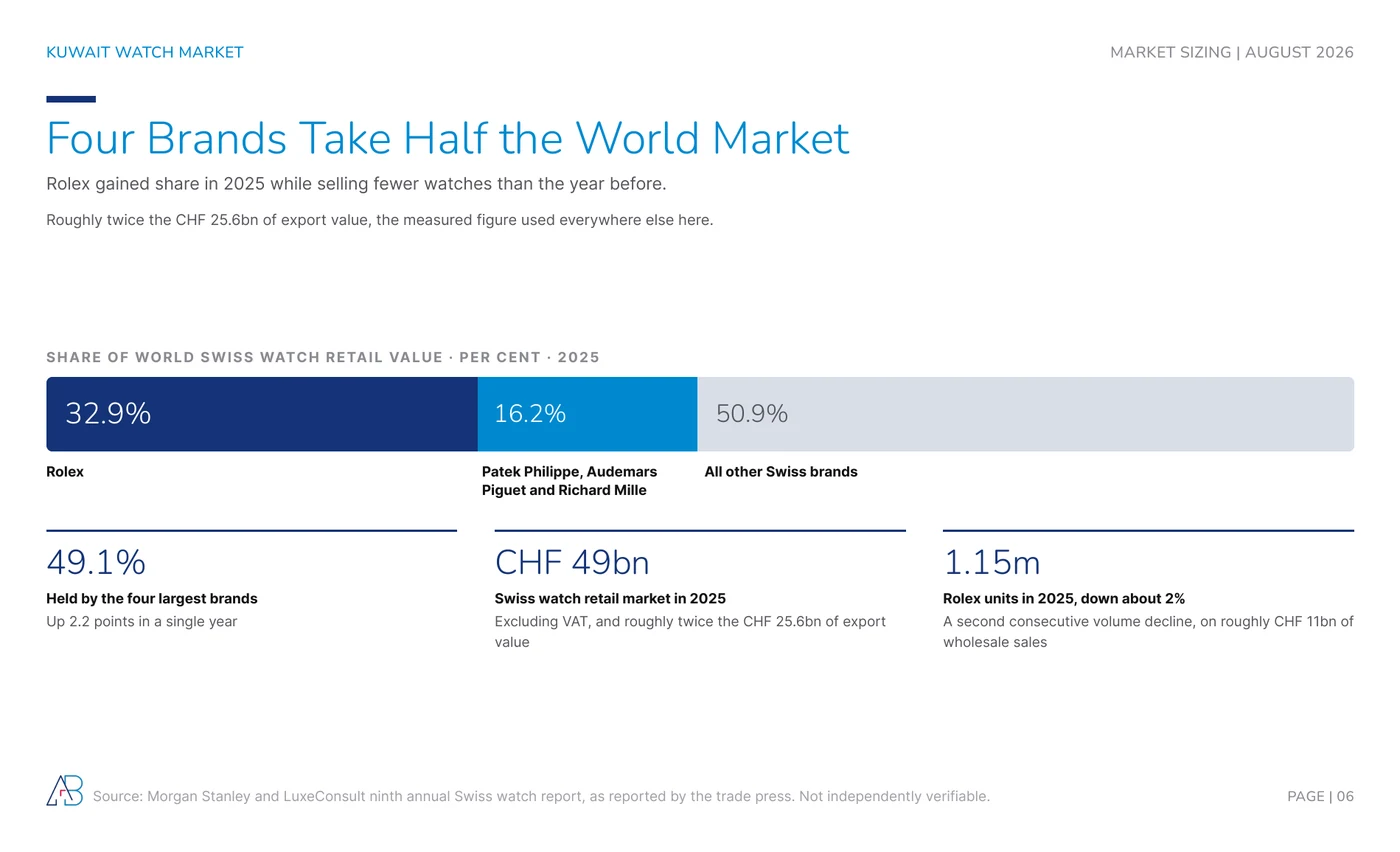
At the top, four brands take about half the world. Morgan Stanley and LuxeConsult put Rolex at 32.9% of Swiss watch retail value in 2025, with Patek Philippe, Audemars Piguet and Richard Mille together at 16.2%, and every other Swiss brand sharing the remaining 50.9%. The four largest hold 49.1%, up 2.2 points in a single year. Rolex sold about 1.15 million watches in 2025, down roughly 2%, a second consecutive volume decline, and gained share anyway.
That estimate is the one number in this study I cannot verify. It comes from a consultancy report as relayed by the trade press, and I have labelled it accordingly wherever it appears. Everything else here traces to a primary source.
Kuwaiti watch imports: fifteen years, one series, no splicing
Kuwait imported KD 101.8m of goods under customs chapter 91 in 2025, against KD 37.3m in 2010. That is 2.7 times as much money crossing the border, and it works out at 6.9% a year compound.
Quoting that rate on its own would be misleading, so here is the full series rather than the endpoints.
Kuwaiti watch imports 2010 to 2025, KD millions, CIF, HS chapter 91
- 2010: 37.3
- 2011: 52.2
- 2012: 57.7
- 2013: 76.3
- 2014: 79.5
- 2015: 78.2
- 2016: 80.6
- 2017: 76.0
- 2018: 72.6
- 2019: 72.5
- 2020: 62.4
- 2021: 90.0
- 2022: 88.8
- 2023: 92.2
- 2024: 104.0
- 2025: 101.8
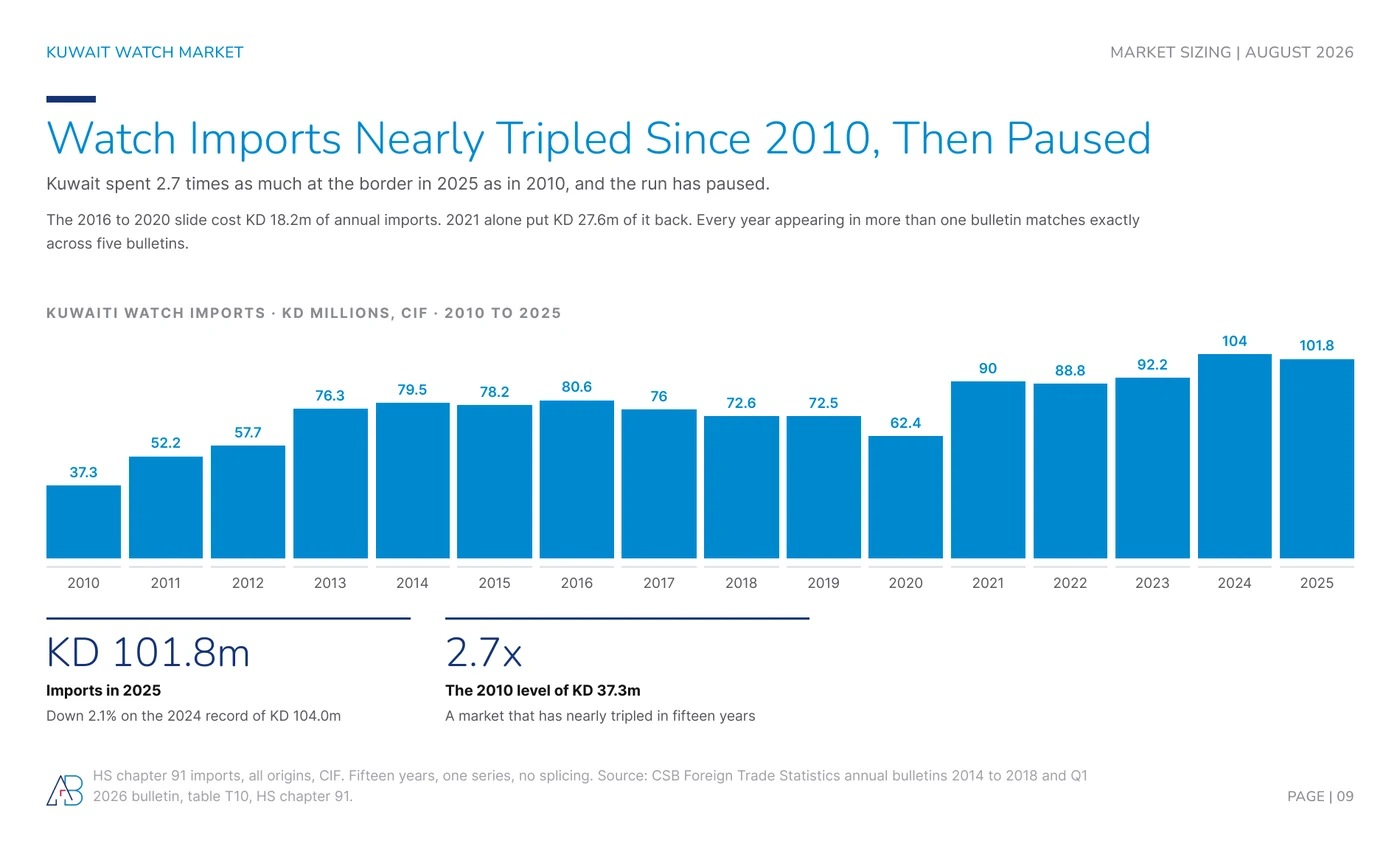
The market fell in five of the six years between 2014 and 2020. It cleared its 2014 level once, in 2016, lost it again, and did not durably pass it until 2021. The 2016 to 2020 slide cost KD 18.2m of annual imports. 2021 alone put KD 27.6m of it back. 2025 is down 2.1% on the 2024 record of KD 104.0m.
Split the series into its three regimes and the single average disappears.
Kuwaiti watch imports: three growth phases, not one trend
- 2010 to 2014: compound annual change +20.8% a year; from KD 37.3m; to KD 79.5m
- 2014 to 2020: compound annual change minus 3.9% a year; from KD 79.5m; to KD 62.4m
- 2020 to 2025: compound annual change +10.3% a year; from KD 62.4m; to KD 101.8m
- 2010 to 2025: compound annual change +6.9% a year; from KD 37.3m; to KD 101.8m
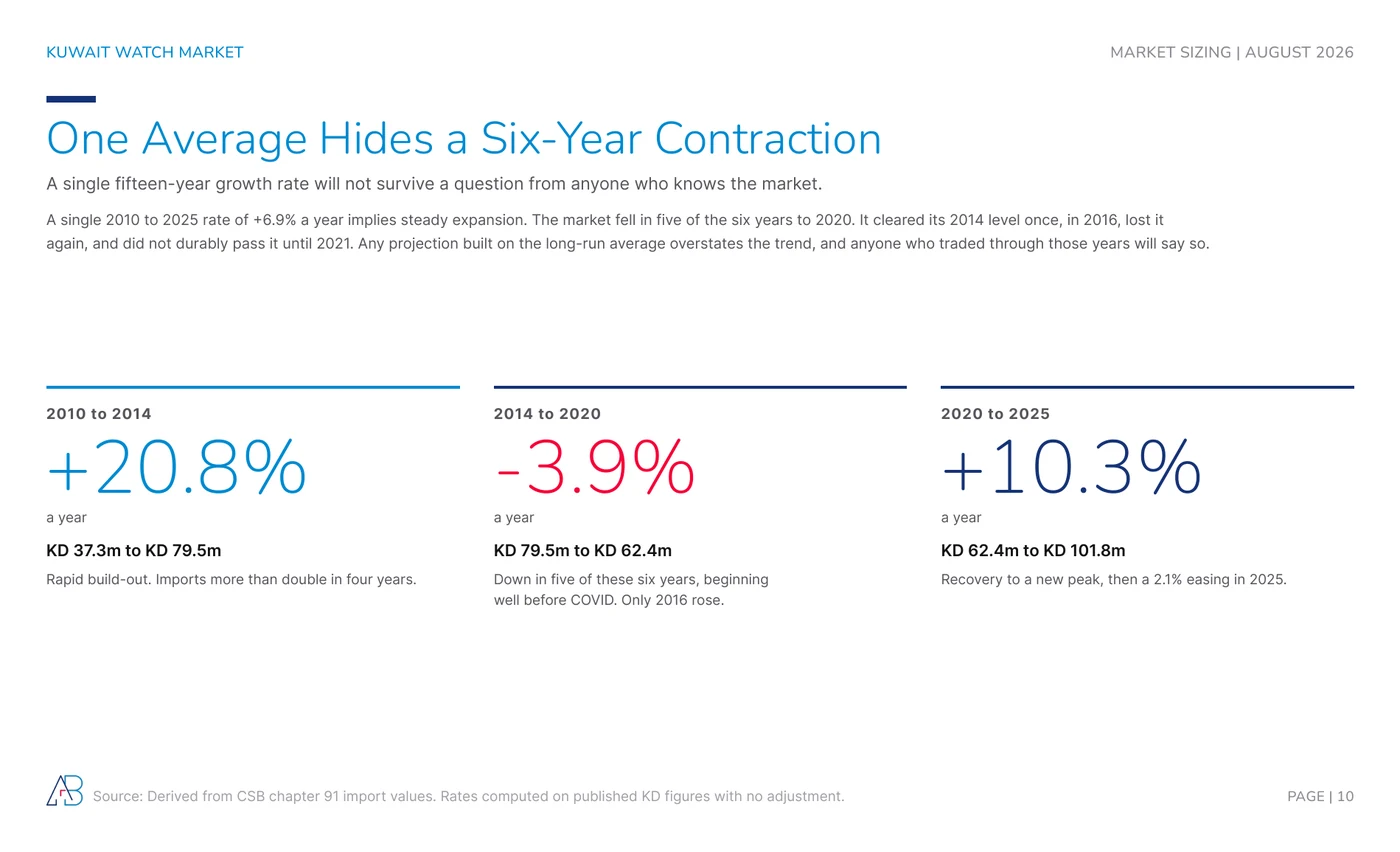
The contraction began well before COVID. Anyone projecting off the fifteen-year average is projecting a trend that never happened, and anyone who traded through those years will say so. The same shape appears in other Kuwaiti import series: the decade of Kuwaiti automotive data has its own mid-decade trough that a single growth rate hides.
The same warning applies to Kuwaiti consumer data generally. When I looked at card spending patterns across 2025, the headline and the underlying behaviour told different stories there too.
The import series checks out against a second, independent filing
Kuwait files these figures twice, into its own bulletins and to the United Nations, compiled by different bodies on different schedules in different currencies. Converted at Central Bank of Kuwait annual average rates, the two agree to within 1.3% in every year from 2019 to 2024, and four of the six land inside half a per cent. That is as close to verification as trade data gets, and it is what makes the rest of this checkable rather than merely asserted.
Kuwaiti watch imports as filed to two bodies, KD millions
- 2019: CSB 72.5; UN Comtrade 72.4; difference minus 0.2%
- 2020: CSB 62.4; UN Comtrade 62.7; difference +0.5%
- 2021: CSB 90.0; UN Comtrade 88.8; difference minus 1.3%
- 2022: CSB 88.8; UN Comtrade 88.7; difference minus 0.1%
- 2023: CSB 92.2; UN Comtrade 92.0; difference minus 0.3%
- 2024: CSB 104.0; UN Comtrade 103.2; difference minus 0.7%
The UN returns also supply what the CSB withholds: partner country at line level, and the wristwatch share of the chapter. Chapter 91 is wider than a watch market, and the remainder can now be quantified rather than waved at. Wristwatches were 92.6% of chapter value in 2019 and 95.9% in 2024. Kuwait imported KD 99.0m of wristwatches in 2024, not KD 104.0m of assorted horology, with straps the largest non-watch line in most years. A wristwatch-only scenario would be roughly 4% lower than the range above, which is why I call that range a scenario rather than a floor.
Where Kuwait's watches come from
Switzerland went from 51% of Kuwaiti watch import value in 2015 to 68% in 2025. That is not Swiss growth outrunning everyone else. It is Swiss growth against absolute decline everywhere else. Swiss value rose KD 29.1m over the decade while every other origin combined fell KD 5.5m. Between 2021 and 2025 alone, non-Swiss imports fell 19%, from KD 40.2m to KD 32.6m, while Swiss value rose 39%.
Swiss share of Kuwaiti watch import value
- 2015: 51%
- 2016: 55%
- 2017: 56%
- 2018: 64%
- 2019: 63%
- 2020: 63%
- 2021: 55%
- 2022: 60%
- 2023: 66%
- 2024: 64%
- 2025: 68%
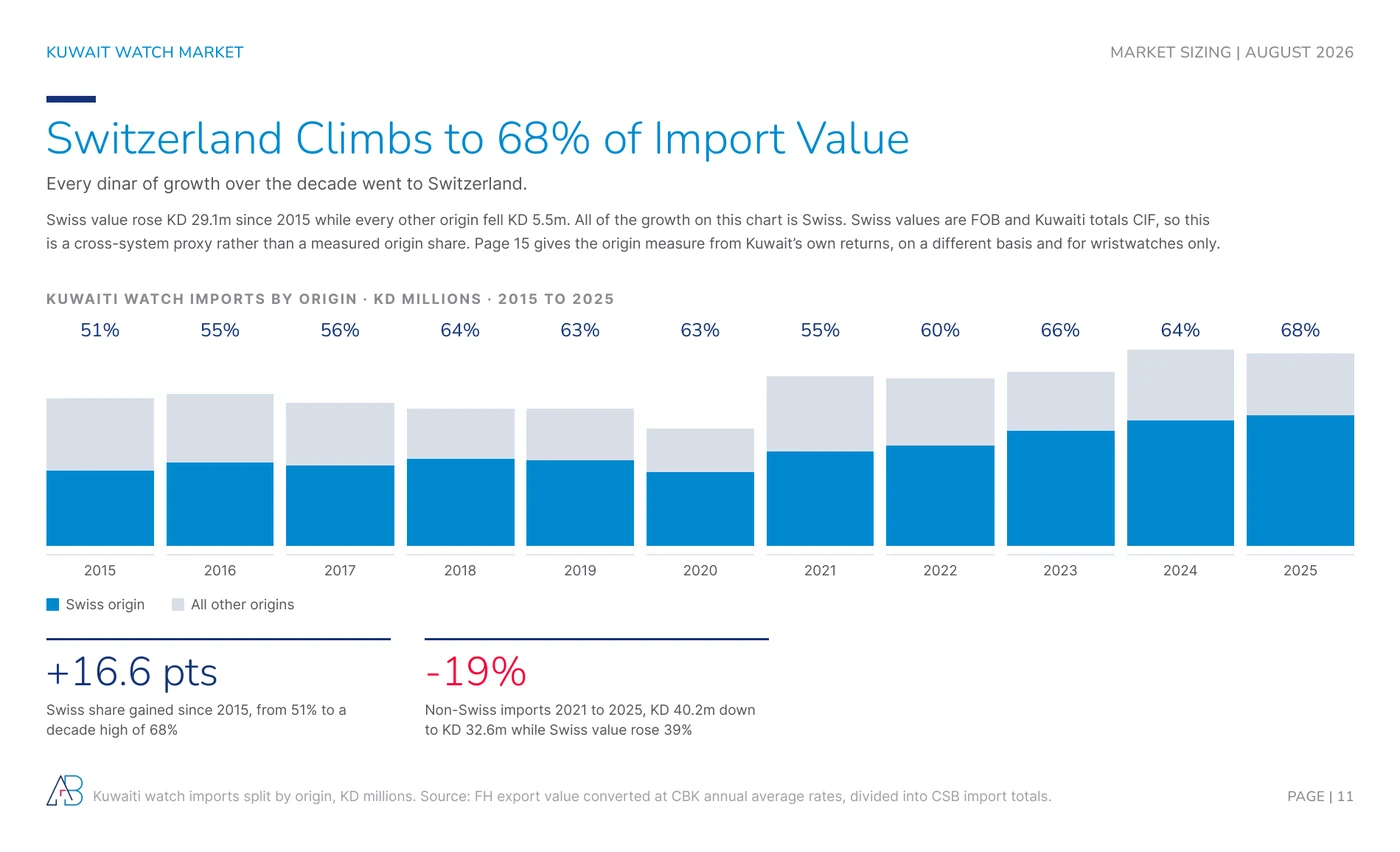
That 68% is a cross-system proxy: Swiss export values are reported FOB and Kuwaiti import totals are CIF, so the two are not like for like. Kuwait's own UN returns give a cleaner origin measure on a narrower basis, wristwatches only, and the picture there is starker.
Across 2021 to 2024 combined, Switzerland supplied 87.62% of Kuwaiti wristwatch import value at USD 878 a watch. China supplied 8.2% at USD 130. Fourteen origins carry measurable value and everything outside the top two is under one per cent each.
Kuwaiti wristwatch imports by origin, 2021 to 2024 combined, share of value
- Switzerland: share of value 87.62%; value, USD 1,021.8m; units 1,163,431; USD per unit 878
- China: share of value 8.2%; value, USD 95.7m; units 736,545; USD per unit 130
- Viet Nam: share of value 0.84%
- Japan: share of value 0.7%
- France: share of value 0.6%
- Bahrain: share of value 0.34%
- Germany: share of value 0.25%
- United States: share of value 0.25%
- Italy: share of value 0.22%
- Thailand: share of value 0.15%
- United Kingdom: share of value 0.15%
- Hong Kong: share of value 0.11%
- All other origins: value, USD 48.7m; units about 90,000
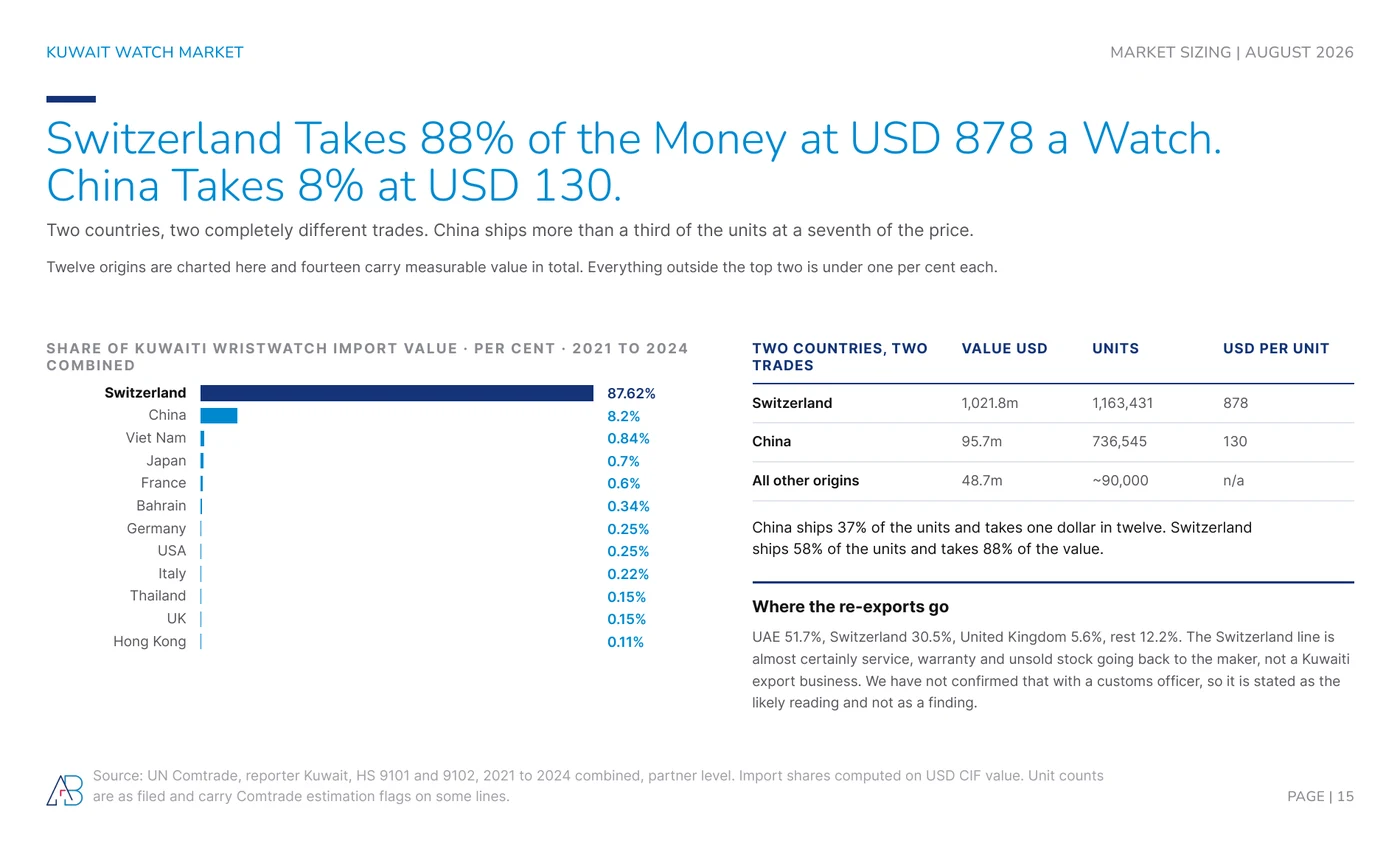
China ships 37% of the units and takes one dollar in twelve. Switzerland ships 58% of the units and takes 88% of the value. Two completely different trades share one customs chapter, and the thing separating them is a price nearly seven times higher.
The money moved into mechanical watches
Average declared value per imported unit tells the same story inside Kuwait. Mechanical value per unit went from KD 294 in 2015 to KD 876 in 2024, three times higher in nine years. Quartz never left a KD 44 to KD 82 band.
Kuwaiti customs detail: mechanical against quartz
- Mechanical value, KD m: 2015 18.3; 2020 35.9; 2021 51.4; 2023 59.8; 2024 59.3
- Mechanical units: 2015 62,472; 2020 59,588; 2021 184,306; 2023 132,385; 2024 67,649
- Quartz value, KD m: 2015 52.7; 2020 15.1; 2021 16.7; 2023 not published; 2024 not published
- Quartz units: 2015 645,282; 2020 216,548; 2021 319,422; 2023 not published; 2024 not published
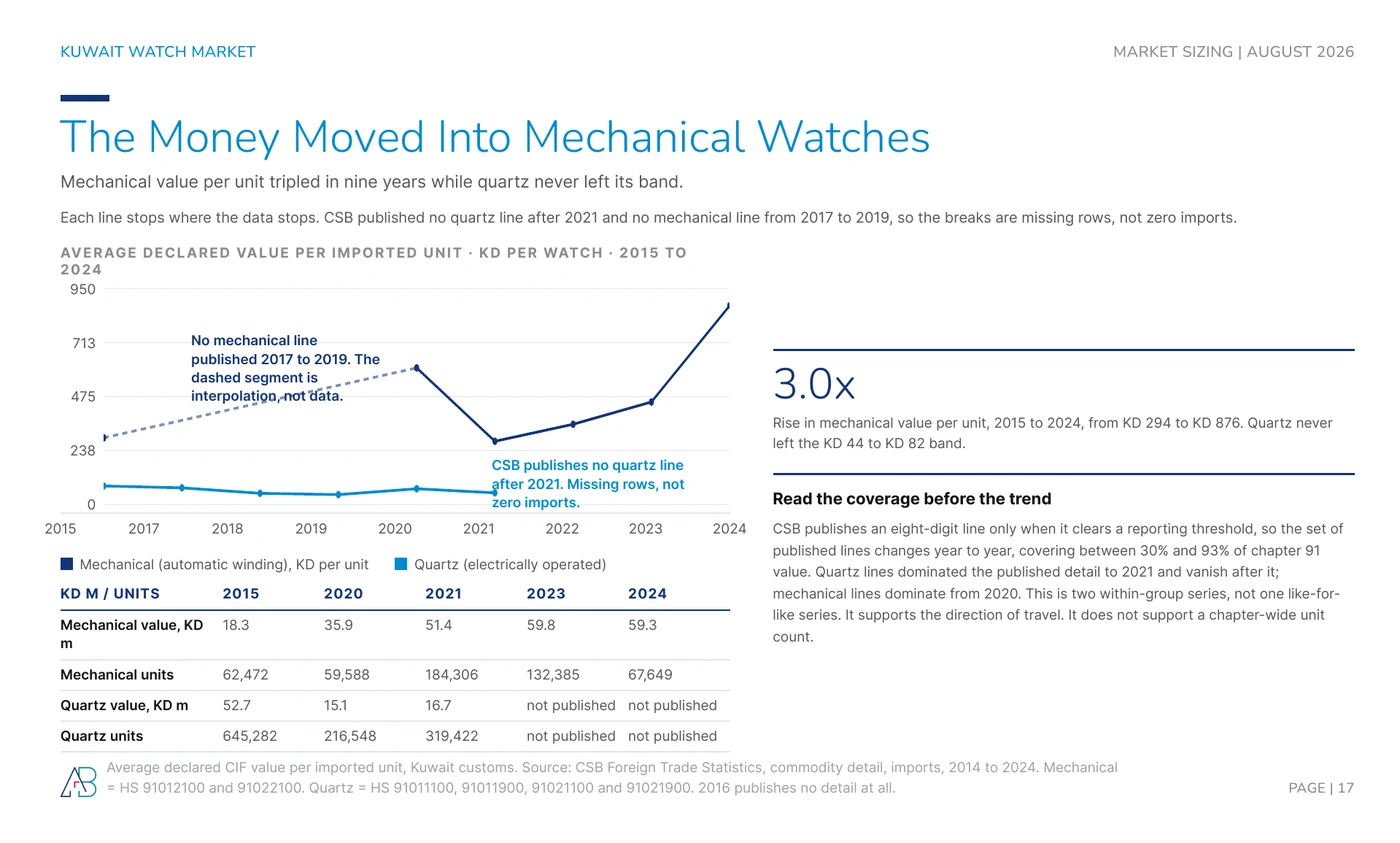
Read the coverage before the trend. The CSB publishes an eight-digit customs line only when it clears a reporting threshold, so the set of published lines changes year to year and covers between 30% and 93% of chapter 91 value. Quartz lines dominate the published detail to 2021 and vanish after it; mechanical lines dominate from 2020. These are two within-group series, not one like-for-like series. They support the direction of travel. They do not support a chapter-wide unit count, and I am not going to pretend otherwise.
The five-year re-export episode nobody explains
Outside one window, re-exports out of Kuwait run between 3.4% and 10.2% of imports. Between 2015 and 2019 they ran at 17.2% to 30.3%, peaking in 2018, when nearly a third of everything imported left again. The ratio took until 2022 to fall back inside the normal band. It stands at 6.4% now.
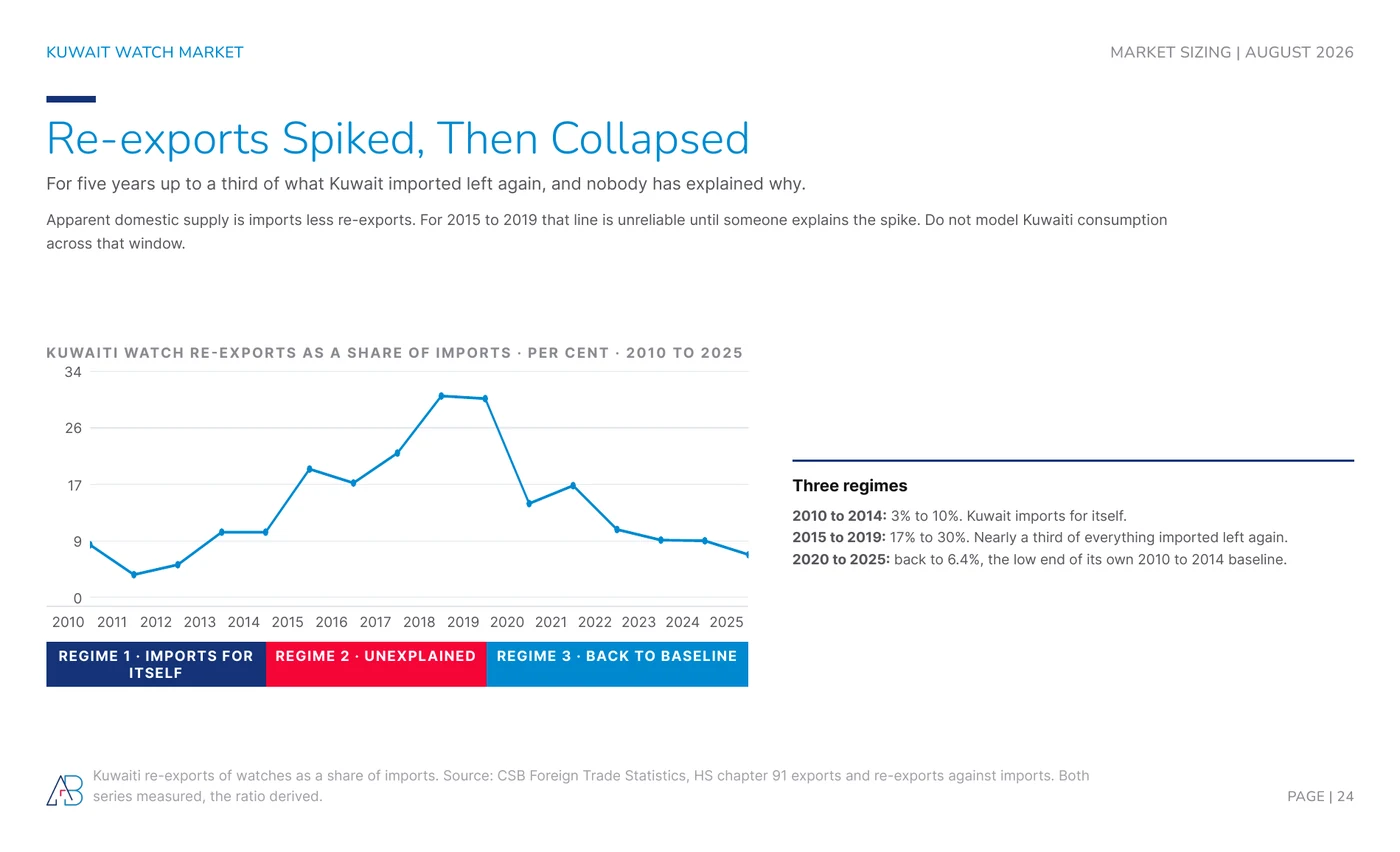
This matters because apparent domestic supply is imports less re-exports. Across that five-year window the supply line is unreliable, and I found no published explanation. The same shape appears in Kuwait's filings to the United Nations, so it is not a quirk of one dataset. I have flagged it rather than modelled around it. Do not model Kuwaiti consumption across 2015 to 2019.
Where the re-exports go is at least visible: UAE 51.7%, Switzerland 30.5%, United Kingdom 5.6%, everywhere else 12.2%. The Switzerland line is almost certainly service, warranty and unsold stock going back to the maker rather than a Kuwaiti export business. I have not confirmed that with a customs officer, so it is the likely reading and not a finding.
How Kuwait compares: small, rich, and growing faster than the world
Swiss watch exports to Kuwait went from CHF 128.3m in 2015 to CHF 187.7m in 2025, up 46.3%. The world went from CHF 21.5bn to CHF 25.6bn over the same decade. Kuwait beat the world index by a wide margin and did not gain share of it, because 2015 was Kuwait's low point at 0.60% of world value and indexing there flatters the comparison. Kuwait has held roughly 0.7% of world value for a decade while growing with it, not pulling away from it. Read both rows or the claim is overstated.
Kuwait against the world, Swiss watch export value
- Kuwait, CHF m: 2015 128.3; 2020 120.4; 2023 179.6; 2025 187.7
- World, CHF bn: 2015 21.5; 2020 17.0; 2023 26.7; 2025 25.6
- Kuwait share of world: 2015 0.60%; 2020 0.71%; 2023 0.67%; 2025 0.73%
Ranked against every market above CHF 50m in 2015, Kuwait is tenth of seventeen over the decade. The Gulf splits four ways: Bahrain and Qatar ahead of it, the UAE behind at +38%, and Saudi Arabia the only Gulf market to fall, with seven times the population and Swiss watch imports down 19%.
Change in Swiss watch import value, 2015 to 2025
- Turkey: +166%
- India: +141%
- Canada: +107%
- Australia: +98%
- United States: +85%
- Mexico: +70%
- Bahrain: +65%
- Qatar: +61%
- United Kingdom: +48%
- Kuwait: +46%
- Singapore: +44%
- Japan: +42%
- UAE: +38%
- China: +35%
- Saudi Arabia: minus 19%
- Italy: minus 21%
- Hong Kong: minus 44%
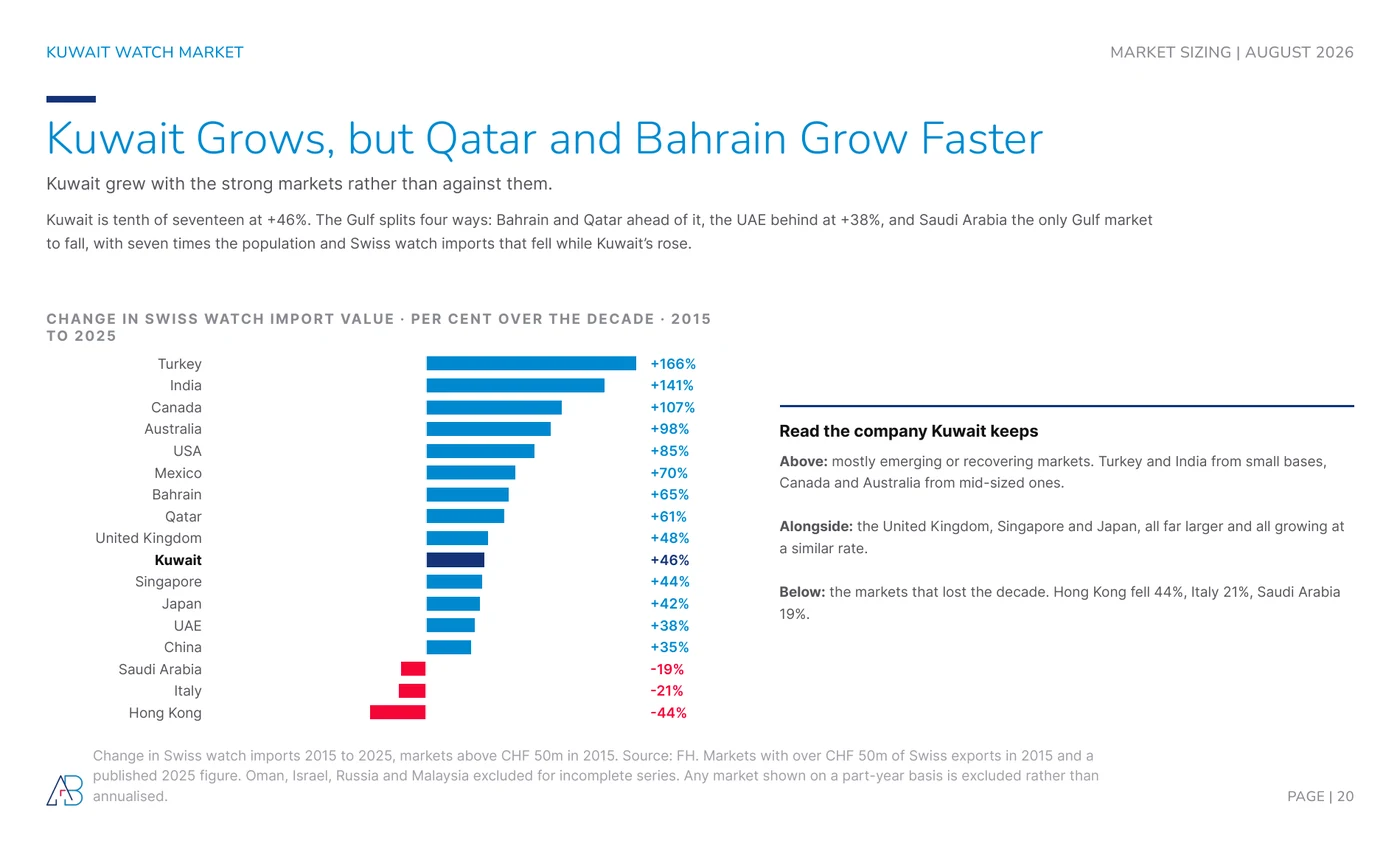
One caution on the markets sitting above Kuwait in that table, and on the per-resident ranking below. Singapore, Hong Kong and the UAE are re-export hubs and tourist destinations. Their figures include watches bought by visitors and watches passing through on the way somewhere else, so part of what looks like demand is traffic. Kuwait has negligible watch tourism and negligible re-export function today, which means its line is nearer to resident consumption than almost any other market in the top six. Comparing them like for like overstates the gap.
Swiss watch imports per resident, 2025, CHF per person
- Singapore: 272
- Hong Kong: 239
- UAE: 120
- Qatar: 89
- Bahrain: 77
- Kuwait: 38
- United Kingdom: 25
- France: 20
- Italy: 18
- Australia: 16
- Japan: 15
- Germany: 15
- United States: 13
- Saudi Arabia: 10
- China: 1
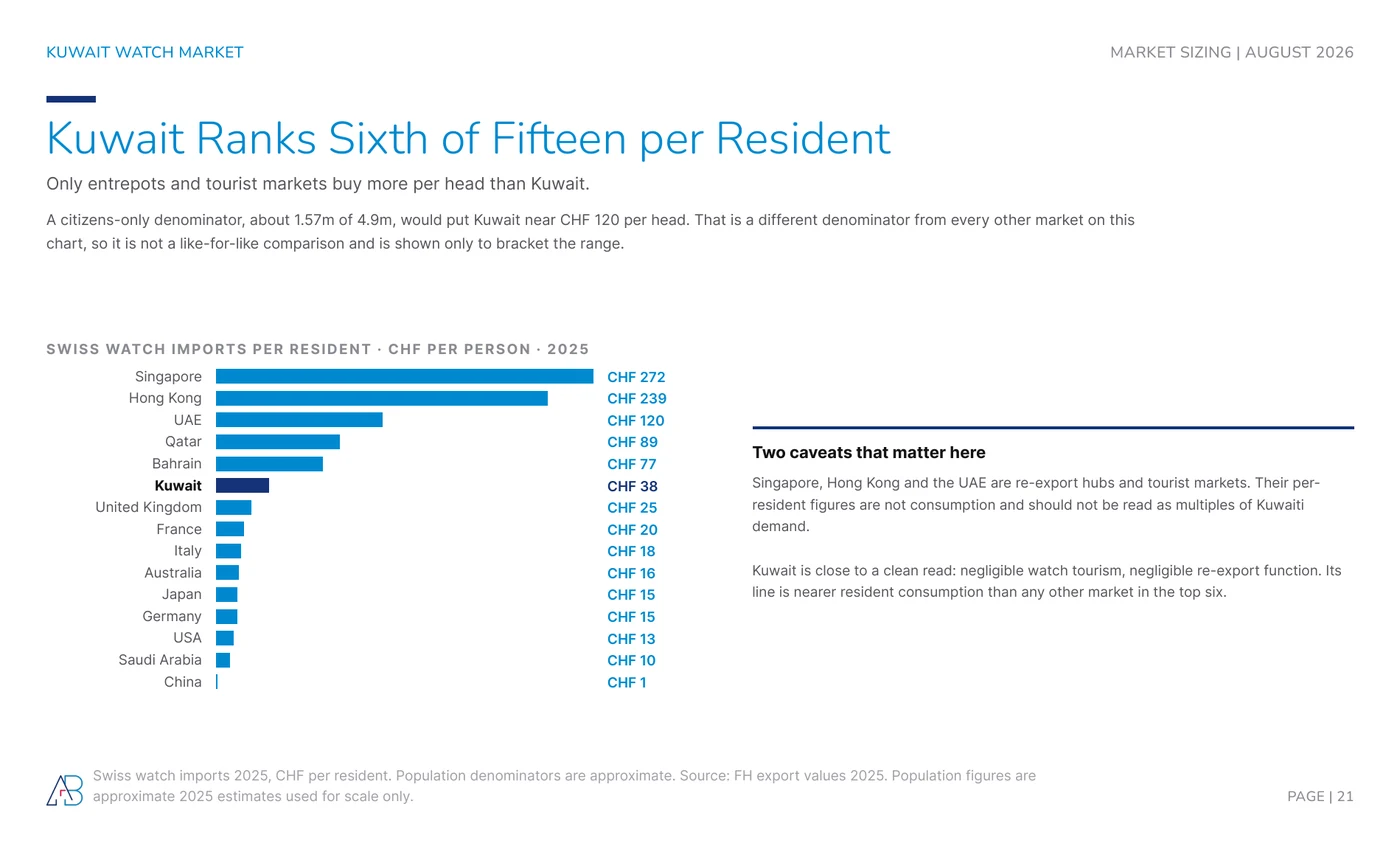
Kuwait is sixth of fifteen at CHF 38 per resident. On a citizens-only denominator, about 1.57m of 4.9m, the figure would be near CHF 120 per head, which would put it level with the UAE. That is a different denominator from every other market on the list, so it is not a like-for-like comparison and I show it only to bracket the range.
Within the Gulf, Kuwait is fourth by absolute value and its share has not moved.
Swiss watch exports to Gulf markets, 2025, CHF millions
- UAE: 1,316
- Saudi Arabia: 352
- Qatar: 276
- Kuwait: 188
- Bahrain: 124
- Oman: 79
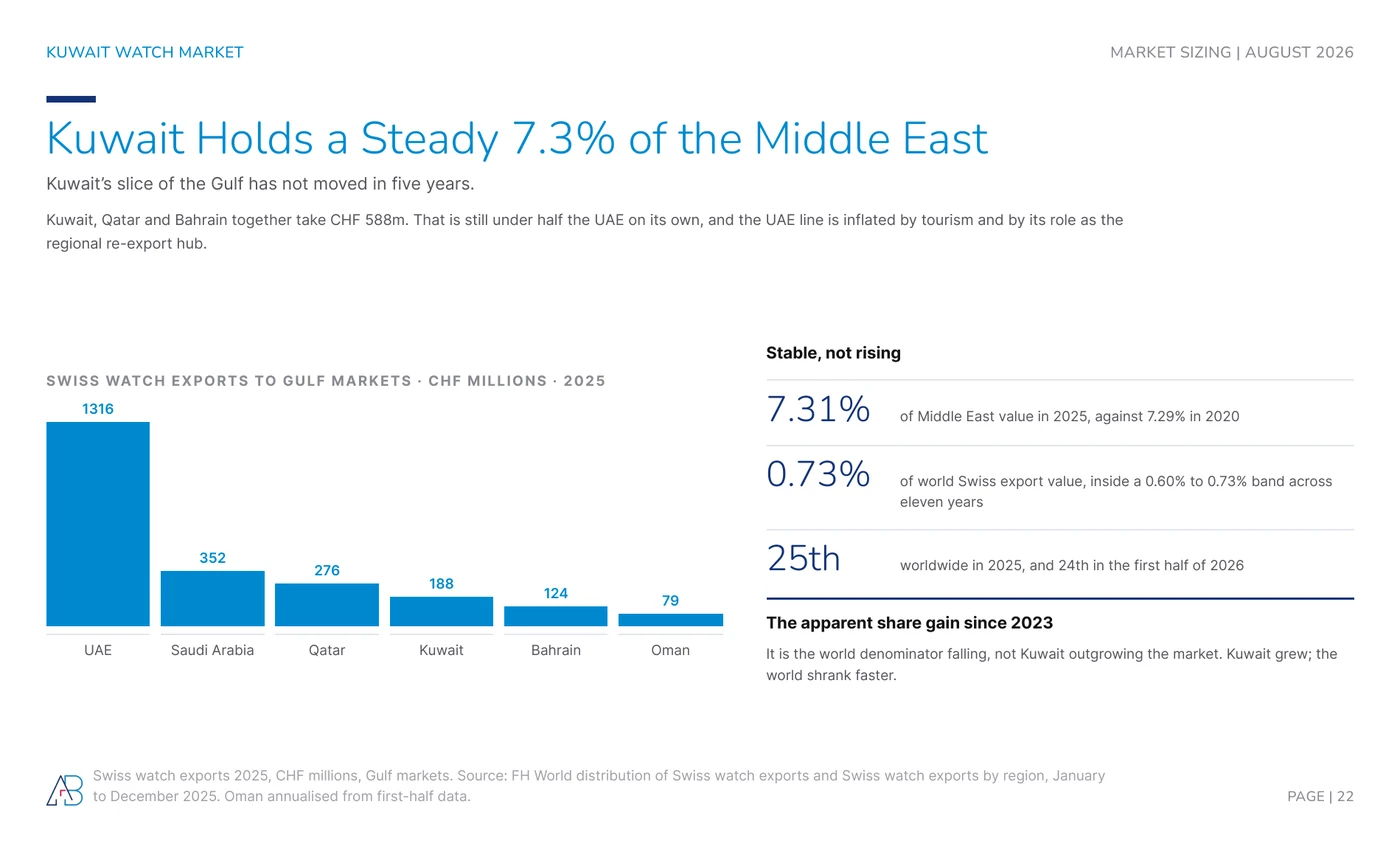
Kuwait took 7.31% of Middle East value in 2025 against 7.29% in 2020. Flat. It sits 25th worldwide in 2025 and 24th in the first half of 2026. The apparent share gain since 2023 is the world denominator falling, not Kuwait outgrowing the market: Kuwait grew, the world shrank faster. Kuwait, Qatar and Bahrain together take CHF 588m, which is still under half the UAE on its own, and the UAE line carries both tourism and the regional re-export function.
Who sells luxury watches in Kuwait
Fourteen named companies sell watches in Kuwait, and the count is the least interesting thing about them. Access to the top of the market runs through two.
Kuwaiti watch distribution: who holds what
- Morad Yousuf Behbehani: Six Richemont maisons on Richemont's own evidence: Jaeger-LeCoultre, Piaget, IWC, Panerai, Baume et Mercier, Roger Dubuis. Cartier is a seventh on strong circumstantial evidence. Plus Hublot from LVMH, Omega and Longines from Swatch Group, and Girard-Perregaux, Oris, Frederique Constant, Seiko and Grand Seiko. 21 doors
- Al Sirhan United, trading as LaRosa: Rolex and Tudor. Nothing else. 4 doors
- Trafalgar Luxury Group: Patek Philippe, TAG Heuer, Chopard, Bvlgari, Harry Winston, Chaumet. 16 doors
- Ahmed Yousef Behbehani: Breitling and Ebel confirmed. Vacheron Constantin claimed by the company but not by the brand. 5 doors plus a service centre
- Behbehani Watch World: About 36 brands at the accessible and mid tier. 8 doors plus a service centre
- Nine further companies: ONTIME leads on door count with fifteen fashion-watch outlets. Beidoun franchises Montblanc. Ali Bin Ali of Qatar and Al Tayer of Dubai each hold one luxury line. Q8 Horology, Yacob Behbehani Sons, Al Qatami Gulf, Time Square and a Swatch Group boutique account for the remainder. Door count various
One house fronts Richemont, Swatch Group and LVMH at once. In most markets those three use separate distributors. A Richemont-adjacent brand entering Kuwait negotiates with that house or goes direct. That is the same structural question that governs brand licensing in Kuwait: the counterparty list is short and it is named.
Al Sirhan United, trading as LaRosa, holds Rolex and Tudor and nothing else, across four doors. A single-family house holding one group and nothing else is a Rolex policy signature, and there is no route to Rolex distribution in Kuwait that does not start there.
Van Cleef and Arpels is the clearest gap in the public record: two boutiques in Kuwait, and no operating company named anywhere. Where a brand names no operator, I have said so rather than guessed.
Three addresses hold six in ten luxury doors
Geography is as concentrated as ownership. Counting distinct physical doors that carry at least one brand appearing in the Kuwaiti auction record with ten or more lots, which excludes fashion-watch retail automatically, there are 72 luxury-tier doors in the country.
Kuwaiti luxury-tier watch doors by location, August 2026
- Salhiya Complex: 17
- The Avenues: 17
- 360 Mall: 10
- Al Kout and Souk Al Kout: 4
- Marina Mall: 4
- The Gate Mall: 3
- Al Hamra: 3
- Behbehani Complex, Sharq: 2
- Al Khiran: 2
- Ten further locations, one door each: 10
- Total: 72
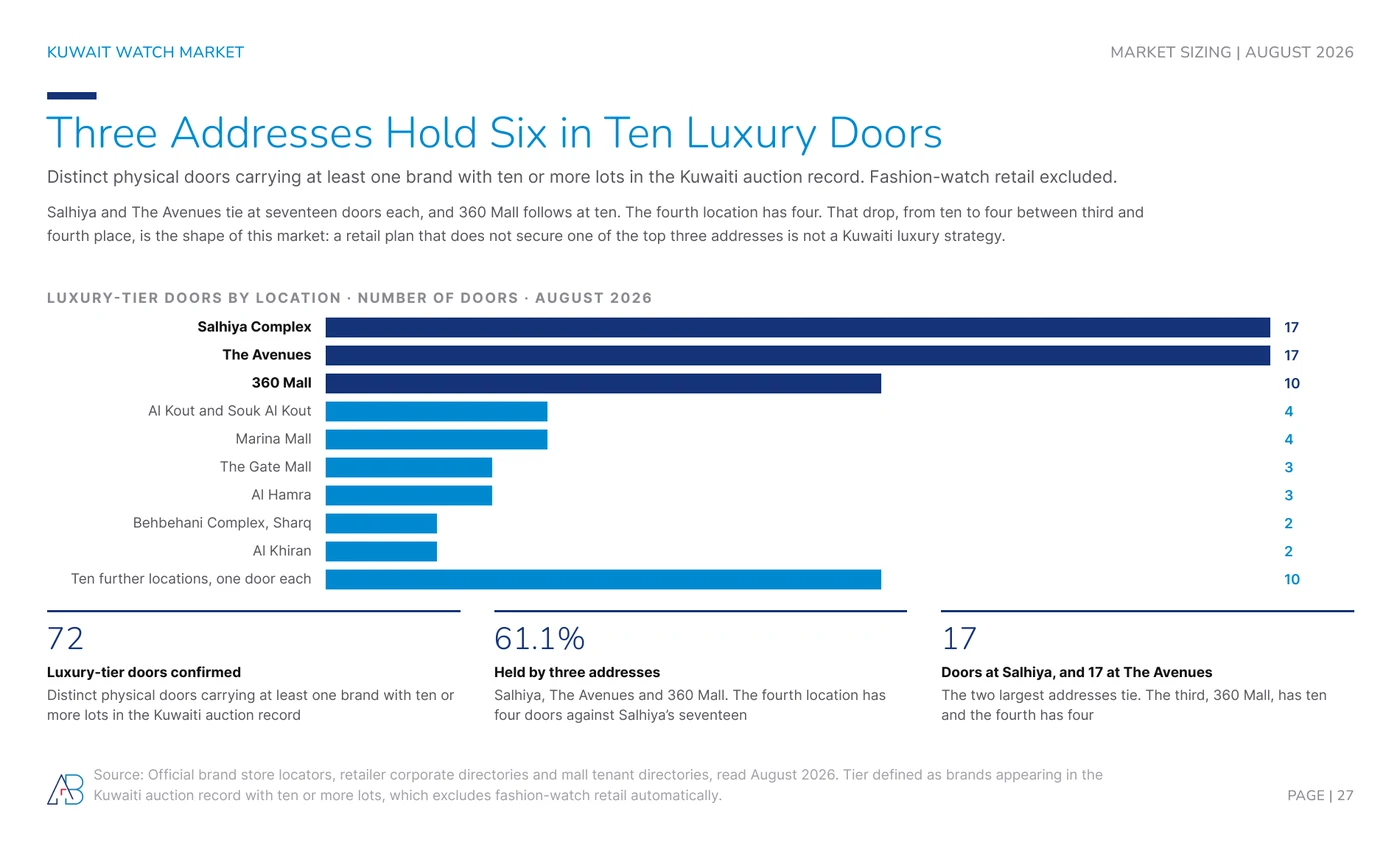
Salhiya and The Avenues tie at seventeen. 360 Mall follows at ten. The fourth location has four. That drop, from ten to four between third and fourth place, is the shape of Kuwaiti luxury retail: three addresses hold 61.1% of every luxury-tier door in the country. A plan that does not secure one of the top three is not a Kuwaiti luxury strategy.
Six resale participants, one publishing prices
On the secondary side I identified six participants. One publishes what anything sold for, and it under-records its own auctions by about a sixth. The other five hold transaction data nobody outside them has seen. This is the largest gap in the market that could still be measured.
The Auction House at theauctionh.com runs a weekly Wednesday sale and names no operator on the site. BUYVEST is a Kuwaiti exchange and auction platform for watches and handbags, publishing its own terms: 10% commission on the sale price, a separate up-front authentication fee, doorstep collection, three to four hour authentication, certificate issued, plus REEM, a pricing database of more than 25,000 watches. GMT24 is a Kuwaiti online marketplace founded in 2020, trading as GMT General Trading, with listings, counter-offers and verified-seller tagging and no published transaction data. Blue Diamond Watch is a pre-owned dealer in Awqaf Complex Gate 5, established 1995, buying, selling, trading and appraising Rolex, Patek and Omega from a single physical site. Al Batel Vintage runs a curated vintage line inside an authorised retail group. Smiths Boutique is a Kuwaiti online-first retailer of independent brands with four paid membership tiers from KD 270 to KD 625 lifetime and a horology course; it sells new rather than pre-owned and appears here as part of the market map.
Two circulating claims did not survive checking. A report states that BUYVEST uses a third party called LUXAR for authentication and that REEM is an AI assistant. No source links LUXAR to BUYVEST, which describes authentication as its own expert team plus AI, the opposite of independent verification. REEM is a pricing database. I have struck both claims rather than repeat them.
What Kuwaiti watches actually resell for
One Kuwaiti platform runs a weekly watch auction and posts every result. I captured 6,213 realised lots across five years, KD 44.85m of hammer in total, read lot by lot on 7 August 2026 and verified against an unfiltered source of 6,333 rows including 120 soft-deleted. It is the only transaction-level price data that exists for this market.
It is also incomplete, and the gaps are known rather than suspected. Two runs of consecutive missing Wednesdays, 13 March to 23 October 2024 and 31 December 2025 to 4 February 2026, account for thirty-nine auctions with no records at all. Nine further dates were partially ingested: 24 December 2025 is confirmed at 11 lots recorded against at least 27 actually sold. Two test transactions in the opening fortnight, each a single lot near KD 100,000, are removed. Restore the gaps and the record becomes 7,378 lots and KD 51.8m.
Published auction record against the continuity scenario
- Observed and published: 231 auctions; 6,213 lots; KD 44.8m
- Continuity scenario, imputed: 268 auctions; 7,378 lots; KD 51.8m
The scenario rests on two disclosed assumptions, and the sensitivity runs both ways. If the 2024 blank run was a real pause rather than a recording failure, the total is KD 46.4m. If the nine sparse dates were real short sales, KD 51.0m. If both are wrong, leaving only the two test lots removed, KD 44.6m. Working basis, both assumptions taken, KD 51.8m.
Kuwait's first half of 2026, set against the world
The record now runs to 29 July 2026, so the first half of that year is complete and can be set beside the global secondary market for the same six months. Kuwait's January to June book is 565 realised lots and KD 3.22m of hammer. EveryWatch puts the global secondary market over the same half at USD 10.5bn.
Those are not the same kind of measurement, and the difference matters more than the similarity. One is a complete census of a single weekly auction in one country. The other is an aggregation across many venues and platforms worldwide. Comparing the two on share of value is fair. Comparing them on size is not, and I am not going to.
On share, Kuwait is a far more concentrated market than the world.
Share of secondary-market value by brand, first half of 2026
- Rolex: Kuwait 59.7%; world 40.9%; gap +18.9 points
- Patek Philippe: Kuwait 15.9%; world 14.4%; gap +1.5 points
- Audemars Piguet: Kuwait 6.8%; world 9.4%; gap minus 2.6 points
- Cartier: Kuwait 3.3%; world 3.6%; gap minus 0.3 points
- Vacheron Constantin: Kuwait 3.1%; world 1.7%; gap +1.4 points
- Richard Mille: Kuwait 2.2%; world 3.4%; gap minus 1.2 points
- Omega: Kuwait 1.2%; world 4.2%; gap minus 3.0 points
- Tudor: Kuwait 1.0%; world 1.2%; gap minus 0.2 points
- F.P. Journe: Kuwait none; world 1.9%; gap minus 1.9 points
- Breitling: Kuwait none; world 1.9%; gap minus 1.9 points
- Four largest brands: Kuwait 84.6%; world 68.0%; gap +16.6 points
Rolex takes 59.7% of Kuwaiti resale value against 40.9% worldwide, a gap of 18.9 points. The four largest brands take 84.6% here against 68.0% globally. The tail is where it shows most: everything outside the world's fourteen largest brands is 12.2% of global value and 4.2% of Kuwait's. F.P. Journe, the defining brand story of the global half at 1.9% of world value, sold nothing at all in Kuwait across those six months.
Growth needs more care than share, and this is where a careless reading goes wrong. Raw Kuwaiti value for the half is down 29.9% on the same period in 2025, which would look like a collapse against a world up 37%. It is not one. The first half of 2026 carries 20 recorded sale dates against 31 in the first half of 2025, because of the blank run from 31 December to 4 February. Measured per recorded sale date, Kuwaiti value is up 8.6%, lots per sale are up 5.8%, and the median lot moved from KD 3,650 to KD 3,900. Kuwait grew, at roughly a quarter of the world's rate.
There is no such thing as an average watch in this market
The median lot sells for KD 4,250. The mean is KD 7,218. When mean and median diverge by seventy per cent, the tail is doing the work, and the coefficient of variation of 1.64 says the same thing.
Realised Kuwaiti auction lots by price band, 2021 to 2026
- Under KD 2,000: share of lots 16.7%; share of value 2.8%
- KD 2,000 to 4,999: share of lots 41.3%; share of value 19.6%
- KD 5,000 to 9,999: share of lots 25.9%; share of value 24.0%
- KD 10,000 to 24,999: share of lots 11.7%; share of value 23.1%
- KD 25,000 to 49,999: share of lots 3.0%; share of value 14.2%
- KD 50,000 and above: share of lots 1.4%; share of value 16.3%
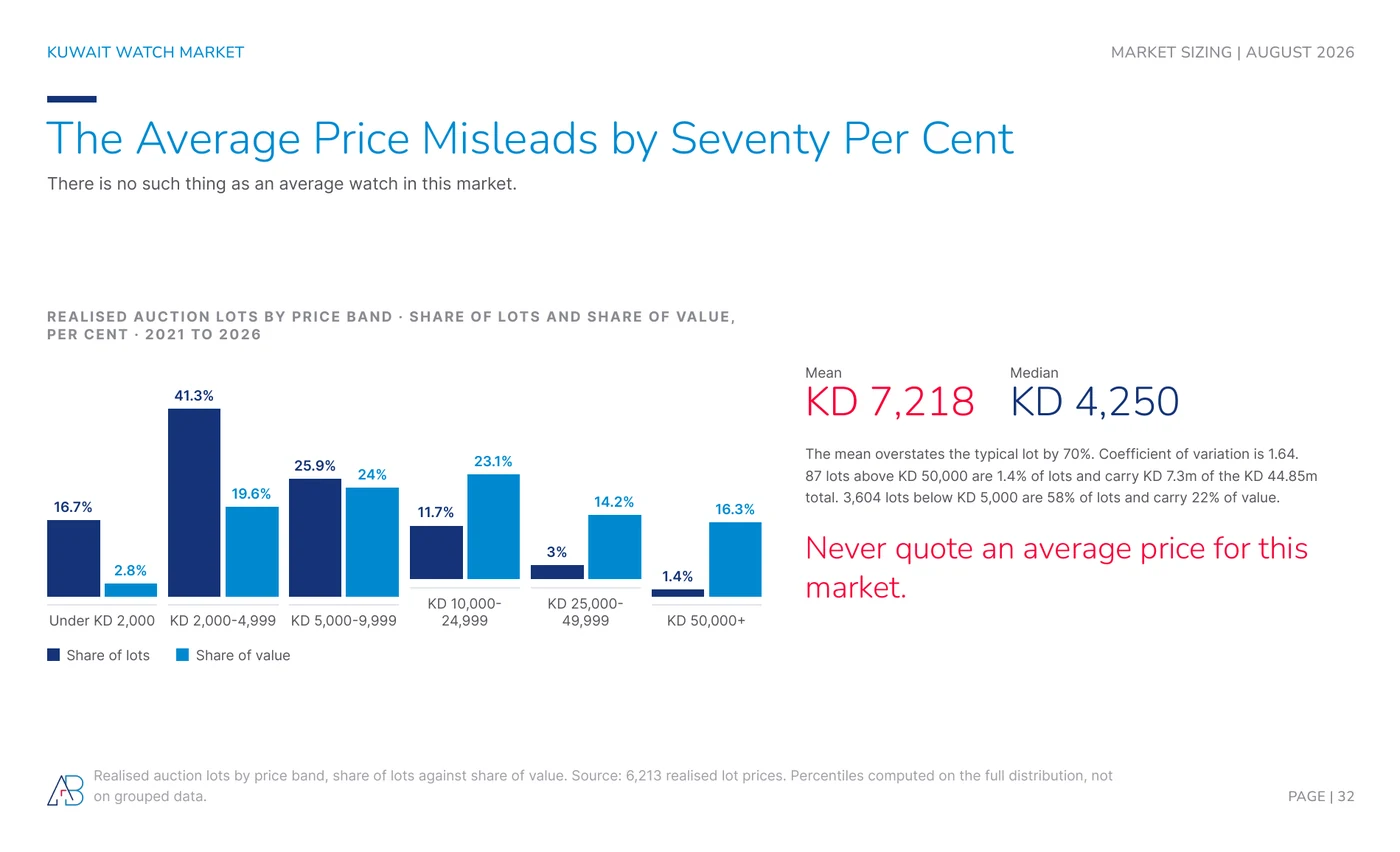
87 lots above KD 50,000 are 1.4% of lots and carry KD 7.3m of the KD 44.85m total. At the other end, 3,604 lots below KD 5,000 are 58% of everything sold and 22% of the money. Never quote an average price for this market. Anyone sizing it off one will be wrong by whatever margin the big lots happened to move that quarter.
Rolex consolidated while the trinity retreated
Between 2021 and 2025, Rolex went from 40.1% of Kuwaiti auction value to 63.6%. It did that inside a pool that was shrinking underneath it: total auction value fell from KD 8.59m to KD 8.07m.
Share of Kuwaiti auction value by brand
- Rolex: 2021 40.1%; 2025 63.6%; 2021 value KD 3.44m; 2025 value KD 5.13m
- Audemars Piguet: 2021 22.3%; 2025 12.2%; 2021 value KD 1.91m; 2025 value KD 0.98m
- Patek Philippe: 2021 21.8%; 2025 10.8%; 2021 value KD 1.87m; 2025 value KD 0.87m
- Richard Mille: 2021 12.2%; 2025 1.6%; 2021 value KD 1.05m; 2025 value KD 0.13m
- All other brands: 2021 3.7%; 2025 11.8%
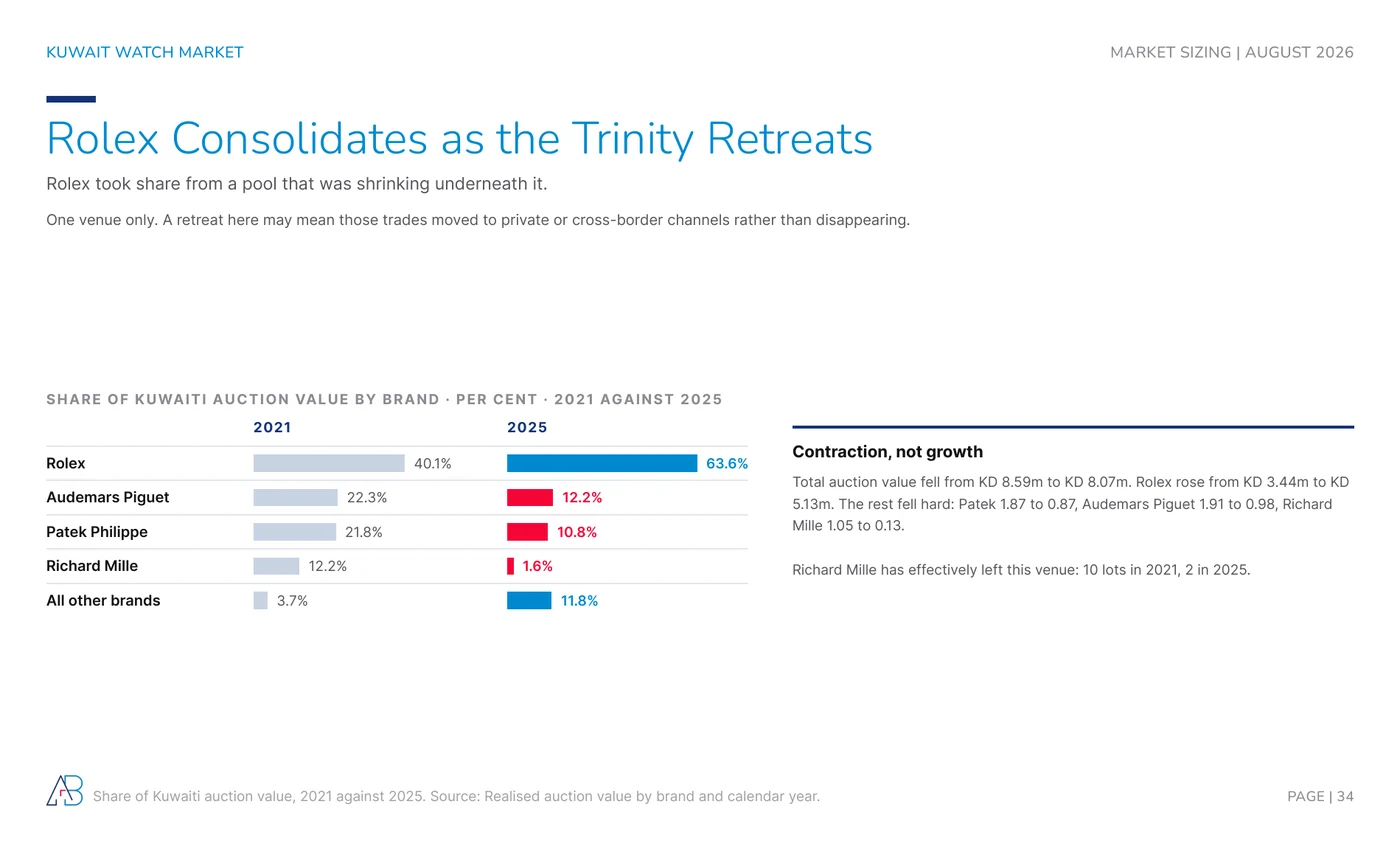
Richard Mille has effectively left this venue: ten lots in 2021, two in 2025. One caution applies to the whole table. This is one venue. A retreat here may mean those trades moved to private or cross-border channels rather than disappearing.
Prices held flat. The mix moved, not the market
The raw median realised price fell 29.7% between 2021 and 2026. That number is worthless on its own, because it measures what came up for sale rather than what anything is worth.
Compare the same watch with itself and the answer changes completely. For each consecutive year pair, take every reference with three or more sales in both years, compare median to median, then chain the median ratio. Mix is held constant by construction. On that basis prices rose 2.2% across five years. The same references, five years apart, sell for about the same money. 136 references carry six or more sales across two or more years, covering 4,048 of the 6,213 lots.
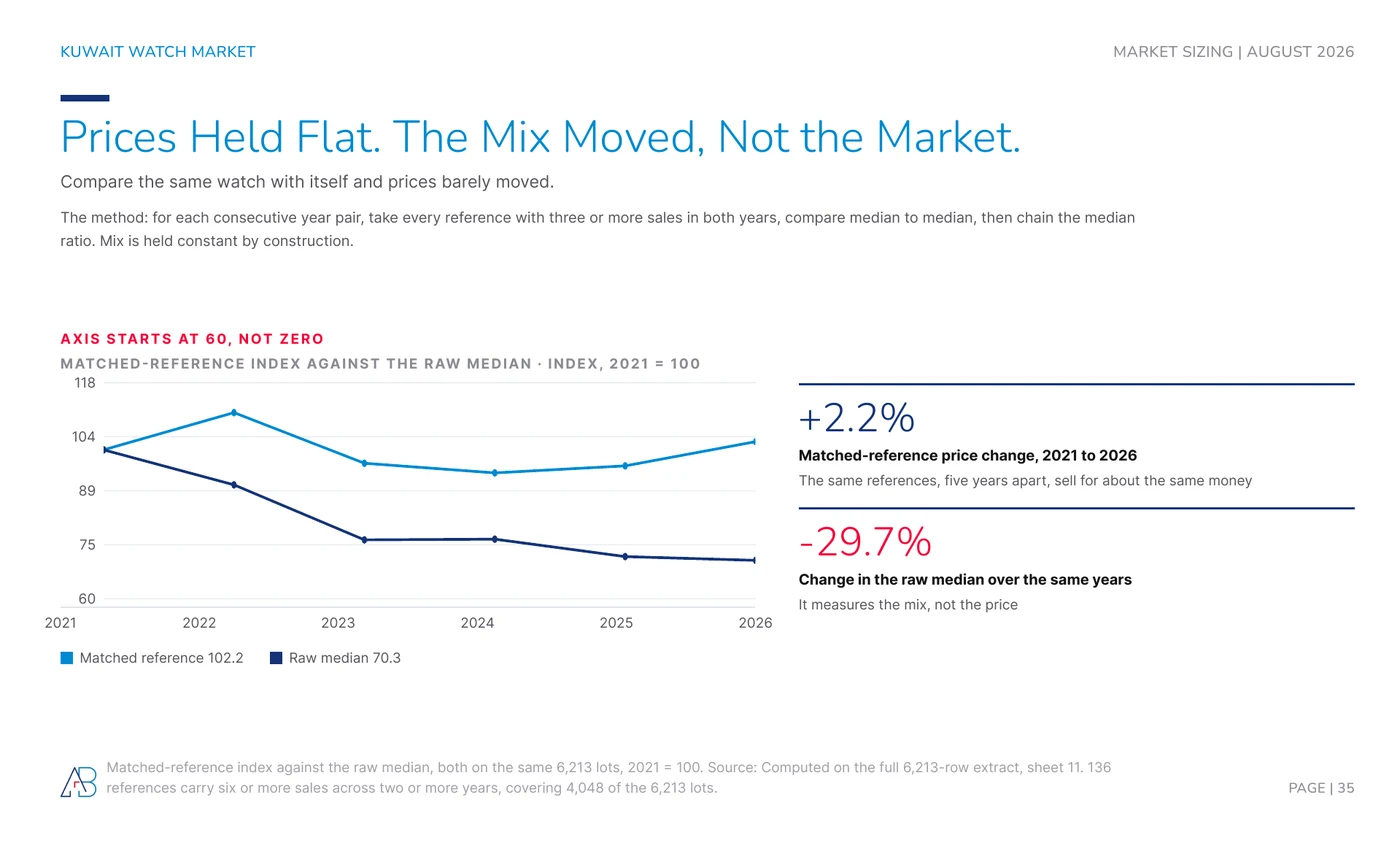
Underneath a flat aggregate, brands diverged by more than fifty points.
Change in resale price for the same references, 2021 to 2026
- Tudor: +24.1%
- Patek Philippe: +7.1%
- All brands pooled: +2.2%
- Rolex: minus 0.8%
- Cartier: minus 14%
- Omega: minus 27.4%
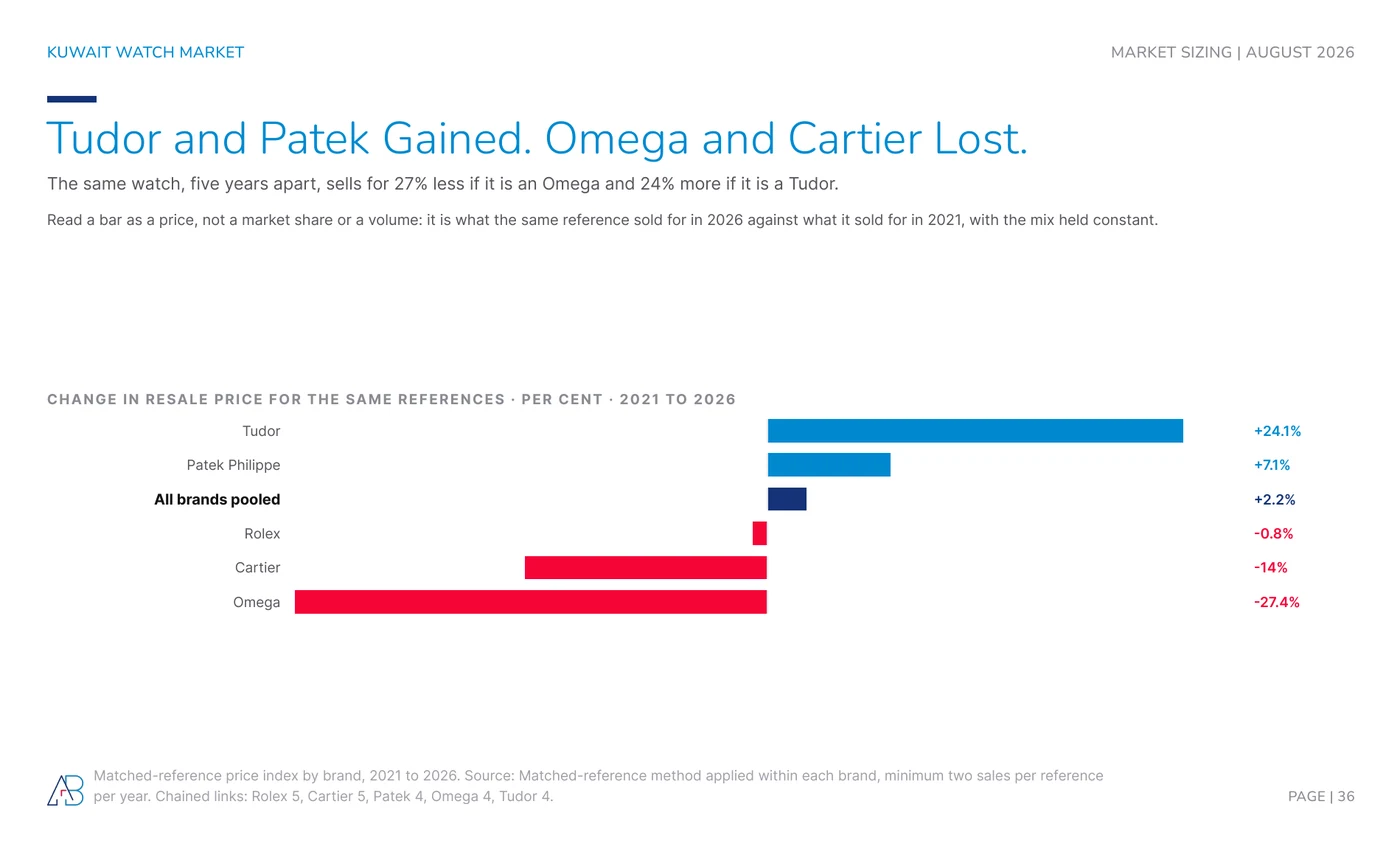
The same watch, five years apart, sells for 27% less if it is an Omega and 24% more if it is a Tudor. Read those as prices, not as market share or volume.
Kuwaiti resale is a near-new market, not a vintage one
Fifty-seven per cent of lots are under two years old. Three-quarters of the book is under four years. Only 2.7% is more than ten years old, and 3,546 of the 6,213 lots carry a production year equal to the sale year or the one before it.
Age at the moment of auction, share of lots, 2021 to 2026
- 0 to 1 year: 57.1%
- 2 to 3 years: 19.2%
- 4 to 5 years: 9.5%
- 6 to 10 years: 7.3%
- Over 10 years: 2.7%
- Not stated: 4.2%
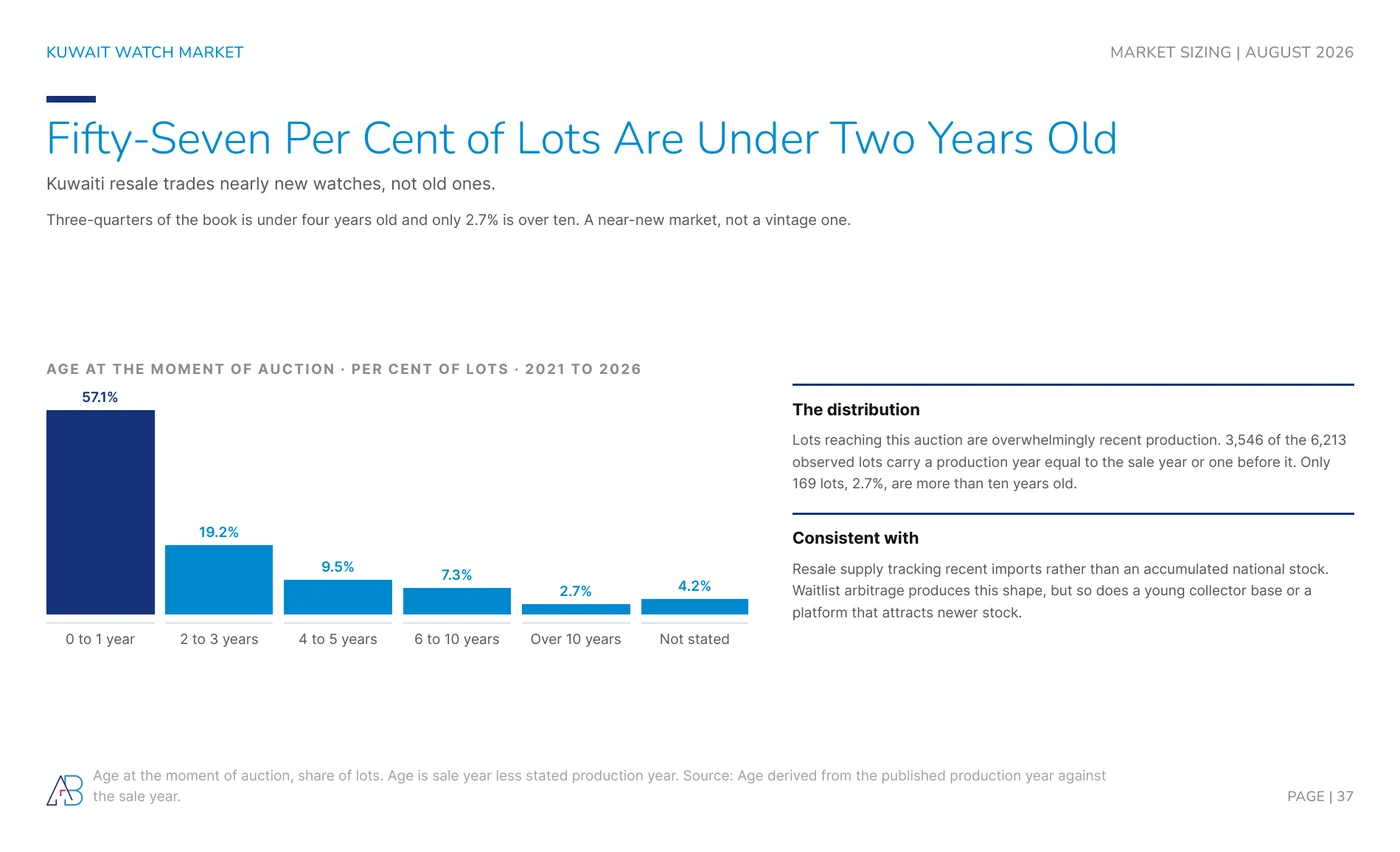
Resale supply here tracks recent imports rather than an accumulated national stock. Waitlist arbitrage would produce this shape. So would a young collector base, or a platform that simply attracts newer stock. I cannot separate the three from what this data shows, and I would rather say so than pick the flattering explanation.
The unworn premium is 12%, not 24%
Compare every unworn lot against every used lot and you get a premium of 24.4%. That figure is wrong in an instructive way. Unworn lots skew towards newer and pricier references, so the comparison measures the mix as much as the condition. Compare like reference with like reference, across the 83 references carrying at least three of each, and the premium is 11.8%. Less than half the obvious answer, and on 8.4% of references an unworn example sells for less than a used one.
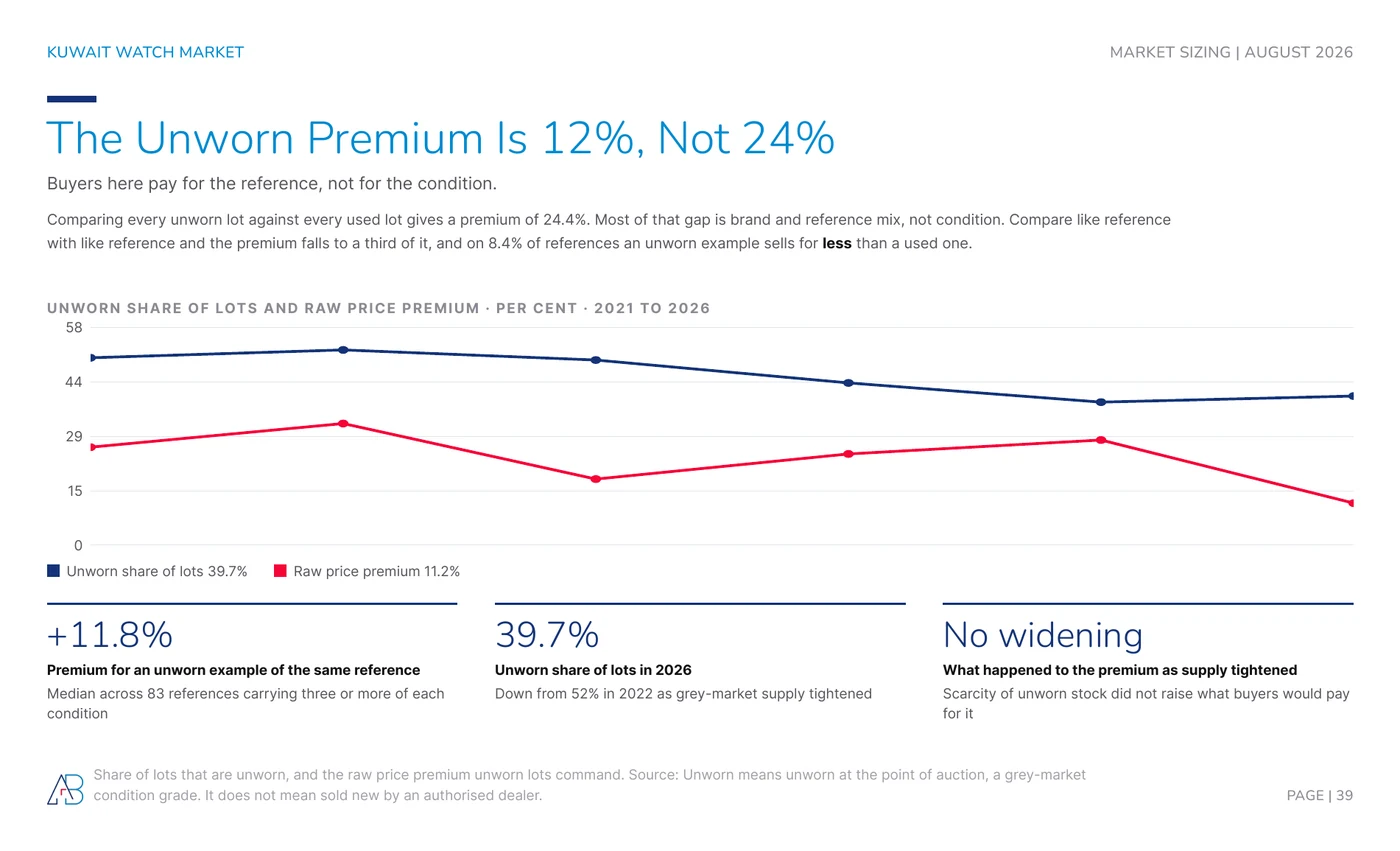
Unworn lots were 52% of the book in 2022 and 39.7% in 2026 as grey-market supply tightened. The premium did not widen. Scarcity of unworn stock did not raise what buyers would pay for it, which tells you buyers here are paying for the reference rather than for the condition.
The twelve most-traded references in Kuwait are all Rolex
1,613 distinct references appear in the record. 88 carry ten or more sales. The twelve that trade most often are, without exception, Rolex.
The twelve most-traded watch references in Kuwait, full record
- 126334, Rolex Datejust 41: 436 lots; KD 1,692,250 realised; median KD 3,900; price path +2.5%
- 126300, Rolex Datejust 41: 372 lots; KD 1,098,320 realised; median KD 2,910; price path +0.7%
- 126710BLRO, Rolex GMT-Master II Pepsi: 190 lots; KD 1,227,840 realised; median KD 6,200; price path minus 6.1%
- 116500LN, Rolex Daytona: 180 lots; KD 1,702,230 realised; median KD 9,025; price path minus 25.2%
- 278273, Rolex Datejust 31: 179 lots; KD 917,760 realised; median KD 5,100; price path +17.1%
- 126710BLNR, Rolex GMT-Master II Batman: 179 lots; KD 944,895 realised; median KD 5,130; price path minus 17.4%
- 124300, Rolex Oyster Perpetual: 168 lots; KD 748,630 realised; median KD 3,225; price path minus 36.9%
- 126610LV, Rolex Submariner Starbucks: 129 lots; KD 630,745 realised; median KD 4,650; price path minus 28.9%
- 126720VTNR, Rolex GMT-Master II Sprite: 98 lots; KD 571,870 realised; median KD 5,325; price path minus 43.2%
- 116610LV, Rolex Submariner Hulk: 83 lots; KD 515,150 realised; median KD 5,700; price path minus 19.1%
- 126234, Rolex Datejust 36: 64 lots; KD 214,040 realised; median KD 3,275; price path +7.7%
- 116710LN, Rolex GMT-Master II: 57 lots; KD 222,870 realised; median KD 3,750; price path minus 26.4%
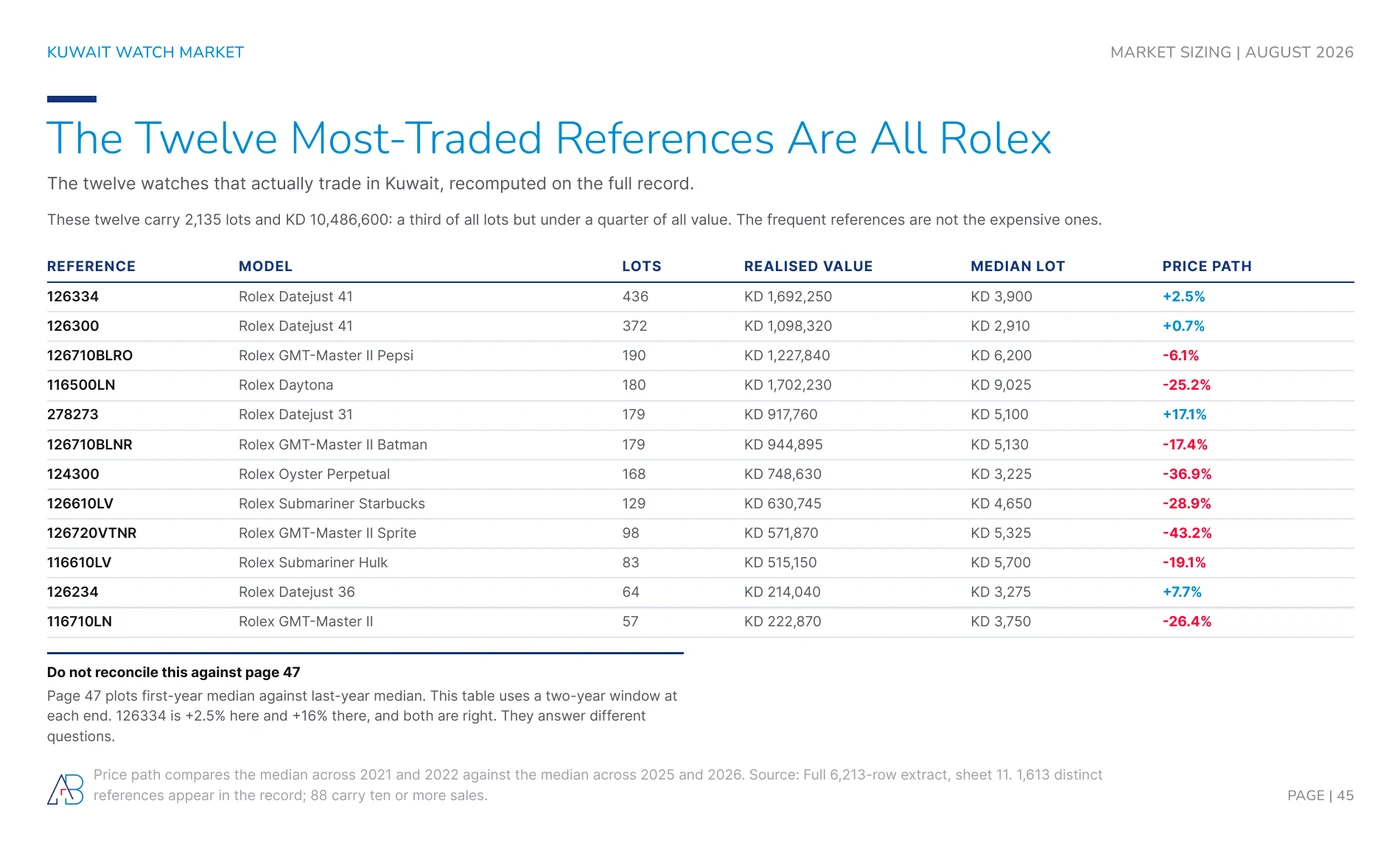
Those twelve carry 2,135 lots and KD 10,486,600: a third of all lots but under a quarter of all value. The frequent references are not the expensive ones. The price path column compares the median across 2021 and 2022 against the median across 2025 and 2026, which is a two-year window at each end rather than a first-year to last-year comparison, so it will not reconcile against a single-year index and is not meant to.
The dress book and the sports book went in opposite directions
Inside Rolex, on 1,433 dress lots and 2,422 sports lots classified by model text, Datejust and Day-Date references rose 15.9% between 2021 and 2026 while sports models fell 11.9%. A 28-point gap in five years, inside one brand.
Share of Rolex auction value by family
- Dress: Datejust and Day-Date: 2021 23.3%; 2023 31.8%; 2025 32.2%; 2026 34.9%
- Sports: 2021 76.7%; 2023 68.2%; 2025 67.8%; 2026 65.1%
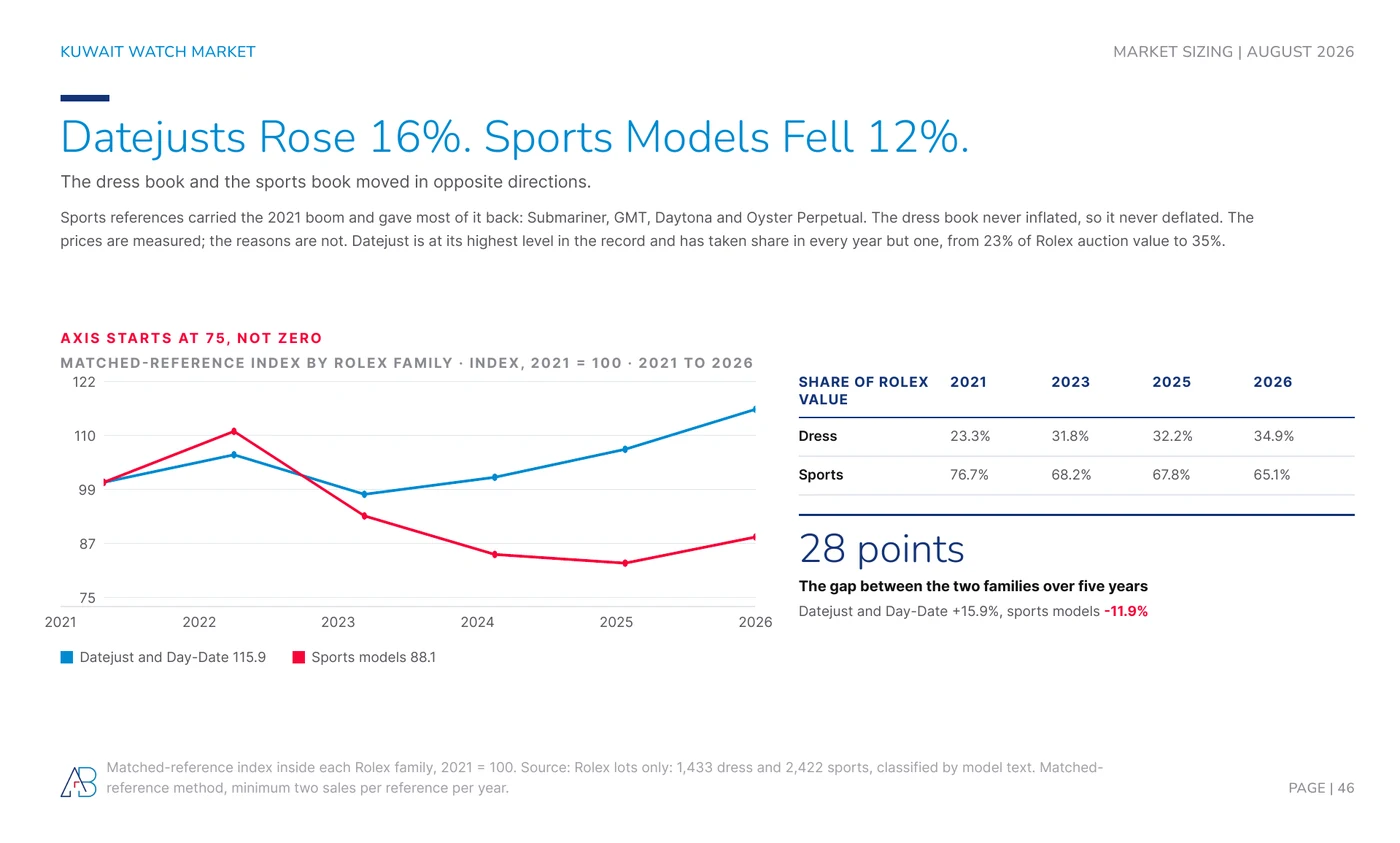
Sports references carried the 2021 boom and gave most of it back: Submariner, GMT, Daytona and Oyster Perpetual. The dress book never inflated, so it never deflated. Datejust is at its highest level in the record and has taken share in every year but one, from 23.3% of Rolex auction value to 34.9%. The prices are measured. The reasons behind them are not, and I am not going to invent one.
Kuwaiti resale is twice as concentrated as the world primary market
Rolex, Patek Philippe, Audemars Piguet and Richard Mille take 90.8% of Kuwaiti auction value across 6,213 lots and KD 44.85m. Rolex alone is 53.5% of the whole record, on 3,887 lots and KD 24,003,870. The same four brands take 49.1% of the world primary market on the Morgan Stanley estimate.
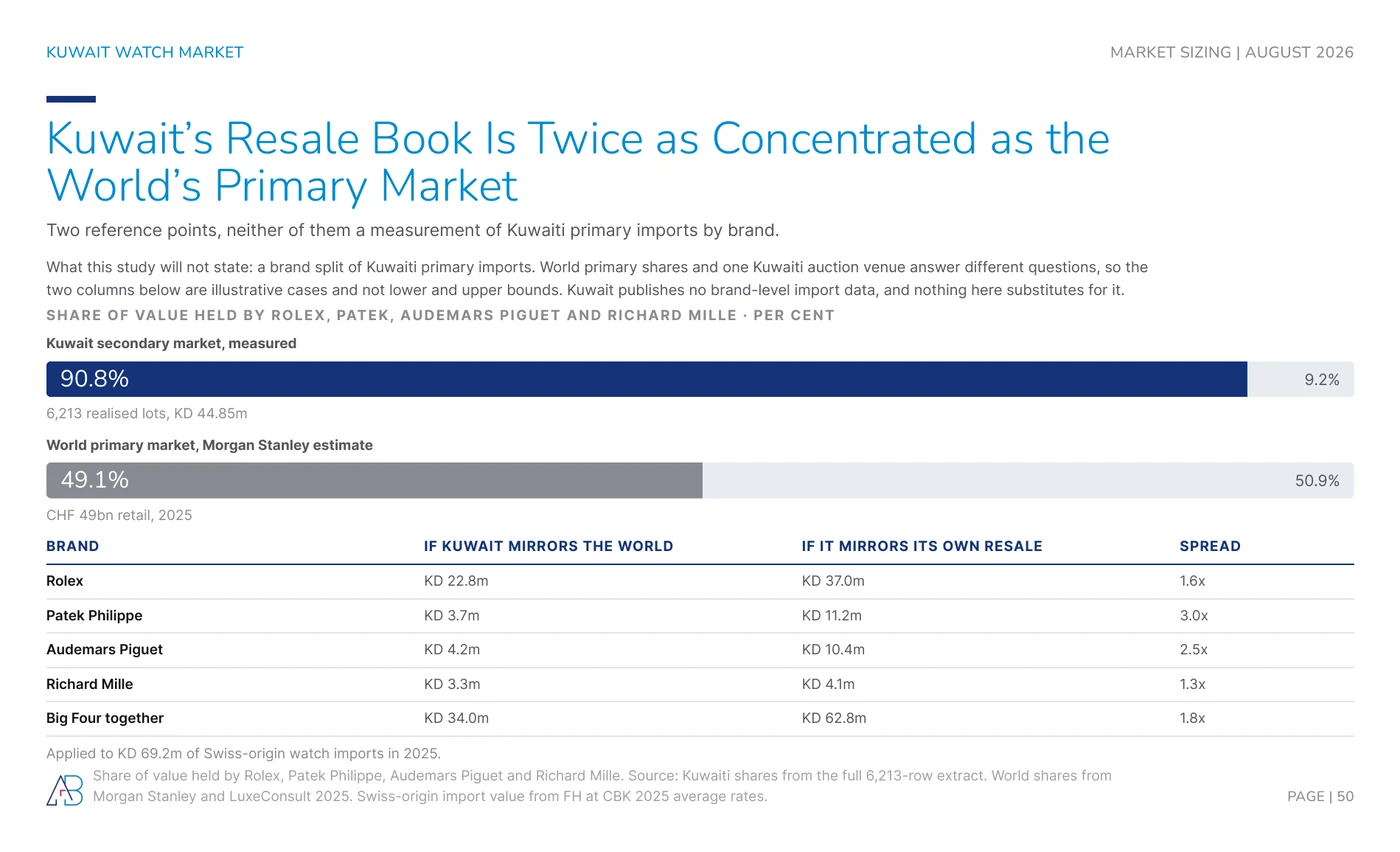
What that gap is worth depends entirely on which one you believe applies to Kuwaiti primary imports, and this study will not state a brand split of Kuwaiti primary imports. Kuwait publishes no brand-level import data. The two columns below are illustrative cases, not lower and upper bounds, applied to KD 69.2m of Swiss-origin watch imports in 2025.
Two illustrative cases applied to KD 69.2m of Swiss-origin imports, 2025
- Rolex: if Kuwait mirrors the world KD 22.8m; if it mirrors its own resale KD 37.0m; spread 1.6x
- Patek Philippe: if Kuwait mirrors the world KD 3.7m; if it mirrors its own resale KD 11.2m; spread 3.0x
- Audemars Piguet: if Kuwait mirrors the world KD 4.2m; if it mirrors its own resale KD 10.4m; spread 2.5x
- Richard Mille: if Kuwait mirrors the world KD 3.3m; if it mirrors its own resale KD 4.1m; spread 1.3x
- Four brands together: if Kuwait mirrors the world KD 34.0m; if it mirrors its own resale KD 62.8m; spread 1.8x
Why the official price index does not measure watches
Kuwait's consumer price index has a subgroup, COICOP 12.3, described as jewellery, clocks and watches. It rose about 75% between 2021 and 2026. Over the same five years the matched-reference index built from realised watch prices rose 2.2%. The gap is 72.6 points.
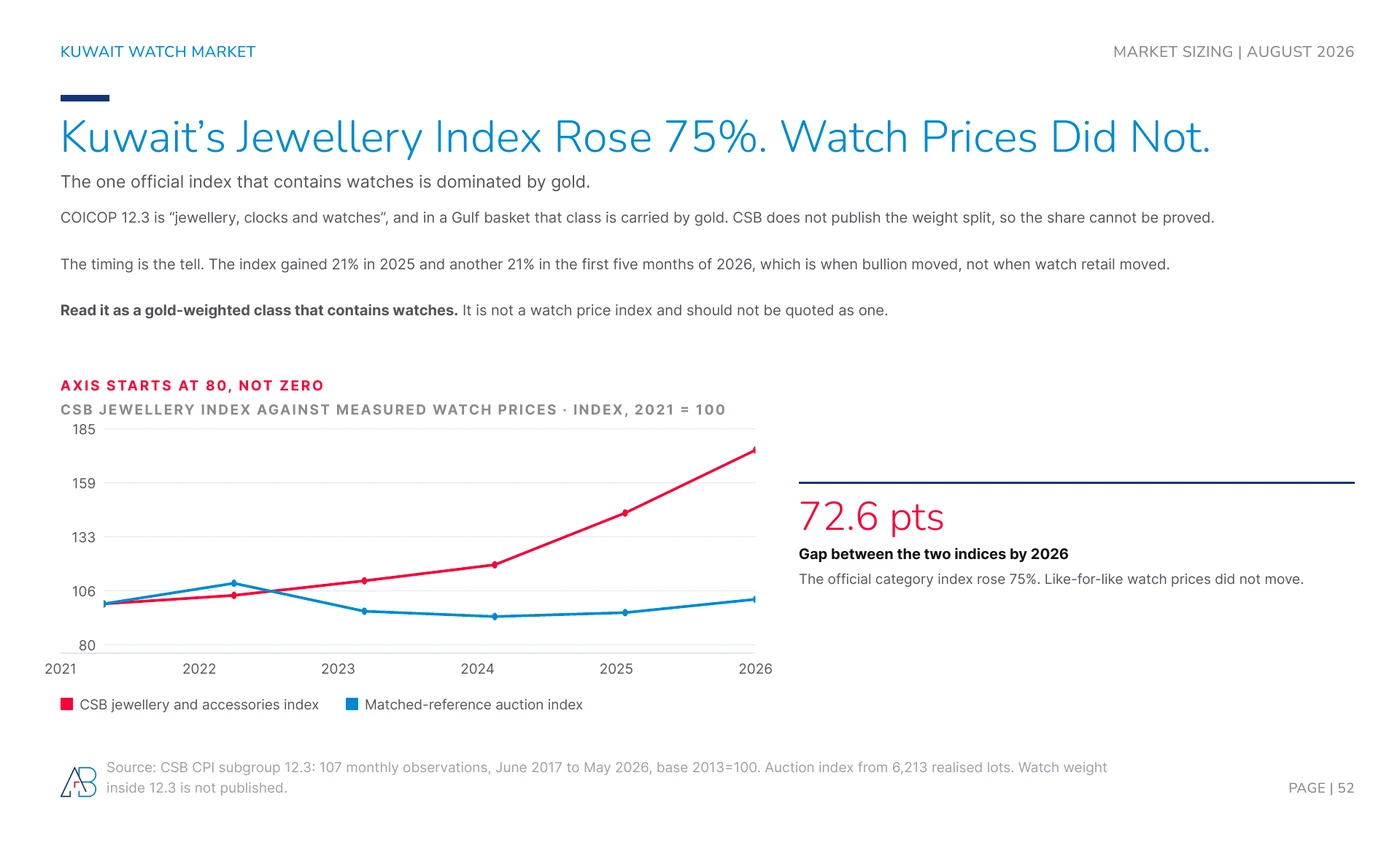
The explanation is gold. In a Gulf basket that class is carried by jewellery, and the CSB does not publish the weight split, so the share cannot be proved. The timing is the tell: the index gained 21% in 2025 and another 21% in the first five months of 2026, which is when bullion moved, not when watch retail moved. Read it as a gold-weighted class that contains watches. It is not a watch price index and it should not be quoted as one.
What the secondary market is worth against the primary one
A watch sells at auction for a hammer price. A dealer who buys it there resells it at a margin, so the retail value of that watch is higher than the hammer. Dividing hammer by one minus the margin converts one to the other: at a 30% margin the hammer is multiplied by 1.43, at 40% by 1.67. That is the same band applied to landed import cost earlier, because both steps run from acquisition cost to retail counter.
Auction hammer converted to retail-equivalent value
- 2025, as published by the index: hammer KD 8.07m; at 30% margin KD 11.53m; at 40% margin KD 13.45m
- 2025, gaps restored: hammer KD 8.29m; at 30% margin KD 11.84m; at 40% margin KD 13.82m
- Whole period 2021 to 2026, scenario: hammer KD 51.8m; at 30% margin KD 74.0m; at 40% margin KD 86.3m
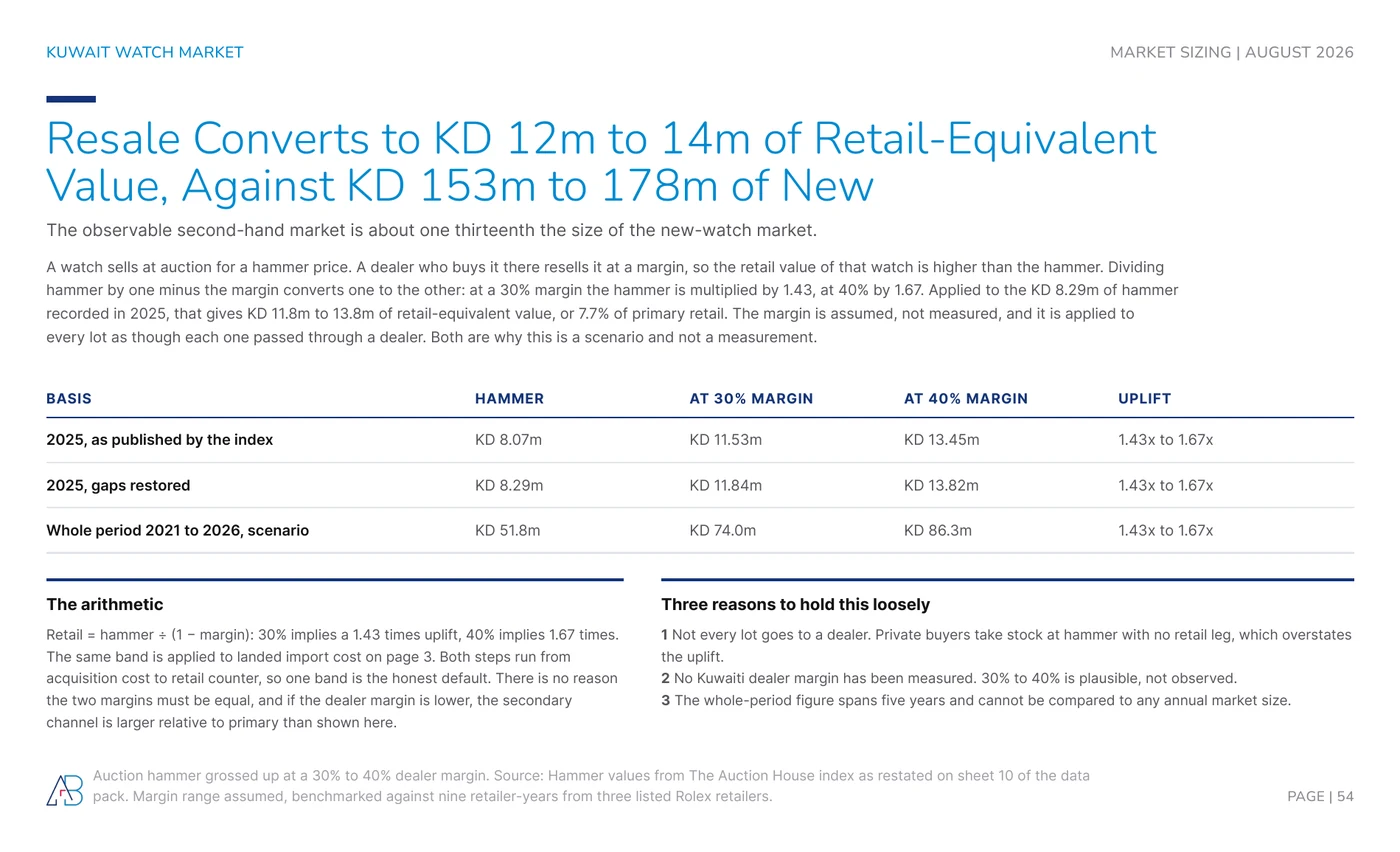
Applied to the KD 8.29m of hammer once the 2025 recording gaps are restored, that gives KD 11.8m to KD 13.8m of retail-equivalent value, or 7.7% of primary retail. The observable second-hand market is about one thirteenth the size of the new-watch market.
Three reasons to hold that loosely. Not every lot goes to a dealer, and private buyers taking stock at hammer with no retail leg would overstate the uplift. No Kuwaiti dealer margin has been measured; 30% to 40% is plausible, not observed, and if the real dealer margin is lower then the secondary channel is larger relative to primary than shown. And the whole-period figure spans five years, so it cannot be compared to any annual market size.
Kuwait levies neither VAT nor excise
On statutory consumption tax alone, Kuwait and Qatar are the only Gulf markets that add nothing at the till, and Qatar does levy excise on tobacco and drinks. The GCC framework agreement of 2016 set a 5% standard rate. Kuwait has still not enacted it.
Standard VAT rate and the price of the same KD 10,000 watch, 2026
- Kuwait: VAT rate 0%; price paid KD 10,000
- Qatar: VAT rate 0%; price paid KD 10,000
- Oman: VAT rate 5%; price paid KD 10,500; premium over Kuwait KD 500
- UAE: VAT rate 5%; price paid KD 10,500; premium over Kuwait KD 500
- Bahrain: VAT rate 10%; price paid KD 11,000; premium over Kuwait KD 1,000
- Saudi Arabia: VAT rate 15%; price paid KD 11,500; premium over Kuwait KD 1,500
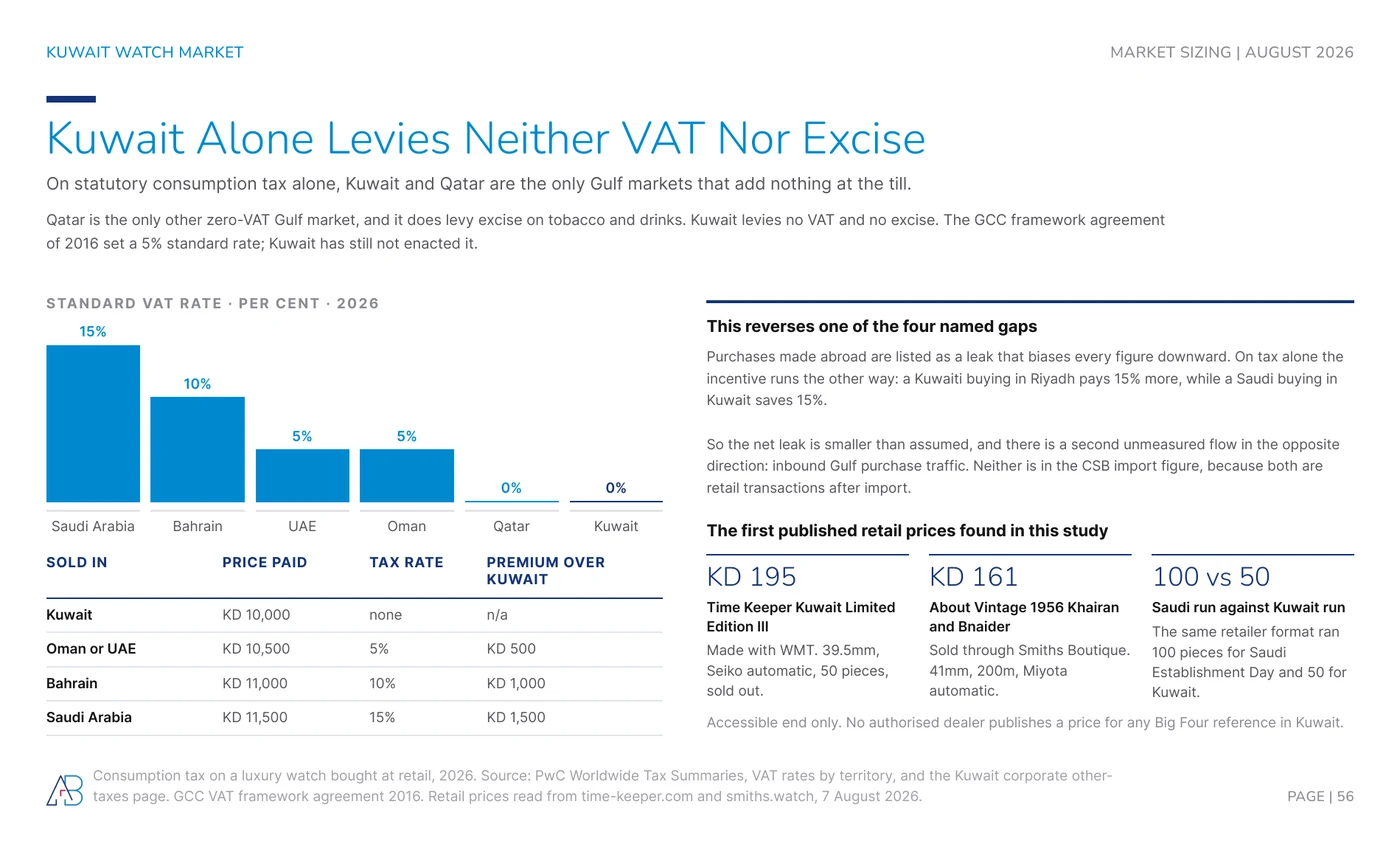
This reverses one of the four gaps named below. Purchases made abroad are usually listed as a leak that biases every figure downward. On tax alone the incentive runs the other way: a Kuwaiti buying in Riyadh pays 15% more, and a Saudi buying in Kuwait saves 15%. So the net leak is smaller than assumed, and there is a second unmeasured flow in the opposite direction, inbound Gulf purchase traffic. Neither appears in the CSB import figure, because both are retail transactions that happen after import.
Two retail prices are worth recording because they are the only published Kuwaiti watch prices this study found, and both sit at the accessible end. The Time Keeper Kuwait Limited Edition III, a 39.5mm Seiko automatic in 50 pieces made with WMT, listed at KD 195 and sold out. The About Vintage 1956 Khairan and Bnaider, a 41mm 200m Miyota automatic sold through Smiths Boutique, listed at KD 161. The second ran 100 pieces for Saudi Establishment Day against 50 for Kuwait. No authorised dealer publishes a price for any Big Four reference in Kuwait.
What this study does not measure
Nine layers of this market are counted or derived. Four cannot be, and naming them is the point rather than an apology.
Kuwait watch market 2025: every layer, labelled
- Watch imports, all origins: KD 101.8m. Measured. CSB customs, chapter 91, CIF
- Of which Swiss origin: KD 69.2m. Derived. FH FOB export value at CBK average rate, set against a CIF total. Not like for like
- Less re-exports out of Kuwait: KD 6.5m. Measured. CSB chapter 91 exports and re-exports
- Apparent domestic supply: KD 95.3m. Derived. Imports less re-exports. Excludes purchases made abroad
- Observable secondary hammer: KD 8.1m. Measured. 1,442 realised lots, one platform, calendar 2025. Restored base KD 8.29m
- Primary retail value: KD 152.7m to KD 178.1m. Derived. Imports plus 5% duty, grossed up on the margin band
- Secondary retail equivalent: KD 11.8m to KD 13.8m. Derived. Restored hammer grossed up on the same band
- Illustrative retail scenario: KD 164m to KD 192m. Scenario. The two retail lines added
- Secondary as a share of primary: 7.7%. Derived. Retail against retail. Observable portion only
- Independent dealer turnover: Not measured. Roughly 20 shops reported in Souk Al Awqaf alone
- Other social and private auctions: Not measured. At least one further Instagram auction runs weekly
- Classifieds and peer-to-peer: Not measured. OpenSooq, 4Sale, Dubizzle, WhatsApp and Instagram
- Kuwaiti purchases made abroad: Not measured. Never enters Kuwait customs. Biases every figure downward
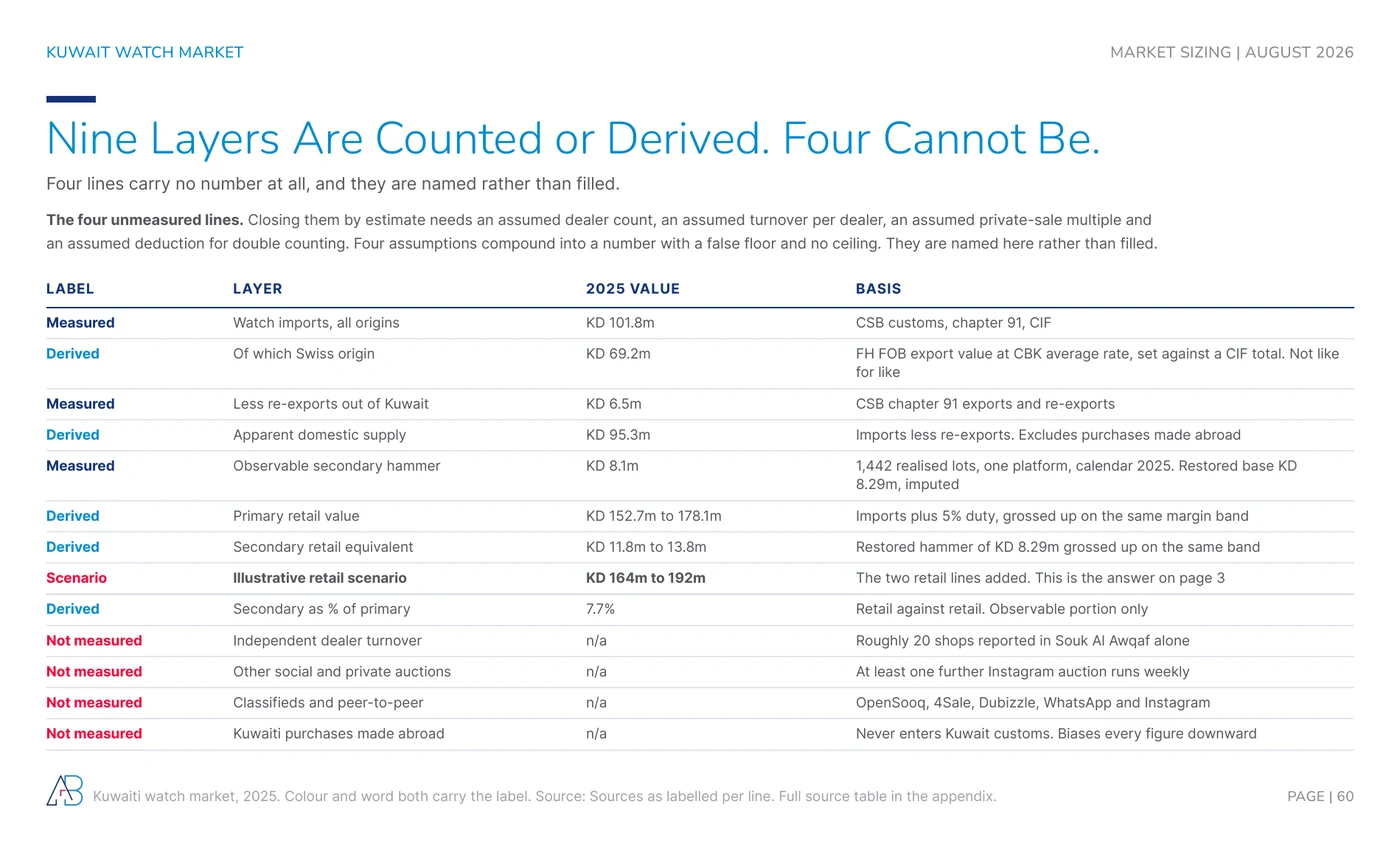
Closing those four by estimate would need an assumed dealer count, an assumed turnover per dealer, an assumed private-sale multiple and an assumed deduction for double counting. Four assumptions compound into a number with a false floor and no ceiling. They are named here rather than filled.
Classifieds deserve a specific note, because they are the channel people assume is a secondary market and is not. OpenSooq, 4Sale and Dubizzle block automated retrieval, and even a complete capture would give asking prices and a stock of listings when what a market size needs is realised prices and a flow. Of twenty-one Rolex listings I sampled by hand on OpenSooq, every one was priced between KD 5 and KD 250 with explicit replica language, against a measured median Rolex auction lot of KD 4,680.
The gap worth acting on
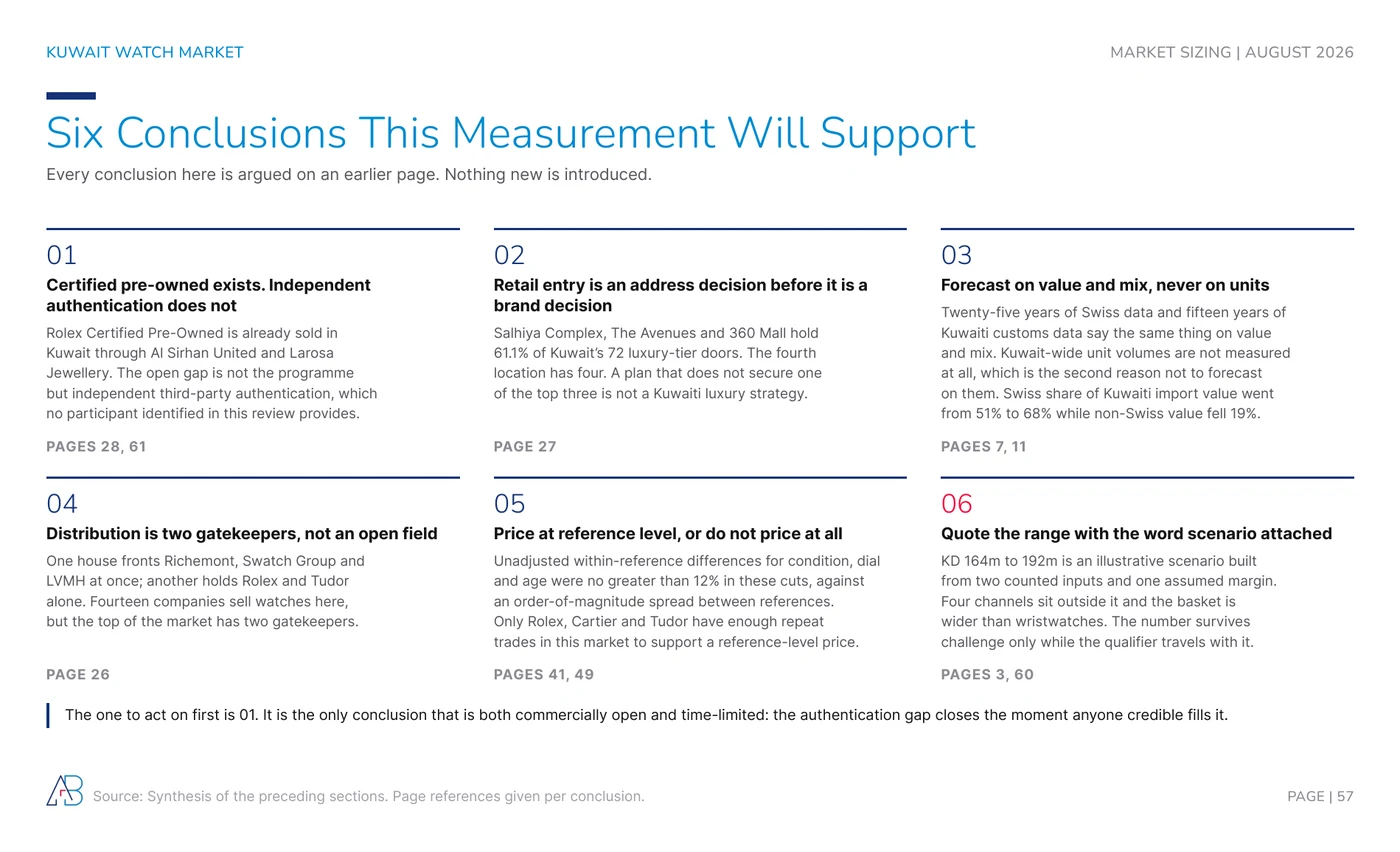
One finding here is commercial rather than statistical. Rolex Certified Pre-Owned is already sold in Kuwait, through Al Sirhan United and Larosa Jewellery, so the programme is not the gap. What nobody in Kuwait offers is independent third-party authentication. Every assurance available comes from the party selling the watch.
The return window sharpens it. A watch carries a one-day return window under Ministry guidance, against the fourteen days that cover standard consumer goods, so a buyer has one working day to get an opinion that is not the seller's, in a market where no independent opinion is for sale.
Put that beside the 11.8% premium buyers demonstrably pay for an unworn example of the same reference, and the 90.8% of resale value concentrated in four brands, and the shape of the opening is hard to miss. This is a market that pays measurably for provenance and has no independent way to establish it. Of the six conclusions this study supports, that is the one I would act on first, and the only one that is time-limited: the authentication gap closes the moment anyone credible fills it.
One regulatory change is worth watching alongside it. Ministerial Resolution No. 182 of 2025, first reported on 2 November 2025, bans cash in the precious metals trade. A rule written for gold may reach the most valuable watches. Until it is clear whether it does, I would not model a cash-to-card shift in watch retail.
Common questions, answered with the numbers
How big is Kuwait's watch market?
KD 164m to KD 192m at retail in 2025, roughly USD 535m to USD 626m. That is a scenario, not a measurement: it takes KD 101.8m of measured imports, adds the 5% Gulf tariff to reach KD 106.9m landed, then applies an assumed 30% to 40% retailer margin. Change the margin and the answer moves: 25% gives KD 153m, 45% gives KD 209m.
How much does Kuwait import in watches each year?
KD 101.8m under customs chapter 91 in 2025, down 2.1% on the 2024 record of KD 104.0m. The 2010 figure was KD 37.3m. Wristwatches specifically were 95.9% of the chapter in 2024, or KD 99.0m.
Who is the official Rolex dealer in Kuwait?
Al Sirhan United, trading as LaRosa, which holds Rolex and Tudor and nothing else across four doors. A single-family house holding one group and no other is a Rolex policy signature, and there is no route to Rolex distribution in Kuwait that does not start there.
Does Kuwait charge VAT on watches?
No. Kuwait levies neither VAT nor excise. The GCC framework agreement of 2016 set a 5% standard rate and Kuwait has still not enacted it. Kuwait and Qatar are the only Gulf markets that add nothing at the till, so the same KD 10,000 watch costs KD 11,500 in Saudi Arabia and KD 11,000 in Bahrain.
What is the most traded watch in Kuwait?
The Rolex Datejust 41, reference 126334, on 436 realised lots and KD 1,692,250 of value, at a median of KD 3,900. The twelve most-traded references in the country are all Rolex and carry 2,135 lots between them.
Is the Kuwaiti watch market growing?
On imports, yes: 6.9% a year compound since 2010, though that single rate hides a contraction in five of the six years to 2020. On resale, the first half of 2026 grew about 8.6% per recorded sale date against the same half of 2025, well behind a global secondary market up 37%.
What does a Rolex sell for on the Kuwaiti secondary market?
The median realised Rolex lot is KD 4,680. Across all brands the median lot is KD 4,250 and the mean KD 7,218, and the seventy per cent gap between those two is why an average price is useless here. Fifty-eight per cent of everything sold goes for under KD 5,000.
Where can you buy pre-owned watches in Kuwait?
Six participants were identified in this review: one weekly public auction, two online marketplaces, one long-established physical dealer, one vintage line inside an authorised retail group, and one online-first retailer of independent brands. Rolex Certified Pre-Owned is sold here through Al Sirhan United and Larosa Jewellery. What nobody offers is independent third-party authentication.
Sources and method
Every measured figure here traces to one of eight primary sources: the Kuwait Central Statistical Bureau Foreign Trade Statistics, Kuwait's UN Comtrade filings, the Federation of the Swiss Watch Industry, Central Bank of Kuwait exchange rates, one Kuwaiti weekly auction platform, the CSB consumer price index, the Kuwait Ministry of Commerce and Industry, and the official store locators of 28 watch brands. No market-research report supplies a measured figure in this study. One supplies two cross-checks, both labelled and both flagged as not independently verifiable.
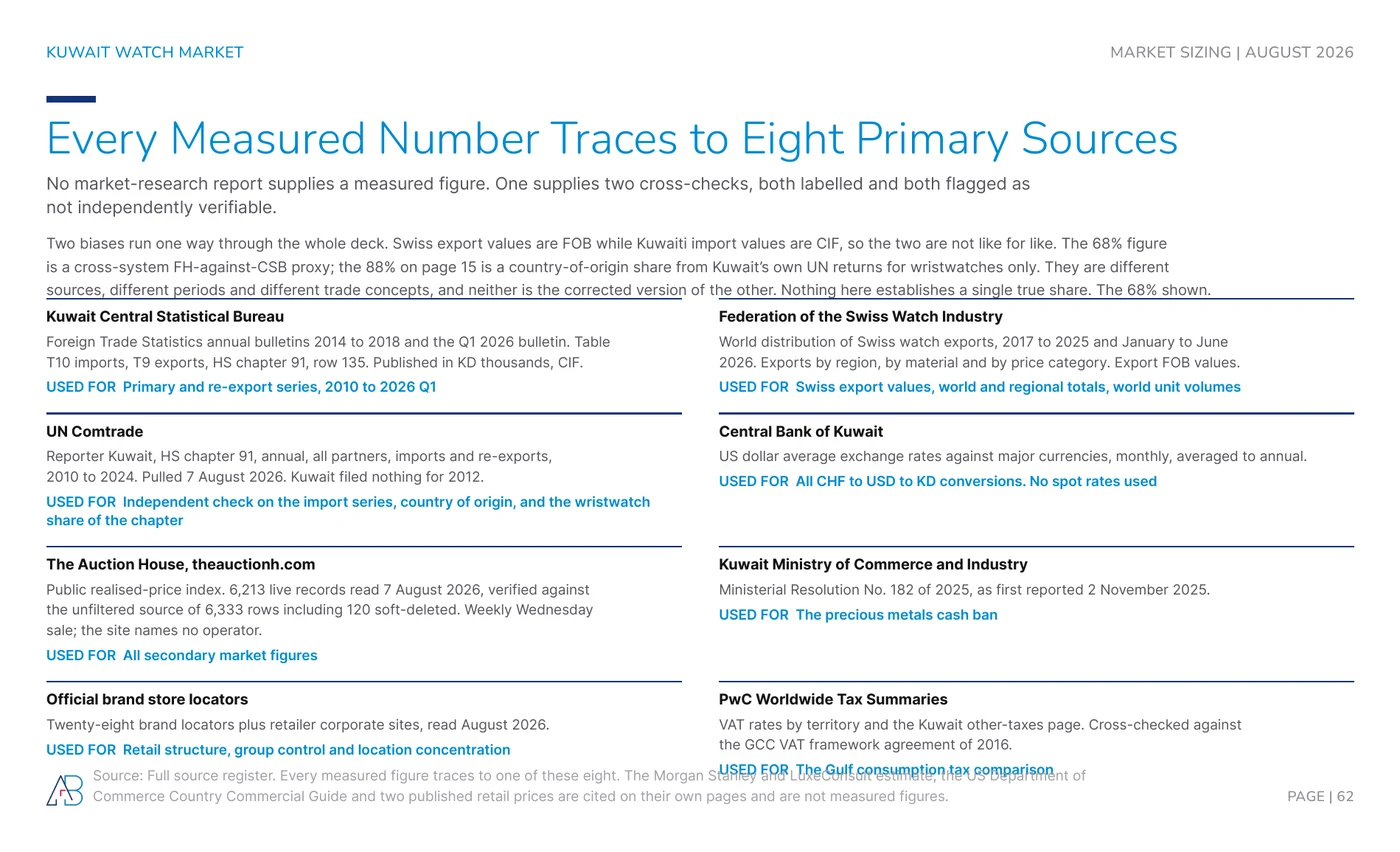
Two biases run one way throughout. Swiss export values are reported FOB while Kuwaiti import values are CIF, so the two are not like for like. And watches transiting Dubai are booked as UAE exports but arrive here. Both mean the true Swiss share is higher than the 68% shown.
The 68% and the 88% are not two versions of the same number. The first is a cross-system FH against CSB proxy for the whole chapter. The second is a country-of-origin share from Kuwait's own UN returns, for wristwatches only, over a different period. Different sources, different trade concepts, and neither is the corrected version of the other. Nothing here establishes a single true Swiss share.
If you are sizing a Gulf market that publishes no market data, the method transfers: find the series the state already publishes for another purpose, find a second filing of the same thing to check it against, and then count the only transaction-level record that exists, however partial, rather than modelling one. It is the same method behind the Kuwaiti automotive market sizing.
The full study
The 63-page version carries every exhibit above plus the workbooks behind them: the 6,213-row lot-level extract, the matched-reference index, the assumption register and the full source table. If you are sizing a Gulf market that publishes nothing, or you want the Kuwaiti figures checked against your own, write to ali.b@alibahbahani.com and I will send it over.