Customer Journey Mapping: The Complete Guide
.avif)
.webp)
Every company I consult with has a version of the customer journey in someone's head. The marketing team thinks it starts with an ad. The sales team thinks it starts with a phone call. The operations team thinks it starts when the order is placed. Nobody has the complete picture because nobody has put it on paper.
Customer journey mapping is the exercise of making the invisible visible. It takes the full path a customer walks, from first hearing about you to becoming a repeat buyer or leaving forever, and documents every step, every touchpoint, every moment of truth. The result is not a chart to hang on the wall. It is a diagnostic tool that shows you where your business works and where it breaks.

How We Map a Journey
At AB&P, we use a 14-stage journey framework that covers everything from pre-awareness (the customer does not know you exist yet) to advocacy (the customer actively recommends you). Each stage includes the customer's goal, the touchpoints they interact with, the emotions they are likely feeling, and the friction they encounter.
We map multiple persona paths because different customers experience the same business differently. A first-time buyer at a car dealership and a returning service customer are in the same building but on completely different journeys. A business traveller booking a hotel and a family planning a holiday have different needs at every stage. Mapping a single generic journey misses the points where specific customer types fall through the cracks.

The Process
Step 1: Define Your Personas
Who are your customers? Not demographics. Behaviours. What are they trying to accomplish? What do they worry about? How do they make decisions? At Dallal, our personas include the first-time Kuwaiti buyer who is anxious about being misled, the expat renter who has limited time and needs to find something fast, and the licensed broker who wants qualified leads. Each persona has a different journey through the same platform.
Step 2: Map What Actually Happens
Walk the journey yourself. Call your own company. Visit your own website on a phone. Go through the checkout process. Wait for the delivery. Try to return something. Then ask five real customers to do the same while you observe. The gap between what you expect and what actually happens is where the insights live.

Step 3: Identify Friction Points
Every moment where a customer hesitates, waits, repeats information, gets confused, or gives up is a friction point. Not all friction is equal. Some is minor (a slightly slow page load). Some is fatal (a payment that fails with no error message). Rank them by impact on conversion and satisfaction. The Friction Fighter approach is to find and eliminate unnecessary friction systematically, starting with the points that cost you the most customers.
Step 4: Map the Emotional Arc
Customer emotions change throughout the journey. Curiosity at the start. Anxiety during the decision. Excitement at purchase. Frustration if something goes wrong post-purchase. Relief when the issue is resolved. Understanding this emotional arc helps you design interventions at the right moments. A reassurance message during the waiting period after a high-value purchase reduces anxiety and support calls simultaneously.

Step 5: Prioritise and Act
A journey map without action is an art project. The point is to produce a prioritised list of changes. What are the three things that, if fixed, would have the biggest impact on customer satisfaction and business results? Start there. Not with 50 improvements spread across every department. Three changes, implemented well, that address the biggest sources of friction.
Journey Mapping for Different Business Types
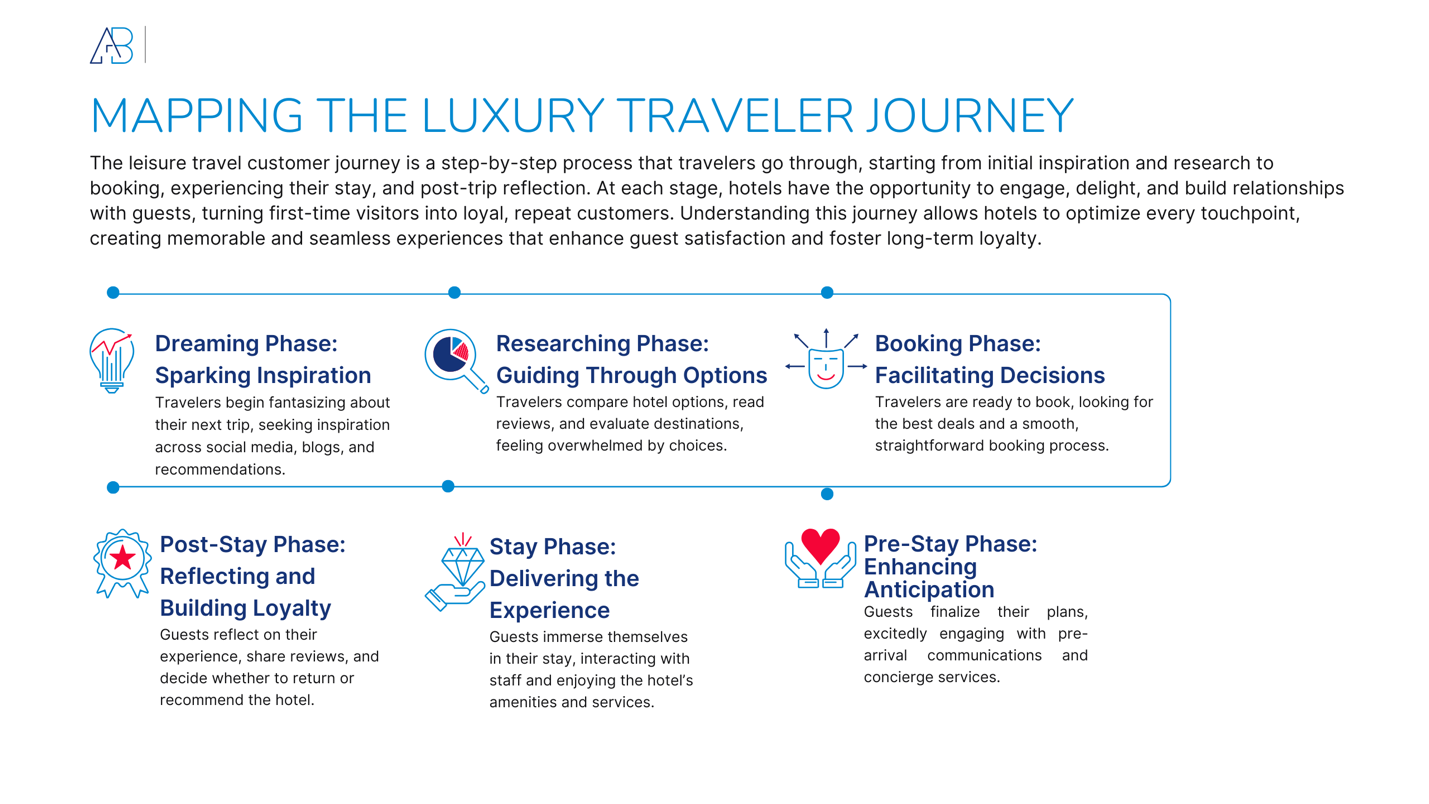
The framework adapts to any business. For a hotel, the journey starts with inspiration and ends with the post-stay review. For a beauty brand, it starts with discovery on social media and ends with repurchase or subscription. For a car dealership, it starts with research and extends through years of service visits.
The stages change. The principle does not: understand what the customer is trying to accomplish at each step, and remove everything that makes it harder than it needs to be. That is customer experience consulting reduced to its core, and it starts with putting the journey on paper.