What Skift Teaches About Customer Experience in the GCC
%201-min.avif)
.webp)
Most travel industry conferences follow a predictable format: keynotes nobody remembers, panels where everyone agrees with each other, and a networking break where people check their phones. Skift's Global Forum operates differently. And the difference is worth studying. not because the event itself matters to your business, but because the principles behind it apply directly to how GCC companies should be thinking about customer experience.
I first encountered Skift during my MBA at EHL Lausanne. What struck me wasn't their research (which is strong), but how they structured the experience around it. The content was never just published. it was staged, sequenced, and delivered in a way that made you feel like you were part of something. That's a design choice. And it's the same design choice that separates a forgettable hotel stay from one you tell people about.
Here are five things Skift does that most companies in Kuwait and the GCC don't. and should.
 Customer Experience" width="auto" height="auto" loading="auto">
1. They treat awareness as storytelling, not advertising
Skift doesn't promote its forum by saying "buy a ticket." Months before the event, they publish research excerpts, share speaker previews, and let their CEO post behind-the-scenes content on LinkedIn. By the time registration opens, the audience already feels invested.
The GCC lesson: Most businesses in the region still announce products and services the way they'd write a press release. "We are pleased to announce..." Nobody is pleased. Nobody cares. The companies that win attention are the ones that build a narrative before they ask for a transaction. If you're launching a new hotel, restaurant, or service. start the story six months early. Share the process, the decisions, the setbacks. Make people feel like insiders before you ask them to become customers.

2. They remove friction from the decision
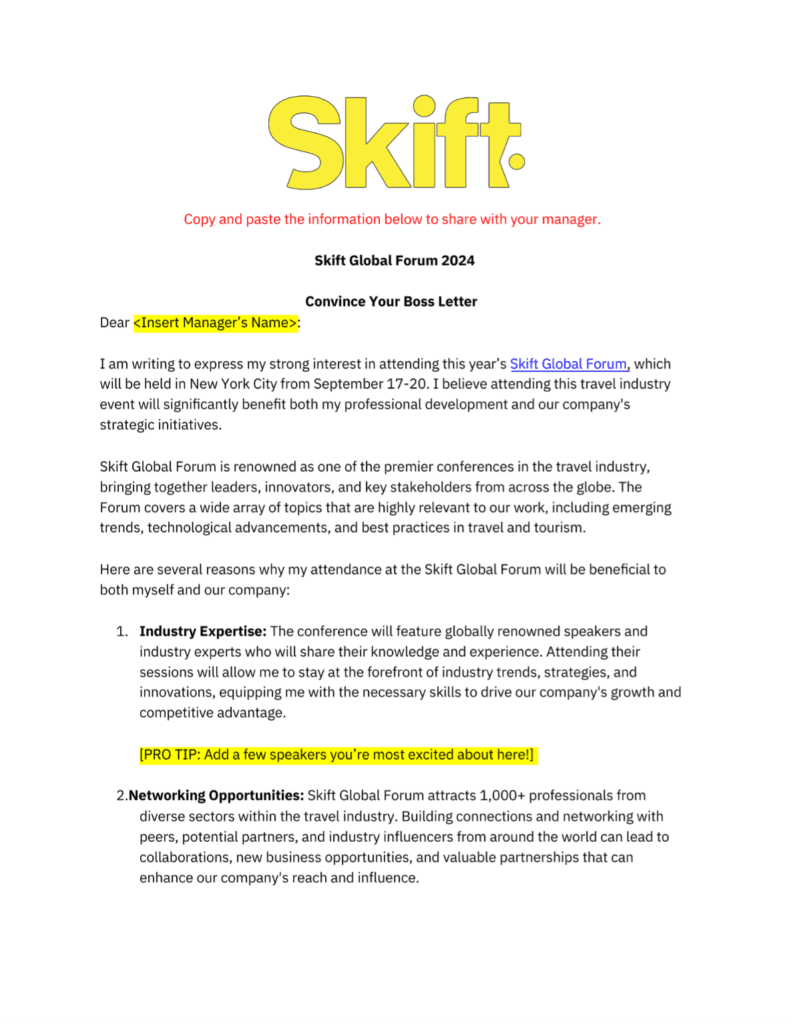
Skift created a "Convince Your Boss" letter. a pre-written email that potential attendees could send to their managers to justify the expense. It sounds trivial. It isn't. Most purchase decisions stall not because the customer doesn't want to buy, but because there's a secondary decision-maker they can't easily persuade.
The GCC lesson: Think about the buying process for your own services. How many steps are between "interested" and "done"? In Kuwait's contracting sector, a client might need board approval to hire a consultant. In hospitality, a GM might need to convince an owner to invest in a CX audit. Are you making that internal sell easier, or are you leaving it to the customer to figure out? Build the justification tools for them. A one-page ROI summary, a comparison framework, a case study with hard numbers. Remove the friction that sits between your customer and their internal stakeholders.
3. They use technology to personalise, not to automate
The forum uses an AI-powered matchmaking tool that suggests relevant connections based on each attendee's profile and interests. This isn't chatbot automation. it's technology deployed in service of a human outcome: better conversations between the right people.
The GCC lesson: The region has adopted technology rapidly, but often in the wrong direction. Automated WhatsApp replies that feel robotic. Chatbots that can't answer real questions. Self-service kiosks that create more friction than they remove. The question isn't whether to use technology. it's whether the technology serves the person or the process. A hospital in Kuwait that uses AI to reduce wait times is using technology well. A bank that forces you through five automated menus before reaching a human is not.

4. They design the experience around participation, not consumption
At the forum, attendees aren't a seated audience watching slides. There are live polls, interactive Q&A sessions, breakout workshops, and structured networking rounds. The event is designed so that every person in the room is a participant, not a spectator.
The GCC lesson: This applies directly to hospitality, retail, and professional services in the region. Most hotel loyalty programmes treat guests as consumers. stay here, earn points, redeem. The hotels that outperform treat guests as participants. invite them into the story, ask for their input, give them a role. The same applies to corporate events, training sessions, and even retail environments. A Kuwait-based retailer that lets customers co-design a product will outperform one that simply sells to them. The shift from consumption to participation is the single largest untapped CX opportunity in the GCC.
5. The founder is the brand's most visible touchpoint
Rafat Ali, Skift's CEO, personally posts updates, responds to comments, and shares his thinking on LinkedIn. He doesn't delegate his presence to a social media manager. The result: people feel connected to the company through a person, not a logo.
The GCC lesson: This is culturally natural in the Gulf but commercially underused. Kuwait's business culture is relationship-driven. People do business with people they know and trust. Yet most companies in the region hide their founders behind corporate brands. The founder's personal visibility. on LinkedIn, at industry events, in published thought leadership. is a competitive advantage that costs nothing and compounds over time. If you're a CEO in Kuwait reading this: your personal brand is your company's most undervalued asset.
What this means for your business
These five principles. narrative-driven awareness, friction removal, purposeful technology, participatory design, and founder visibility. aren't specific to the events industry. They're CX fundamentals that apply to any business trying to build loyalty in a competitive market.
The GCC is at an inflection point. Customers here are more connected, more travelled, and more demanding than ever. The companies that treat customer experience as a design discipline. not a department. will be the ones that last.
Skift figured this out for a conference. The question is whether your business can figure it out for everything else.
Ali Bahbahani is the founder of Ali Bahbahani & Partners, a Kuwait-based advisory firm specialising in customer experience, brand strategy, and business transformation. Contact us to discuss how these principles apply to your business.